
Age of Dinosaurs

CITE
We have made every effort to follow citation style rules, but there may be some minor differences. If in doubt, please refer to the appropriate citation style manual.
Origin of birds. (2026). In Q-files Encyclopedia, Prehistoric, Age of Dinosaurs. Retrieved from
https://www.q-files.com/prehistoric/age-of-dinosaurs/origin-of-birds
"Origin of birds." Prehistoric, Age of Dinosaurs, Q-files Encyclopedia, 10 Mar. 2026.
https://www.q-files.com/prehistoric/age-of-dinosaurs/origin-of-birds.
Accessed 29 Oct. 2026.
Origin of birds 2026. Prehistoric, Age of Dinosaurs. Retrieved 29 October 2026, from
https://www.q-files.com/prehistoric/age-of-dinosaurs/origin-of-birds
Prehistoric, Age of Dinosaurs, s.v. "Origin of birds," accessed October 29, 2026.
https://www.q-files.com/prehistoric/age-of-dinosaurs/origin-of-birds


Origin of birds
For many years, the 150-million-year-old Archaeopteryx, fossil remains of which were discovered in the 1860s, was the only fossil link between birds and dinosaurs. A creature with the feathered wings of a bird but the teeth and long, bony tail of a dinosaur, Archaeopteryx appeared to have evolved its bird-like features in around 10 million years—a short period in evolutionary terms. In recent years, however, discoveries of other fossils have revealed that many bird-like traits—feathers, beak, hollow bones and a wishbone—had evolved in dinosaurs over many millions of years before Archaeopteryx.

Archaeopteryx
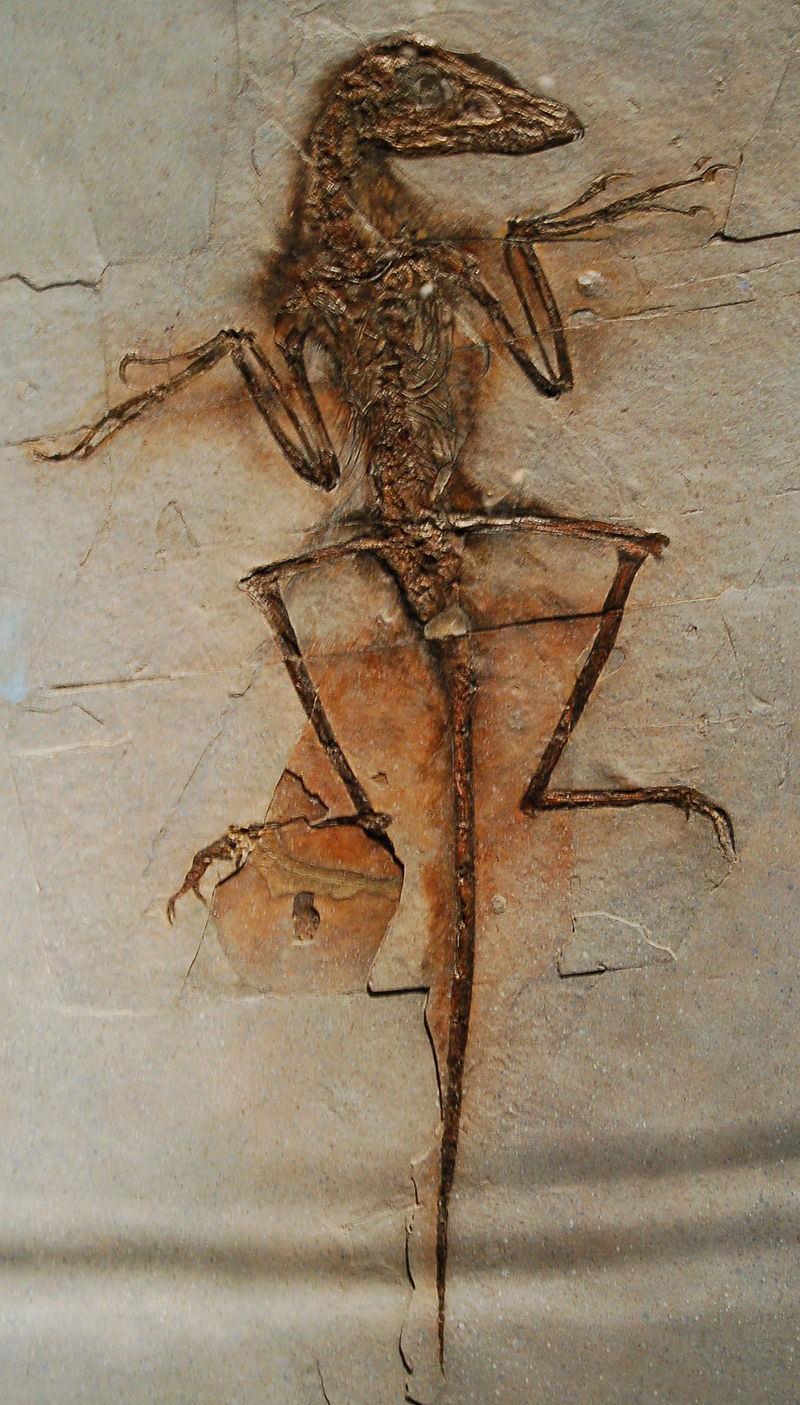
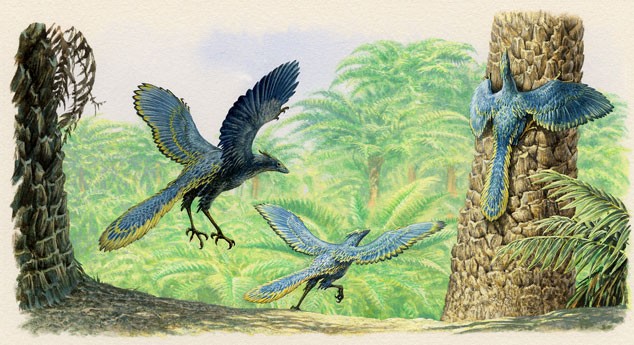
Archaeopteryx lived in Jurassic Europe, about 150 million years ago. Its fossils come from Late Jurassic rocks in southern Germany. The amazing details in these fossils show, besides a tooth-filled beak and a long bony tail, a pair of wings and the impressions made by its delicate feathers.

While Archaeopteryx may not have been a strong flier—it lacked the shoulder mechanism that modern birds have to make swift, powerful upstrokes of their wings—it was probably capable of flapping flight over short distances. Like magpies today, it could use updrafts to give it extra lift while flapping its wings. Archaeopteryx could also glide down from the trees in short, swooping flights to grab its prey on the ground below. Gliding was perhaps the first stage in the evolution of flight (see below).
Early theories
Scientific investigation into the origin of birds began with the discovery of fossils of Archaeopteryx in the 1860s, shortly after the 1859 publication of Charles Darwin's On the Origin of Species. Thomas Henry Huxley (1825–95), known as "Darwin's Bulldog" because of his strong support for the new theory of evolution by natural selection, saw Archaeopteryx as a transitional fossil between birds and reptiles.
Danish artist Gerhard Heilmann (1859–1946) saw similarities between Archaeopteryx and other birds to theropods like Compsognathus (which lived at the same time and shared the same habitat as Archaeopteryx). But he also noted that birds had clavicles (collar bones) fused to form the furcula ("wishbone"), which he believed was absent in dinosaurs. This led Heilmann to conclude that ancestors of birds could not have been theropods.
Today, palaeontologists know that clavicles, and in most cases wishbones, are in fact present in theropods, and indeed all saurischian dinosaurs.


Deinonychus
Deinonychus, a small theropod that lived about 115 million years ago, was discovered in 1964. It not only showed many similarities to birds, but it also appeared to be an intelligent, fast-moving pack-hunter, rather than the slow, plodding reptiles that, up to then, was how palaeontologists thought about dinosaurs. So began what is known as the "dinosaur renaissance", in which scientists took the view that dinosaurs were active and warm-blooded, rather than cold-blooded, sluggish animals.
Noting the similarities between the skeletons of Deinonychus and Archaeopteryx, US palaeontologist John Ostrom (1928–2005, the man who described and named Deinonychus in 1969) revived the proposal that birds were descended from theropod dinosaurs.
Later studies suggested that dromaeosaur theropods like Deinonychus had an extremely bird-like anatomy and so were considered particularly closely related to birds. Many dromaeosaur fossils showed clear evidence of feather coverings, and so it is assumed Deinonychus would have also had feathers.


Feathered dinosaurs
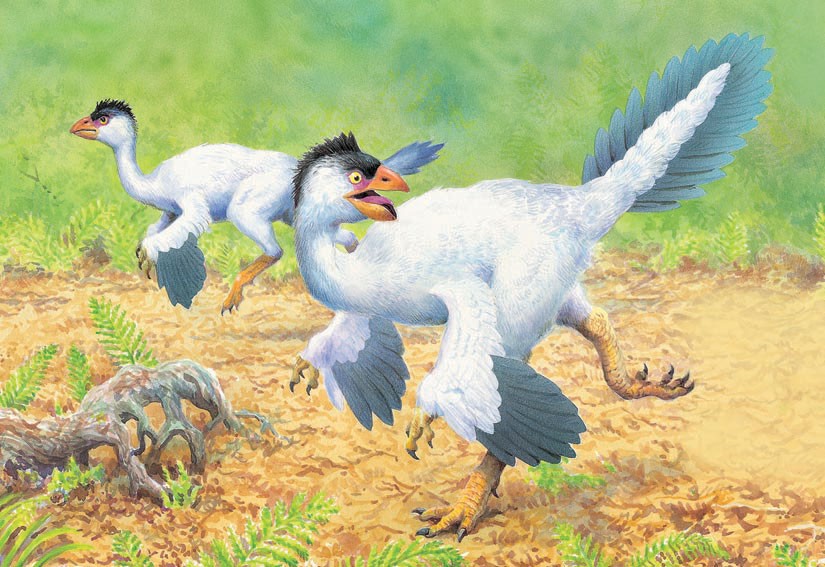
Support for Ostrom's ideas came in the early 1990s with the discovery of a number of superbly preserved fossils of feathered dinosaurs in the Early Cretaceous rocks (dating to around 125 million years old) of the northeastern Chinese province of Liaoning. Although many of these creatures lacked wings, they had a range of plumage types, from fuzzy bristles to full feathers.
Finds such as Sinosauropteryx, Sinornithosaurus and Caudipteryx—all ground-running, bird-like theropods—indicated that having feathers was not necessarily anything to do with the ability to fly. The theory that it was the evolution of feathers from reptilian scales that enabled certain dinosaurs to fly (and so become birds) was now abandoned. Feathers clearly evolved in dinosaurs—and for reasons other than flight—long before birds developed.
The fossil evidence from Liaoning also showed that birds and dinosaurs shared other features such as hollow bones, gastroliths in the digestive system, nest-building and brooding behaviour.


Maniraptors
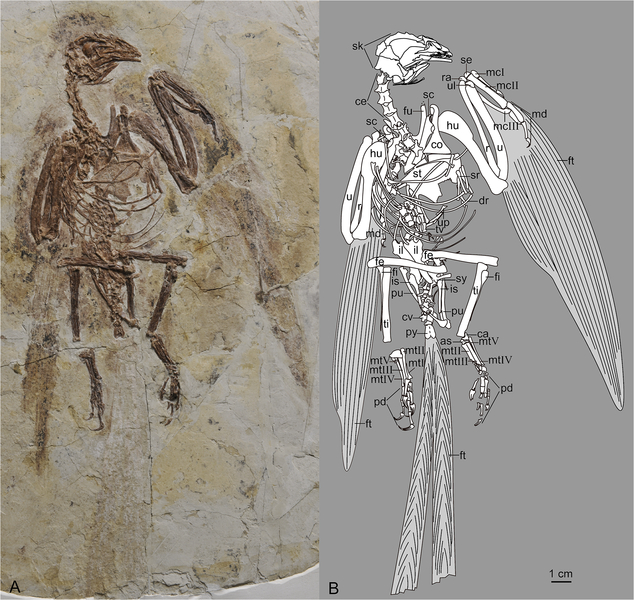
Archaeopteryx, once the only known feathered animal from the Age of Dinosaurs, was no longer unique. Other fossils of birds (or very bird-like dinosaurs), including Anchiornis, Xiaotingia and Aurornis, dated to 160 million years ago—10 million years earlier than Archaeopteryx—are now known to science.
From the new fossil evidence, palaeontologists no longer consider Archaeopteryx to be the direct ancestor of modern birds, but instead a creature belonging a group of small, feathered theropods known as the maniraptors—those kinds most closely related to present-day birds. (Theropods are bipedal, meat-eating dinosaurs that included both giants like Tyrannosaurus rex and tiny, fast-running creatures like Compsognathus.)

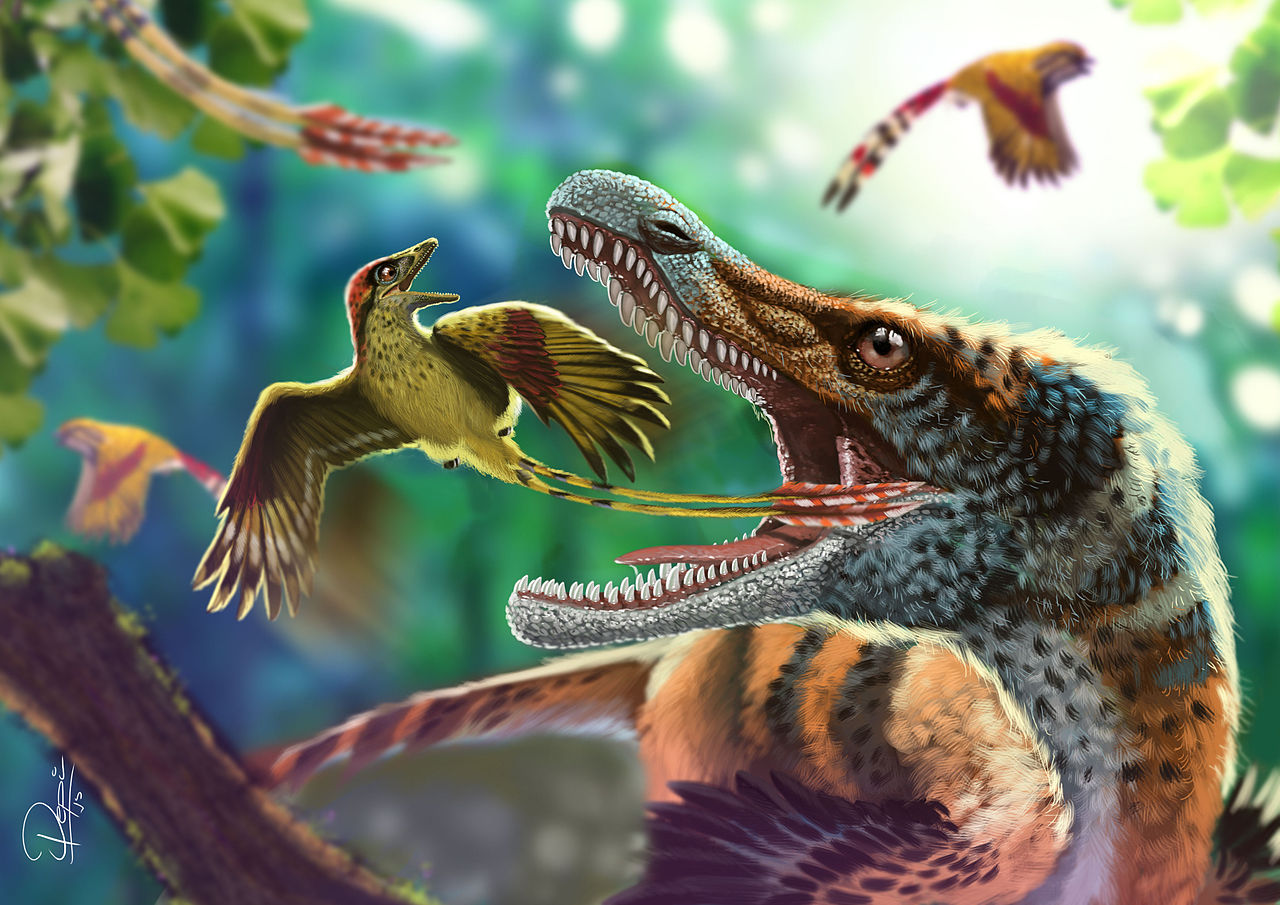
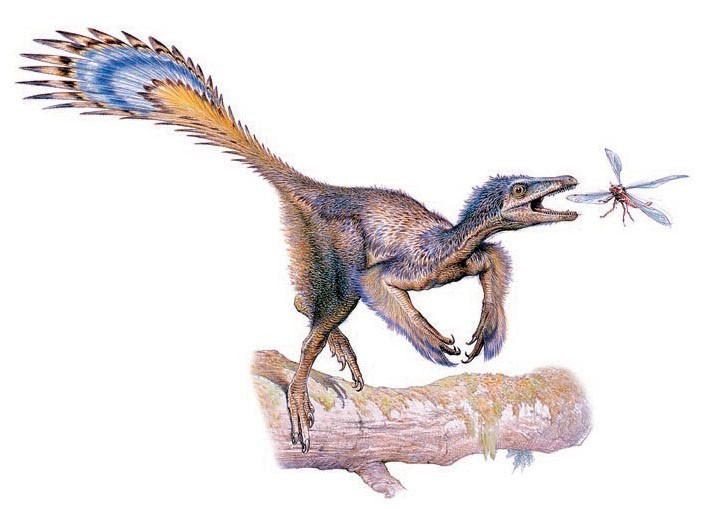
The maniraptors include four major sub-groups: dromaeosaurs (such as Deinonychus, Velociraptor and Microraptor), oviraptorids, therizinosaurs and avialans (a group that includes all birds, present and past; Archaeopteryx, Anchiornis, Xiaotingia and Aurornis were from this group). Maniraptors all had long arms, three-fingered hands and half-moon-shaped wrist bones. Other skeletal similarities between them are found in the neck, pubis, shoulder blades, clavicles and breast bone.

Emergence of birds
Examining recent fossils from the Chinese province of Liaoning, palaeontologists came to realise that certain bird-like traits—feathers, beak, wings, hollow bones and a wishbone—had evolved not in a few million years in the Late Jurassic, but more gradually over a much longer period, probably almost as soon as dinosaurs started to appear on Earth some 80 million years earlier. They also noted that many of these traits—for example, feathers for insulation or display when mating—had originally evolved for a different purpose.
This means it is difficult to draw the line between the first birds and the bird-like theropods that came before them. The evolution of birds from dinosaurs was not sudden, but gradual and seamless.
Evolution of feathers
From the study of the variety of feathered theropods found in Liaoning and elsewhere, scientists have able been to work out how feathers evolved. Some theropods had simple filaments, called protofeathers, while others had a covering of fluffy down, a type of feather found on birds today.
Detailed examination of the protofeathers of Sinornithosaurus showed that the individual feathers each consisted of a central quill, called a rachis, with thinner barbs branching off from it. This pattern is similar to—although more primitive than—modern bird feathers.

But if feathers did not evolve first for flight, what advantage did they give to the first creatures that had them? Scientists have different answers to this. The original purpose of feathers could have been for insulation—to keep warmth in, just as they do in birds today, seen particularly in cold-habitat birds like many penguins. This makes it likely that feathered dinosaurs were warm-blooded, like birds and mammals, but unlike other reptiles.
The insulating qualities of feathers could also have been used when sitting on a clutch of eggs to incubate them. Theropods such as Citipati, a relative of Oviraptor, have been found with their forelimbs spread over nests. They may have been using their feathery wings to shelter their young.

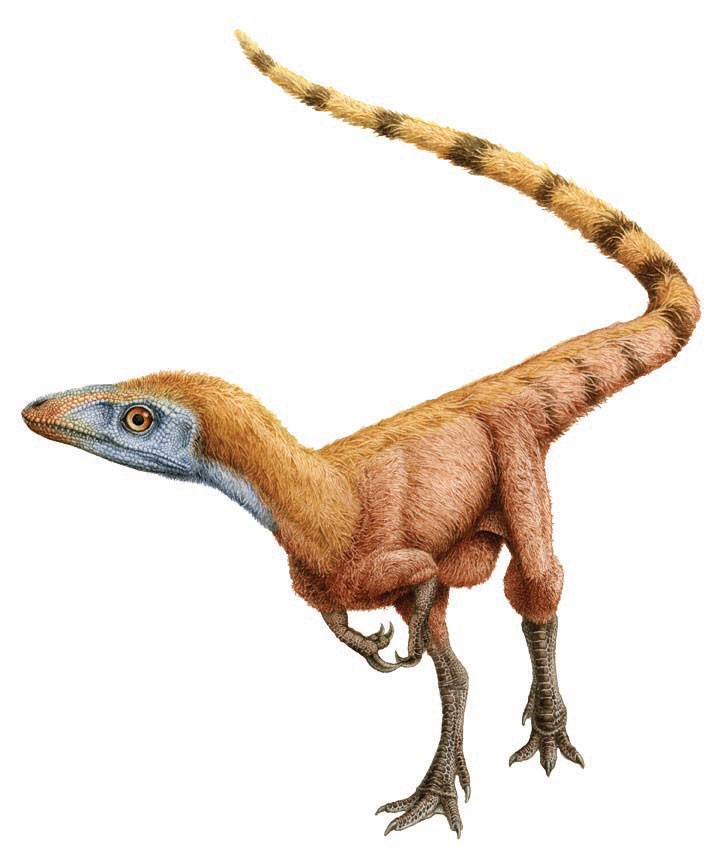
Another possibility is that feathers first evolved for display purposes when seeking a mate. Feathers on birds today come in a huge range of colours and patterns. In some cases, they serve to attract the opposite sex, in the way the peacock, for example, unfolds his magnificent feathers to attract a peahen.
Since the discovery in 2009, of melanosomes (microscopic sacs known to produce colours in bird feathers) in dinosaur feathers, this idea has been gaining ground among palaeontologists. It provides a possible explanation as to why Sinosauropteryx's tail, for example, had stripes.

Evolution of flight
Many scientists think that bird flight was made possible by the gradual adaptation of a number of existing anatomical features that had evolved for other purposes over many millions of years: for example, wrist bones, feathers and smallness.

Whatever their original purpose, long feathers on their limbs would have given the very lightest dinosaurs from the maniraptor group the ability to glide or even fly when they held their feathered limbs out wide while running or jumping. Natural selection would, over time, favour longer, stiffer and more aerodynamic feathers to form wings on the forelimbs. These wings then evolved further, giving the flier more and more control while airborne.
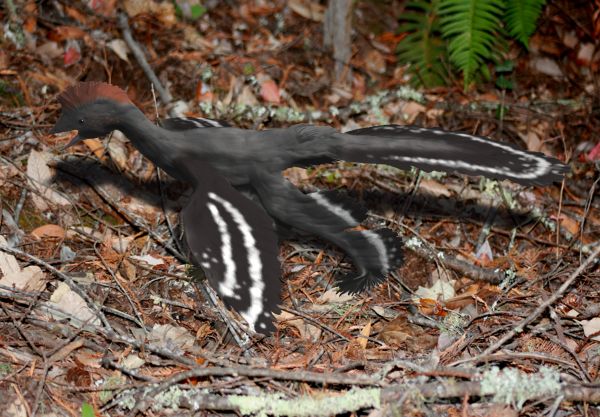
Modern birds use their wrist bones in flight to draw their wings in towards their bodies during an upstroke. Anchiornis, a Jurassic maniraptor incapable of flapping flight, had a similarly-shaped wrist bone, which allowed it to fold its arms to its sides, keeping its arm feathers off the ground as it walked. So it seems that this feature—crucial for flight—evolved long before birds took to the air, but for quite a different purpose.
There are different theories as to how flight in birds evolved. Some scientists argue that some small, speedy, feathered dinosaurs achieved flight by flapping their feathered arms as they ran ("from the ground up"). Others, noting the feathery legs of Anchiornis, Microraptor and other bird-like dinosaurs—which would have made running difficult—suggest that these animals used their feathers to help them glide down from trees, and eventually stay airborne ("from the trees down").
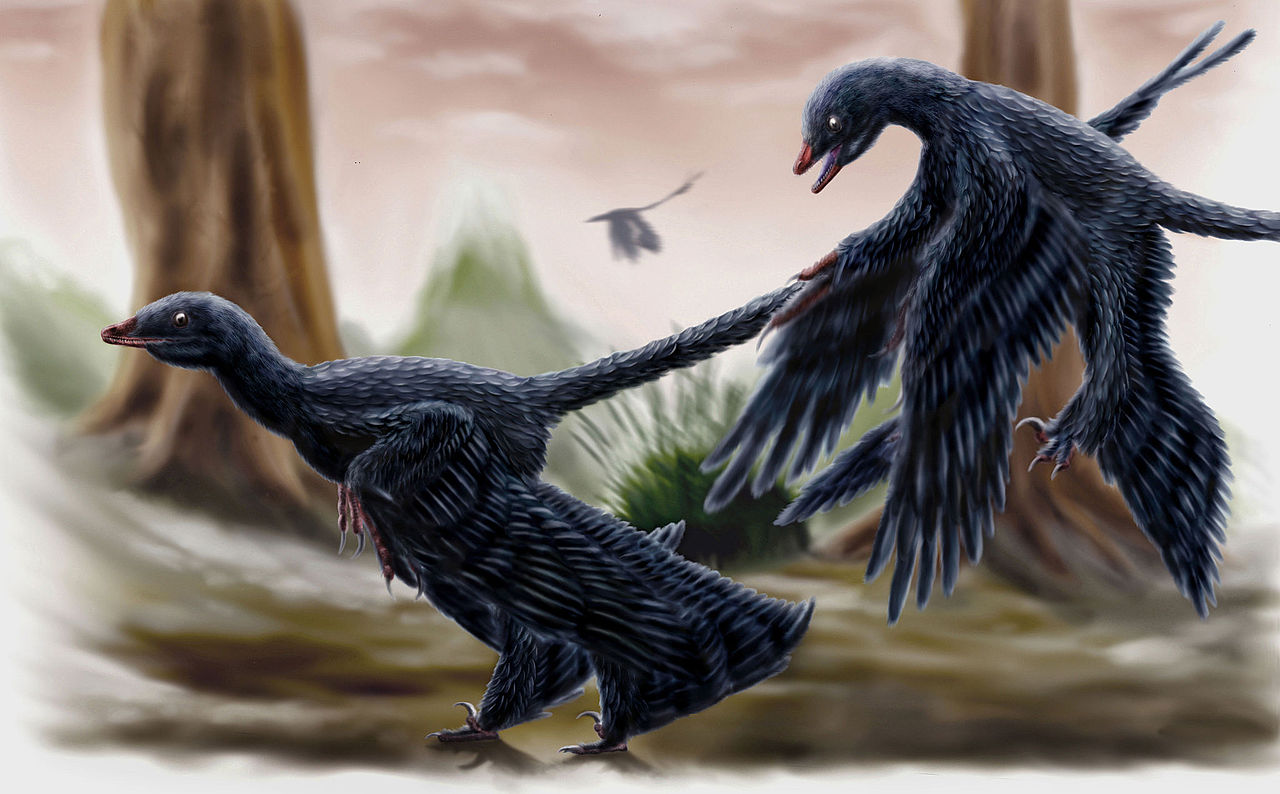
A third view is that flight evolved by a combination of the two. Chicks of some modern birds flap their short young wings as they escape from predators up steep inclines like tree trunks or even cliffs ("wing-assisted incline running", or WAIR). Flapping those same wings also helps steady them in the air as they glide back down to the ground after danger has passed. As the young bird matures, this controlled descent gradually becomes powered flight. Possibly, flight in adult bird-like dinosaurs came about the same way over many years.

Evolution of lightness
Another essential feature of flying birds is their lightness. This an important trait for enabling true flight, which requires a certain ratio of wing size to body weight. Like other bird features, diminishing body size began long before birds themselves evolved. While many types of dinosaur steadily grew in size as the Triassic gave way to the Jurassic, a few types of theropod evolved the opposite way, becoming smaller and smaller. This may have been to adapt to new habitats where there was a greater advantage to being small rather than large: for example, living in trees (an abundant source of insects and grubs, as well as shelter) or on islands where food was scarce.
Other evolutionary adaptations were required to make these animals light enough to take to the air. The first was to lose the bony tail. Over time, this dwindled into the small, fleshy pygostyle (called a "parson's nose" in modern birds), while the tail function, used in controlling flight, was taken over by tail feathers. Soon afterwards, clawed fingers and toothed snouts also disappeared, while legs evolved to become thinner and longer.

Evolution of shape
Another key feature in the origin and early evolution of birds was keeping a more rounded skull shape into adulthood. Not only are birds generally much smaller than their dinosaur ancestors, they actually quite closely resemble dinosaur babies.

Fossils of the earliest birds discovered show that they looked very similar to the fossil embryos found inside the eggs of a Velociraptor. Modern adult birds resemble these tiny, infantile dinosaurs. This may have been because natural selection—causing certain types of theropod to evolve smaller and smaller—shortened the development process from baby to adult, leaving the adult looking more like a juvenile. Smaller skulls with less prominent snouts would also have allowed the beak—another distinguishing characteristic of birds—to evolve.
Were some dinosaurs descended from birds?
While it is generally believed that birds evolved from dinosaurs, US palaeontological illustrator and writer Gregory S. Paul (born 1954) thinks that some dinosaurs, especially the dromaeosaurs, may have evolved from birds—that is, the other way round. These creatures, Paul suggests, may have evolved from flying species of bird (that emerged during the Jurassic) to become flightless. They kept their feathers and wings—just as the modern ostrich, emu and other ratites have done.
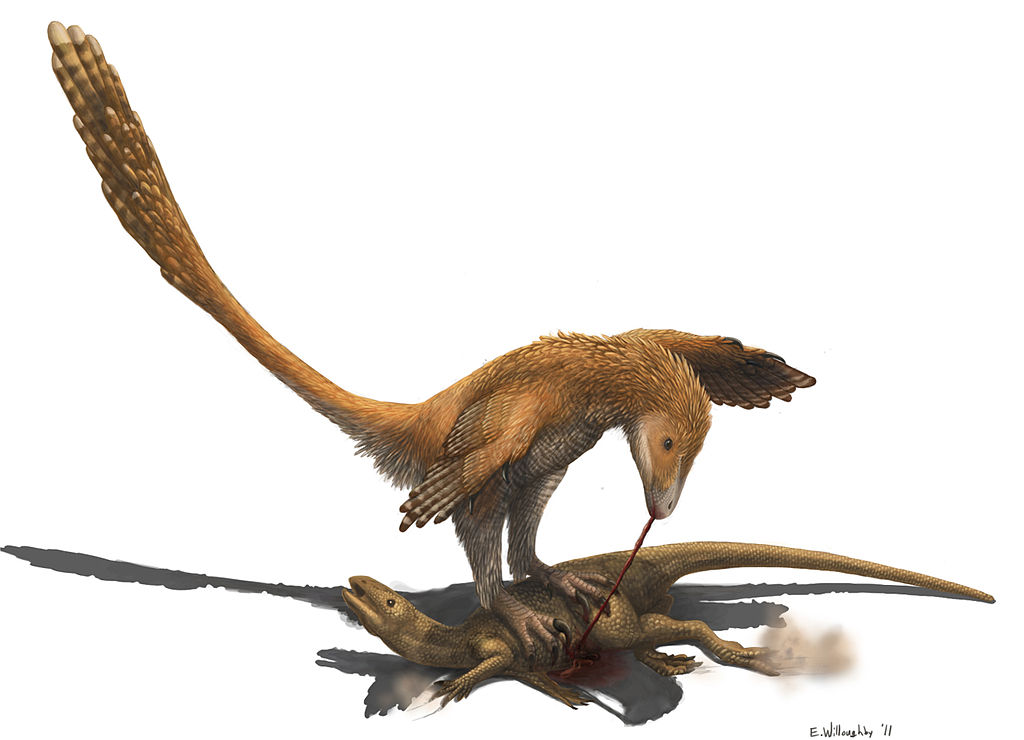

Alternatively, it is possible that creatures like Deinonychus and Velociraptor could have descended from four-winged gliders, becoming too large and so losing the ability to glide. In the meantime, other descendants of the same gliding forebears might have evolved in a different way— say, by growing smaller and lighter—to become true fliers and the first birds.
Consultant: Chris Jarvis
pics


Without in any way limiting Q-files Ltd’s exclusive rights under copyright, any use of this publication to “train” generative artificial intelligence (AI) technologies to generate text is expressly prohibited. Q-files Ltd reserves all rights to license use of this work for generative AI training and development of machine learning language models.