
Dinosaur species

CITE
We have made every effort to follow citation style rules, but there may be some minor differences. If in doubt, please refer to the appropriate citation style manual.
Deinonychus. (2026). In Q-files Encyclopedia, Prehistoric, Dinosaur species. Retrieved from
https://www.q-files.com/prehistoric/dinosaur-species/deinonychus
"Deinonychus." Prehistoric, Dinosaur species, Q-files Encyclopedia, 30 Apr. 2026.
https://www.q-files.com/prehistoric/dinosaur-species/deinonychus.
Accessed 6 Nov. 2026.
Deinonychus 2026. Prehistoric, Dinosaur species. Retrieved 6 November 2026, from
https://www.q-files.com/prehistoric/dinosaur-species/deinonychus
Prehistoric, Dinosaur species, s.v. "Deinonychus," accessed November 6, 2026.
https://www.q-files.com/prehistoric/dinosaur-species/deinonychus


Deinonychus
Deinonychus was a ferocious theropod from Early Cretaceous North America. It had long hindlimbs with a large, scythe-shaped claw on second toe of each foot. Its muscular arms had three-fingered, clawed hands. It had a very long stiffened tail. Its relatively large head with powerful jaws lined with about 60 backward-curving, saw-edged fangs. Although there is no fossil evidence, Deinonychus was probably feathered like its relatives, Dromaeosaurus and Velociraptor, members of the group of dinosaurs, known as maniraptors, most closely related to birds.


Toe-claw
Deinonychus means “terrible claw”, a reference to its scythe-shaped toe-claws. In life, the bone would have been covered with a sheath made of a horn-like material. The toe-claws were so long—at least 12 centimetres (4.7 inches)—they would have had to be raised up so that they would not get in the way while the dinosaur ran. Palaeontologists think the toe-claws would have been used for stabbing at attackers in self-defence or for pinning down its prey, rather than as slashing weapons.
Hunting technique
Deinonychus was a small animal, no taller than a 10-year-old child, although its long tail made it the length a small car. Yet it was a highly effective killer. Deinonychus probably hunted in small packs, working together to bring down prey much bigger than themselves, such as the large plant-eater, Tenontosaurus. Emerging from their hiding place in dense vegetation, they would gradually surround their prey, closing off all escape routes.
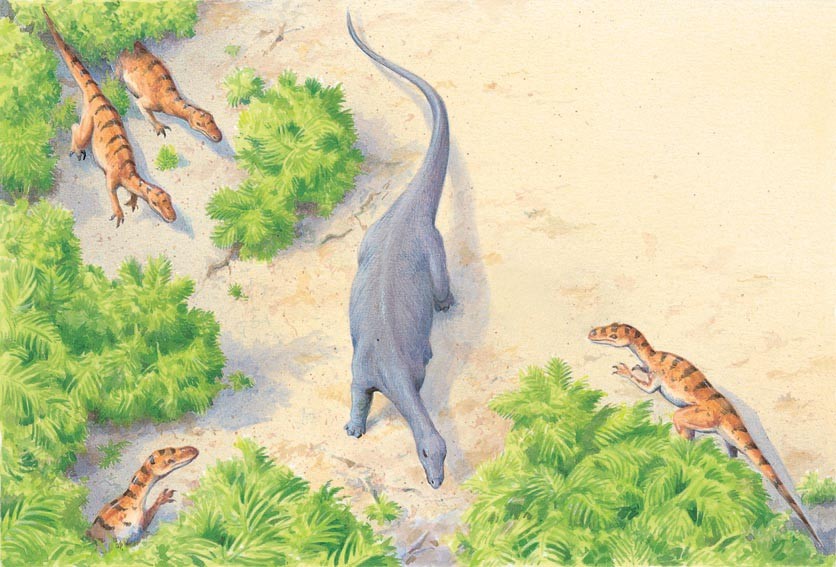
One might then leap on its back while the others attempted to stab through its hide with repeated kicks of their lethal toe-claws. Eventually the weight of numbers would win the day for the Deinonychus gang. Another possibility is that the Deinonychus brought down their prey in a similar way to present-day birds of prey, leaping on it and using their claws to pin it down. Once they had subdued their victim, the predators took bites out of the living animal until it died from loss of blood.

Fossil discoveries

Deinonychus was discovered by accident in 1931 while scientists were excavating the remains of Tenontosaurus, one of the large dinosaurs Deinonychus preyed upon. It was largely ignored until more fossils were discovered in 1964. Teeth found near Tenontosaurus indicated that several Deinonychus may have hunted, or at least scavenged, on the corpse of the larger dinosaur.
From the later discovery of fossil eggshells found near an adult specimen, palaeontologists think that Deinonychus, almost certainly feathered like other members of dromaeosaur family, may have, like a bird, brooded its eggs and raised its young.
Facts about Deinonychus
Pronunciation: Die-NON-ee-kus
Size: 3.5–4 m (11–13 ft) long and 0.8 m (2.6 ft) tall at shoulder
Where and when: Swamps and woodland in North America, 113 million years ago (Early Cretaceous)
Diet: Meat
Prey: Large, plant-eating dinosaurs, such as Tenontosaurus
Features: Scythe-shaped toe-claw, good for stabbing through thick skin; other claws for gripping the backs of prey; a strong tail for balance while attacking and sprinting; razor-sharp teeth for tearing flesh; strong back legs for agility; sharp-sightedness and keen intelligence; feathers for heat insulation;
Relatives: Velociraptor, Tsaagan (East Asia); Saurornitholestes, Dromaeosaurus (North America)


Consultant: Chris Jarvis
pics


Without in any way limiting Q-files Ltd’s exclusive rights under copyright, any use of this publication to “train” generative artificial intelligence (AI) technologies to generate text is expressly prohibited. Q-files Ltd reserves all rights to license use of this work for generative AI training and development of machine learning language models.