
Dinosaur species

CITE
We have made every effort to follow citation style rules, but there may be some minor differences. If in doubt, please refer to the appropriate citation style manual.
Triceratops. (2026). In Q-files Encyclopedia, Prehistoric, Dinosaur species. Retrieved from
https://www.q-files.com/prehistoric/dinosaur-species/triceratops
"Triceratops." Prehistoric, Dinosaur species, Q-files Encyclopedia, 11 Mar. 2026.
https://www.q-files.com/prehistoric/dinosaur-species/triceratops.
Accessed 6 Nov. 2026.
Triceratops 2026. Prehistoric, Dinosaur species. Retrieved 6 November 2026, from
https://www.q-files.com/prehistoric/dinosaur-species/triceratops
Prehistoric, Dinosaur species, s.v. "Triceratops," accessed November 6, 2026.
https://www.q-files.com/prehistoric/dinosaur-species/triceratops


Triceratops
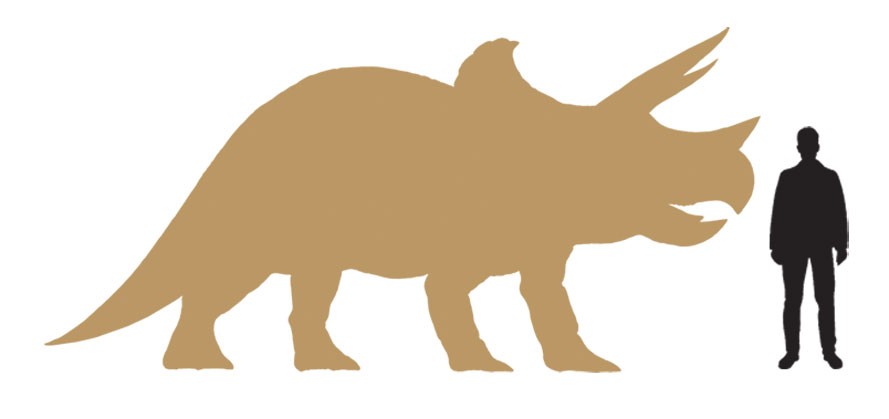
Triceratops was a ceratopsian dinosaur that lived in North America during the Late Cretaceous Period—in fact, right at the very end of the Age of Dinosaurs. It had a massive head with long snout, behind which was a massive, upward-curving sheet of solid bone, called a neck frill. Triceratops means “three-horned face”. Projecting out from its skull were two long brow horns and a shorter nose horn. It had a parrot-like beak and jaws lined with many teeth, which it used to chomp its way through the toughest of plant foods. Four stocky legs supported its heavy, tough-skinned body.

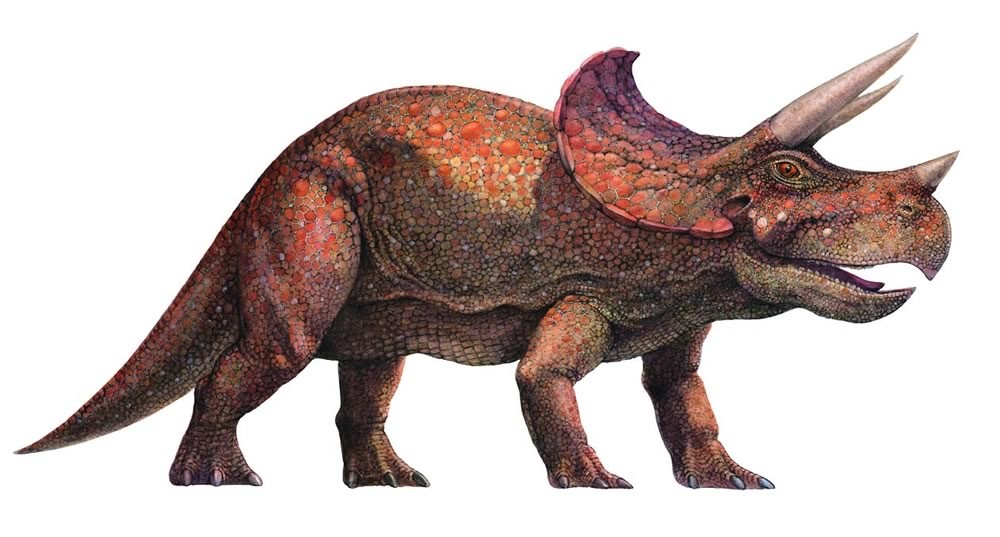
Neck frill
Among the ceratopsian dinosaurs, only Triceratops had a frill that was made of solid bone. Its relatives had hollows in their frills covered with skin, which made their frills lighter. Triceratops's neck frill would help protect it from an attack to the back of the neck. It might also help the dinosaur to look bigger, meaner and more threatening than it actually was.
The skin on the frill increased Triceratops's body surface area, helping it to warm up or shed heat more quickly. In males, the size and magnificence of their frills, which might have been brightly coloured, could have served them well when displaying to females during courtship.

Fossil remains
What we know about Triceratops has been pieced together from hundreds of fossil pieces. A complete skeleton of Triceratops has never been found (although one that is 85% complete, known as "Horridus", was put on display in 2022). Its skull comprised more one third of its entire body. Its neck frill was over 2 metres (6.6 feet) long. Some skull remains show signs of damage, suggesting that rival male Triceratops may have fought each other for supremacy of the herd.

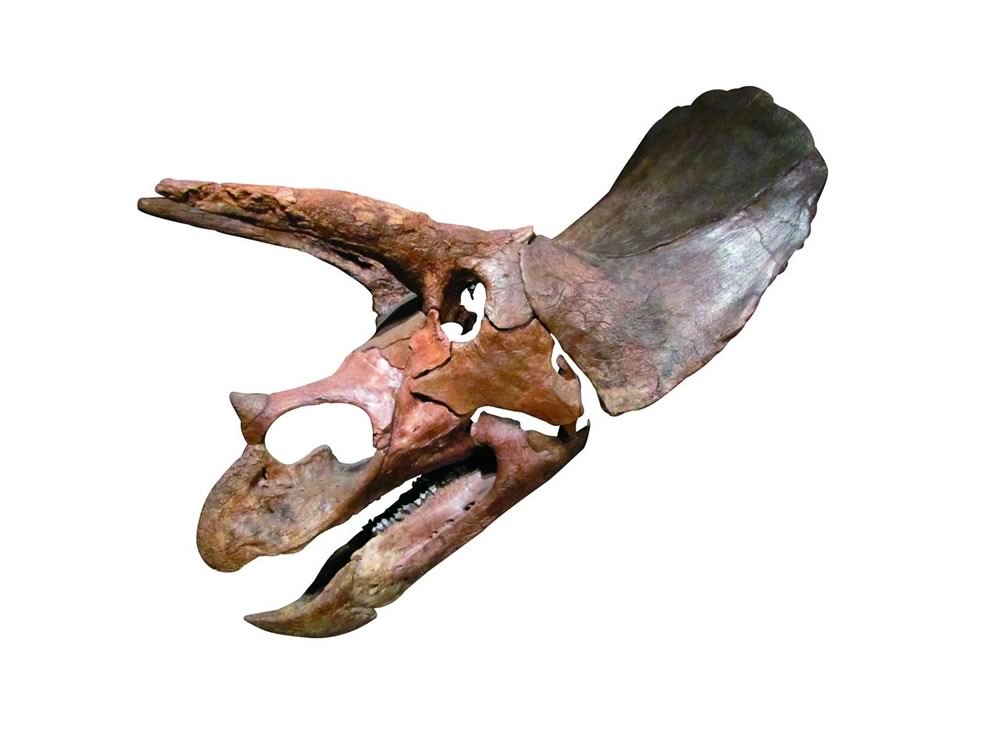
Triceratops's jaws merged with a long, narrow, toothless beak, used for grasping and plucking off plant material. Its large teeth were stacked in a number of columns on either side of each jaw, with between three and five teeth per column. Some individuals had up to 800 teeth, although only a small fraction of those were in use at any one time: they were replaced throughout the life of the animal. The large number of teeth suggests that Triceratops ate vast quantities of tough plant material over the course of its life.
Defence
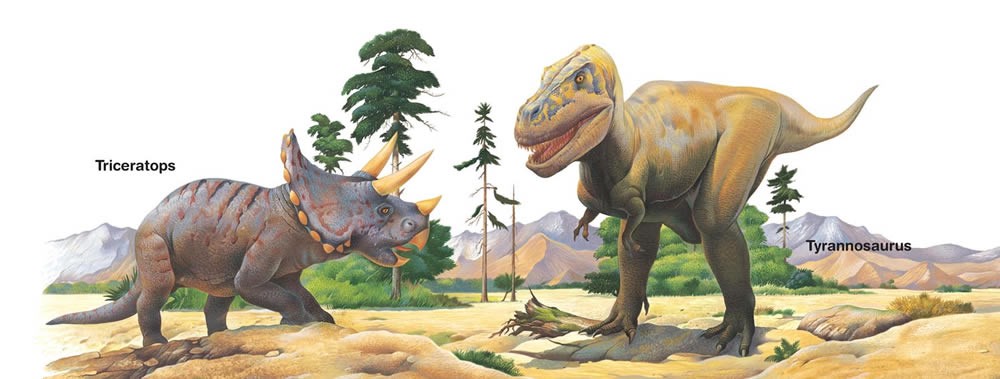
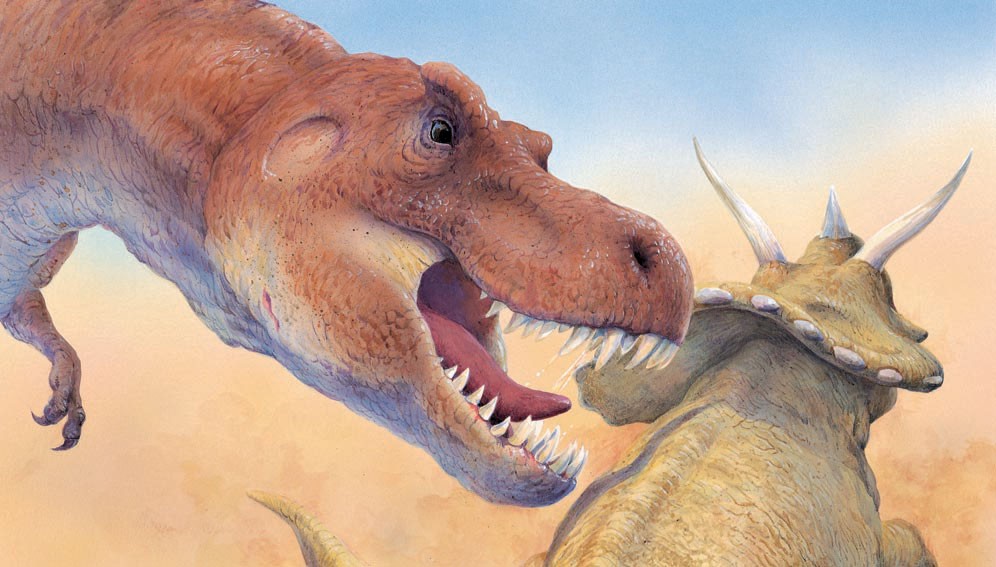
How was Triceratops able to fend off such a fearsome predator as Tyrannosaurus rex, which lived at the same time and in the same place? Typically, Triceratops moved around in herds, benefitting from safety in numbers. Under threat of attack, the herd would quickly form a circle around younger and weaker members. They would stand their ground and lower their heads to show off their neck frills, trying to look as threatening as possible. They might even jab their horns into the attacker if it came too close.
Torosaurus

Torosaurus ("bull lizard"), a close relative of Triceratops, had the largest head of any animal that ever lived on land. Its massive skull was about the size of a small car. Measured from its beak to the back of its neck frill it was 2.6 metres (8.5 feet) long. This plant-eating dinosaur lived in North America 70 million years ago.
Facts about Triceratops
Pronunciation: Try-SERRA-tops
Size: 9 m (30 ft) long and 2.5 m (8 ft) tall
Where and when: Open woodland in North America, 66 million years ago (Late Cretaceous)
Diet: Low-growing plants and young trees
Predators: Tyrannosaurus rex, Albertosaurus
Features: Defensive neck frill; lots of large, strong teeth for chewing plants
Relatives: Chasmosaurus, Arrhinoceratops, Torosaurus, Anchiceratops, Pentaceratops. Slightly more distant relatives were Styracosaurus and Centrosaurus.

Consultant: Chris Jarvis
pics


Without in any way limiting Q-files Ltd’s exclusive rights under copyright, any use of this publication to “train” generative artificial intelligence (AI) technologies to generate text is expressly prohibited. Q-files Ltd reserves all rights to license use of this work for generative AI training and development of machine learning language models.