
Dinosaur species

CITE
We have made every effort to follow citation style rules, but there may be some minor differences. If in doubt, please refer to the appropriate citation style manual.
Maiasaura. (2026). In Q-files Encyclopedia, Prehistoric, Dinosaur species. Retrieved from
https://www.q-files.com/prehistoric/dinosaur-species/maiasaura
"Maiasaura." Prehistoric, Dinosaur species, Q-files Encyclopedia, 11 Mar. 2026.
https://www.q-files.com/prehistoric/dinosaur-species/maiasaura.
Accessed 6 Nov. 2026.
Maiasaura 2026. Prehistoric, Dinosaur species. Retrieved 6 November 2026, from
https://www.q-files.com/prehistoric/dinosaur-species/maiasaura
Prehistoric, Dinosaur species, s.v. "Maiasaura," accessed November 6, 2026.
https://www.q-files.com/prehistoric/dinosaur-species/maiasaura


Maiasaura
Maisaura was a hadrosaur, a duck-billed dinosaur, that lived in North America in the Late Cretaceous Period. It had a flattened snout with a toothless beak and batteries of self-sharpening cheek teeth inside its jaws. Its forelegs were shorter than its hindlegs, and its "hands" had hooves and fleshy pads, showing that Maiasaura usually walked around on four legs, but often stood on just two. On its scaly skin were clusters of tubercles (wart-like projections). There was a small, solid crest above its eyes. The first fossil remains of Maiasaura were discovered alongside those of nests, eggshells and hatchlings—the first evidence that some dinosaurs cared for their young.


Parenting behaviour
Maiasaura means “good mother lizard”, after the discovery that the dinosaur may have reared its hatchlings. Studies of fossilized dinosaur nests, eggs and even the baby dinosaurs inside the eggs gave palaeontologists a great deal of information about how dinosaurs brought up their young. Taken together with study of nesting habits in modern birds and reptiles, they have been able to build up a picture of the dinosaurs’ parenting behaviour.
Nesting colonies
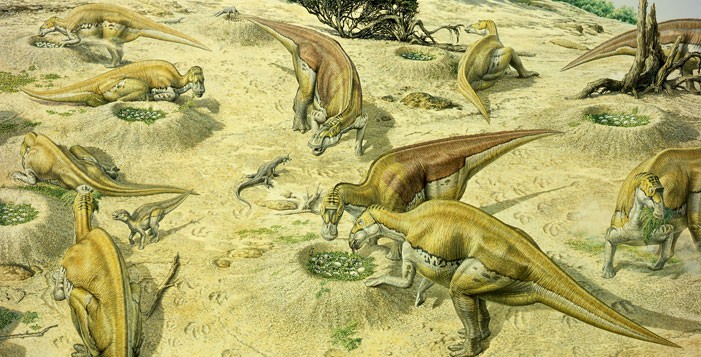
Maiasaura built its nests in colonies on high ground to avoid flooding and predators—a similar strategy to modern sea birds, such as albatrosses. The nests had gaps between them just sufficient to allow the parents to visit their nests without disturbing their neighbours’. While birds incubated the eggs themselves, this was clearly impossible for a heavy, 9-metre (30-foot) dinosaur.

Building a nest
How might the female Maiasaura have built her nest? First, she chose a spot close to other nests where there was soft soil. Using her feet, she gouged out a hollow in the ground in which she laid her eggs in a spiral or circular pattern. Then she built up the soil around the eggs with her snout and covered the eggs with a blanket of rotting vegetation to keep the eggs warm. Afterwards, she stood guard to keep predators away.
Nests
The nests were mounds of soil. They were about 2 metres (6.6 feet) in diameter and contained up to 30 eggs laid in a circular or spiral pattern so that no egg touched the other. The eggs were incubated by heat coming from rotting vegetation piled on top of them, rather than a parent sitting on the nest.

The eggs were about the size of ostrich eggs: 15 centimetres (6 inches) long. They had shells thin enough to allow oxygen to pass through, and for the hatchling to break out of them. The textured surface would have prevented the tiny pores in the shells from becoming blocked.

Babies
Fossils of baby Maiasaura show that they were too weak to leave the nest. Their teeth were also partly worn, suggesting that adults brought food to them in their nest. Other fossil evidence, including fragments of trampled eggshell and even the remains of regurgitated vegetation, confirm this.
Had the shells had been found with just their tops knocked off but otherwise intact, it would have indicated that the hatchlings were fully developed and capable of walking away from the nest immediately.
There are a few rare examples of fossilized eggs with the embryonic dinosaurs still inside. The babies’ “cute” appearance (large head and eyes) would have made a mother Maiasaura feel maternal towards her brood, just like other animal mothers today. Baby Maiasaura grew very quickly, from about 30 centimetres (12 inches) at birth to 1.4 metres (4.6 feet) at one year old.

Migration

Maiasaura may well migrated in search of fresh food supplies. Vast herds, perhaps tens of thousands strong, marched along broad trackways across the dry plains. The young Maiasaura would have been kept in the centre of the herd as protection from predators.
Facts about Maiasaura
Pronunciation: MY-ah-SAW-rah
Size: 9 m (30 ft) long and 3 m (10 ft) tall
Where and when: Coastal plains of North America, 74 million years ago (Late Cretaceous)
Diet: Plants, berries, leaves and seeds
Predators: Albertosaurus, Daspletosaurus, Gorgosaurus
Features: Self-sharpening cheek teeth; a head crest for possible headbutting contests between males
Relatives: Edmontosaurus, Brachylophosaurus (North America); Saurolophus (North America and East Asia); Shantungosaurus (East Asia)


Consultant: Chris Jarvis
pics
Without in any way limiting Q-files Ltd’s exclusive rights under copyright, any use of this publication to “train” generative artificial intelligence (AI) technologies to generate text is expressly prohibited. Q-files Ltd reserves all rights to license use of this work for generative AI training and development of machine learning language models.