
Dinosaur species

CITE
We have made every effort to follow citation style rules, but there may be some minor differences. If in doubt, please refer to the appropriate citation style manual.
Diplodocus. (2026). In Q-files Encyclopedia, Prehistoric, Dinosaur species. Retrieved from
https://www.q-files.com/prehistoric/dinosaur-species/diplodocus
"Diplodocus." Prehistoric, Dinosaur species, Q-files Encyclopedia, 11 Mar. 2026.
https://www.q-files.com/prehistoric/dinosaur-species/diplodocus.
Accessed 21 Sep. 2026.
Diplodocus 2026. Prehistoric, Dinosaur species. Retrieved 21 September 2026, from
https://www.q-files.com/prehistoric/dinosaur-species/diplodocus
Prehistoric, Dinosaur species, s.v. "Diplodocus," accessed September 21, 2026.
https://www.q-files.com/prehistoric/dinosaur-species/diplodocus


Diplodocus
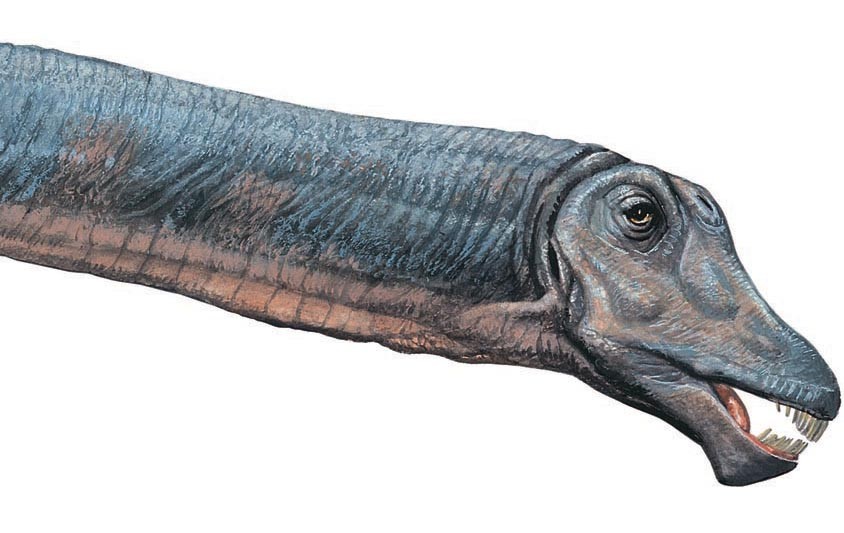
Diplodocus was an immensely long sauropod that lived in North America during the Jurassic Period. But it was relatively light for its great length, weighing no more than three elephants. It had a large, stocky body with pillar-like legs, the front ones slightly shorter than the back ones. A row of short, pointed spines ran along the ridge of its back. Its long neck ended in a relatively small head. It had an extremely long, whip-like tail.


Neck
Diplodocus’s neck was 6 metres (20 feet) long. In order to pump blood up to its head, both these dinosaurs would have needed unbelievably large hearts. Scientists have suggested that they may instead have had as many as eight very simple hearts in their chest and neck. Each pumped blood from one heart to the next, like a relay team. Males might have used their long necks to show off to females or intimidate their enemies.
Feeding
Diplodocus made use of its long neck to reach up into branches or into dense stands of trees to feed on leaves, or down into rivers to drink. The forward-pointing, peg-shaped teeth at the front of Diplodocus’s jaws were ideal for plucking plants or for stripping leaves from branches. Having no chewing teeth, Diplodocus relied on stones it had swallowed, called gastroliths, to mash up the leaves in its stomach.

Tail
Diplodocus’s long tail, which was ridged with sharp scales, was probably used as a defensive weapon. A Diplodocus might have cracked it very fast like a whip in the face of its attackers. It could also have cracked it to make a loud noise that would scare rivals or enemies away.
The tail would also have counterbalanced the weight of its long neck and supported its body when rearing up on its hindlegs. Diplodocus’s name means “double beam”, a reference to the unusual shape of the bones in the middle part of its tail.


Barosaurus
Barosaurus, whose name means "heavy lizard", was Diplodocus's closest relative. The two dinosaurs differed in the number and shape of their vertebrae and their proportions. Barosaurus had an even longer neck—9 metres (30 feet)—than Diplodocus, but a shorter tail, so was about the same length overall (although from studies of a single bone from one Barosaurus specimen, it could have measured an incredible 48 metres or 157 feet long). The longest vertebrae bones in Barosaurus's neck were up to 1 metre (3 feet) long. As a comparison, in humans they are only about 2 centimetres (0.75 inch) long.
Facts about Diplodocus
Pronunciation: Di-PLOH-doh-kus
Size: 27 m (89 ft) long and 5 m (16.4 ft) tall
Where and when: Forests and grasslands of North America, 150–147 million years ago (Late Jurassic)
Diet: Leaves, ferns, water plants
Predators: Young or sickly individuals may have been prey for Allosaurus or Ceratosaurus hunting in packs. Diplodocus’s sheer size protected it from predators.
Features: Very long neck for reaching up into tall trees for leaves; peg-shaped front teeth for stripping leaves; a long whip-like tail for defence
Relatives: Barosaurus, Apatosaurus, Supersaurus, Amphicoelias (North America); Amargasaurus (South America)


Consultant: Chris Jarvis
pics

Without in any way limiting Q-files Ltd’s exclusive rights under copyright, any use of this publication to “train” generative artificial intelligence (AI) technologies to generate text is expressly prohibited. Q-files Ltd reserves all rights to license use of this work for generative AI training and development of machine learning language models.