
Dinosaur species

CITE
We have made every effort to follow citation style rules, but there may be some minor differences. If in doubt, please refer to the appropriate citation style manual.
Euoplocephalus and the ankylosaurs. (2026). In Q-files Encyclopedia, Prehistoric, Dinosaur species. Retrieved from
https://www.q-files.com/prehistoric/dinosaur-species/euoplocephalus-and-the-ankylosaurs
"Euoplocephalus and the ankylosaurs." Prehistoric, Dinosaur species, Q-files Encyclopedia, 11 Mar. 2026.
https://www.q-files.com/prehistoric/dinosaur-species/euoplocephalus-and-the-ankylosaurs.
Accessed 6 Nov. 2026.
Euoplocephalus and the ankylosaurs 2026. Prehistoric, Dinosaur species. Retrieved 6 November 2026, from
https://www.q-files.com/prehistoric/dinosaur-species/euoplocephalus-and-the-ankylosaurs
Prehistoric, Dinosaur species, s.v. "Euoplocephalus and the ankylosaurs," accessed November 6, 2026.
https://www.q-files.com/prehistoric/dinosaur-species/euoplocephalus-and-the-ankylosaurs


Euoplocephalus and the ankylosaurs
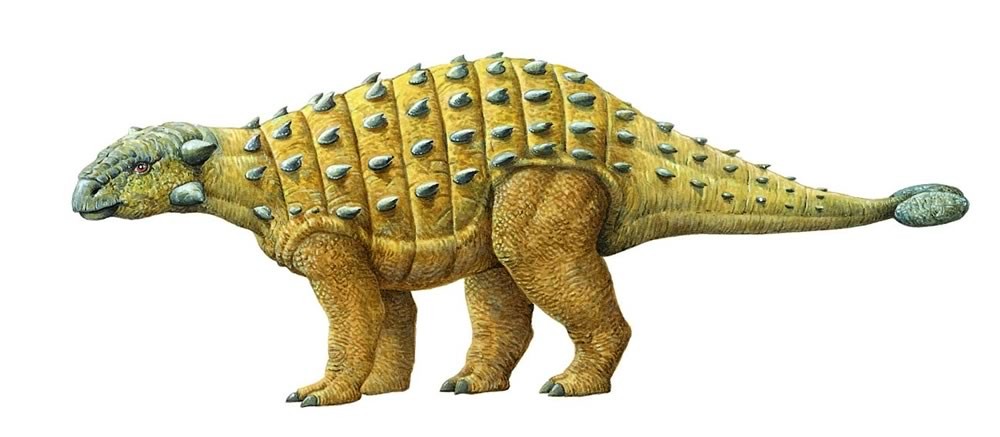
Euoplocephalus was an ankylosaur, an armoured dinosaur, that lived in North America during the Late Cretaceous Period. It may have wandered alone in search of plants and roots to eat. Euoplocephalus had a stocky, low-slung body with stout legs and clawed feet. Plates of bony armour, known as scutes, were embedded into skin on its head (including eyelids), neck, back and tail. The plates were dotted with thick studs. There were large spines on its shoulders and a heavy club of bone at the end of its tail. It had small teeth.


Ankylosaurs
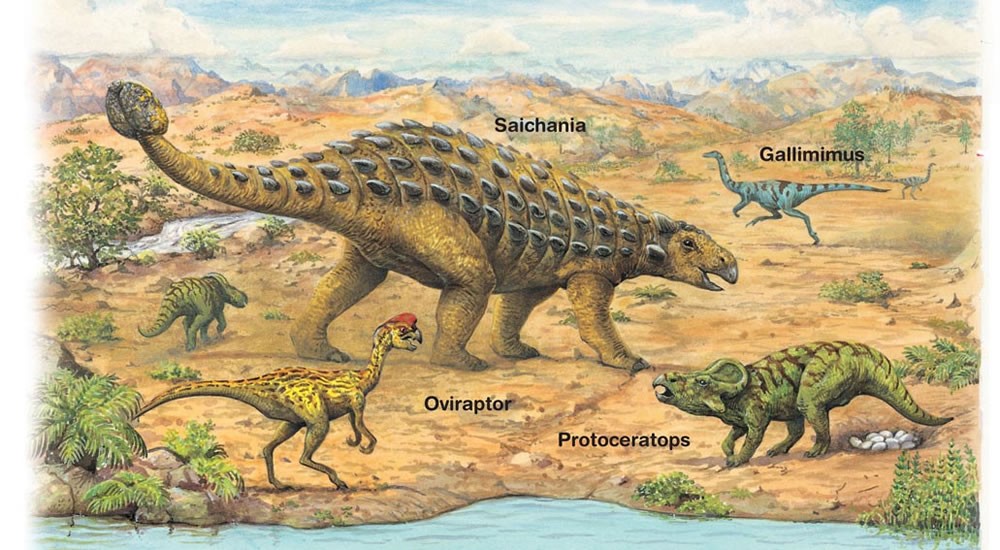
Euoplocephalus means “well-armoured head”—for obvious reasons. The name Ankylosaurus means “stiffened reptile”, a reference to the way its bones were fused together. Saichania, an ankylosaur from East Asia, is Mongolian for “beautiful one”, not because of its rugged good looks, but because its fossilized bones were extremely well-preserved when discovered. Talarurus also lived in Mongolia in the Late Cretaceous. Its name means “basket tail”, after the shape of its tail club.
Tail club defence
Anklyosaurs like Euoplocephalus, Anklyosaurus and Talarurus all had a deadly weapon to defend themselves with. At the end of their tails was a "club", a large ball of bone. It could be swung from side to side into the body or head of any flesh-eater, such as a Tarbosaurus, that attacked them. The tail bones interlocked to form a stiff rod, increasing the swing force.

Ankylosaurus

Euoplocephalus and Anklyosaurus looked quite similar and lived in the same part of the world in the Late Cretaceous, although Euoplocephalus appeared 15 million years earlier than Ankylosaurus. Anklyosaurus was bigger (10 metres long) and had smooth, rounded knobs on its armour while Euoplocephalus had spikes.

Spicomellus
The oldest anklyosaur known lived in North Africa 165 million years ago during the mid-Jurassic. Named Spicomellus, it is described in a 2025 study as "one of the strangest dinosaurs ever discovered." It was almost entirely covered by bony spikes. Those around its neck were more than a metre long, while others were fused to its ribs—a feature never seen in any other animal, living or extinct. Spikes also stuck out of its sides and hips, and ran the length of its back to the tip of its tail.
Facts about Euoplocephalus
Pronunciation: You-op-loh-SEFF-ah-lus
Size: 6 m (20 ft) long and 2.2 m (7.2 ft) tall
Where and when: Open woodland in North America, 85–66 million years ago (Late Cretaceous)
Diet: Low-growing plants and roots
Predators: Giant theropods such as Albertosaurus, Daspletosaurus and Tyrannosaurus rex
Features: Protective armour, spikes and tail club; huge stomach, capable of breaking down tough plant material; large nasal passages giving good sense of smell
Relatives: Ankylosaurus, (North America); Pinacosaurus, Saichania and Talarurus (East Asia), Spicomellus (North Africa)


Consultant: Chris Jarvis
pics
Without in any way limiting Q-files Ltd’s exclusive rights under copyright, any use of this publication to “train” generative artificial intelligence (AI) technologies to generate text is expressly prohibited. Q-files Ltd reserves all rights to license use of this work for generative AI training and development of machine learning language models.