
Dinosaur species

CITE
We have made every effort to follow citation style rules, but there may be some minor differences. If in doubt, please refer to the appropriate citation style manual.
Carnotaurus. (2026). In Q-files Encyclopedia, Prehistoric, Dinosaur species. Retrieved from
https://www.q-files.com/prehistoric/dinosaur-species/carnotaurus
"Carnotaurus." Prehistoric, Dinosaur species, Q-files Encyclopedia, 10 Mar. 2026.
https://www.q-files.com/prehistoric/dinosaur-species/carnotaurus.
Accessed 6 Nov. 2026.
Carnotaurus 2026. Prehistoric, Dinosaur species. Retrieved 6 November 2026, from
https://www.q-files.com/prehistoric/dinosaur-species/carnotaurus
Prehistoric, Dinosaur species, s.v. "Carnotaurus," accessed November 6, 2026.
https://www.q-files.com/prehistoric/dinosaur-species/carnotaurus


Carnotaurus
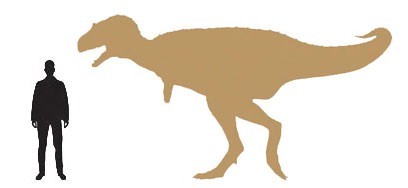
Carnotaurus was a large theropod that lived in South America during the Late Cretaceous Period. It is known from a single fossil, an almost complete skeleton, that was found in Patagonia in 1984. The name Carnotaurus means “flesh-eating bull”, after its bull-like appearance: it had a short, bull-like head with its thick horns above its forward-facing eyes. Carnotaurus had a slender lower jaw with long, thin teeth. Its arms were extremely short, with four immobile, claw-less fingers. The skin on its body was lined with rows of bony lumps. It had a long, thin tail.


Aucasaurus
Closely related to Carnotaurus was Aucasaurus, another Late Cretaceous South American theropod. A smaller animal than Carnotaurus, it, too, had tiny arms with useless hands. A fossil found of its skull was damaged, leading palaeontologists to think it might have been smashed during a clash with another Aucasaurus.
Ceratosaurus

More distantly related to Carnotaurus was a theropod that lived in North America, Europe and Africa in Jurassic times: Ceratosaurus. A 6-metre (20-foot) predator, it, too, had horns above it eyes as well as a large, blade-like horn on its snout. It had short arms, but, unlike those of Carnotaurus, they were powerfully built. Unusually for a theropod, Ceratosaurus had a row of bony spines running down its back. It preyed on a wide range of smaller dinosaurs and probably scavenged on whatever it came across.
Facts about Carnotaurus
Pronunciation: Car-noh-TAW-rus
Size: 7.5 m (25 ft) long and 2.2 m (7.2 ft) tall
Where and when: Plains of Patagonia, Argentina, South America 70 million years ago (Late Cretaceous).
Diet: Meat
Prey: Hadrosaurs such as Secernosaurus; the young of titanosaurs such as Argentinosaurus
Features: Forward-facing eyes gave Carnotaurus binocular vision, which was good for spotting prey; blade-like, saw-edged teeth—perfect for slicing up flesh; short, bull-like head could be used by males for butting rivals in mating contests
Relatives: Aucasaurus (Argentina), Majungasaurus (Madagascar) and Rajasaurus (India)

Consultant: Chris Jarvis
pics

Without in any way limiting Q-files Ltd’s exclusive rights under copyright, any use of this publication to “train” generative artificial intelligence (AI) technologies to generate text is expressly prohibited. Q-files Ltd reserves all rights to license use of this work for generative AI training and development of machine learning language models.