
EASY READ Space

CITE
We have made every effort to follow citation style rules, but there may be some minor differences. If in doubt, please refer to the appropriate citation style manual.
EASY READ Space glossary. (2026). In Q-files Encyclopedia, Space, EASY READ Space. Retrieved from
https://www.q-files.com/space/easy-read-space/easy-read-space-glossary
"EASY READ Space glossary." Space, EASY READ Space, Q-files Encyclopedia, 25 Mar. 2026.
https://www.q-files.com/space/easy-read-space/easy-read-space-glossary.
Accessed 13 Sep. 2026.
EASY READ Space glossary 2026. Space, EASY READ Space. Retrieved 13 September 2026, from
https://www.q-files.com/space/easy-read-space/easy-read-space-glossary
Space, EASY READ Space, s.v. "EASY READ Space glossary," accessed September 13, 2026.
https://www.q-files.com/space/easy-read-space/easy-read-space-glossary


Space glossary
A
Aphelion The point in an object’s orbit when it is farthest away from the Sun.
Asteroid A rocky or metallic body that orbits the Sun. Asteroids range in size from blocks one metre (39 inches) across, to objects about 1000 km (600 miles) in diameter. The region between Mars and Jupiter where most of the known asteroids in the Solar System lie is called the Asteroid Belt.
Astronomical Unit (AU) The average distance between the Earth and the Sun. One AU is 149,597,871 km (92,917,931 miles).
Atmosphere The envelope of gases surrounding a planet, moon or star.
Axis An imaginary straight line that runs through the centre of a planet from pole to pole.
B
Big Bang The rapid expansion during which the Universe is thought to have been formed. During the Big Bang, which happened about 13.8 billion years ago, all matter, energy, space and time were created.
Binary star A system of two stars that orbit each other.
Black hole A region of space from which nothing can escape. A black hole is sometimes left behind when a supergiant star blasts itself apart in a supernova.
Blue giant A massive, hot star. Blue supergiants are rare and have short lives. They often end in a supernova.
C
Cassini Division The largest of the gaps between Saturn’s rings. The gap is about 4800 km (3000 miles) wide.
Cassini-Huygens A probe launched in 1997 to study Saturn and its rings and moons. In 2005, the Cassini probe released the Huygens lander, which landed on Saturn’s moon, Titan. A parachute was deployed to slow the lander’s descent and permit a soft landing. Cassini later undertook a fly-by of Enceladus, before being deliberately crashed into Saturn in September 2017 to end the mission.
Celestial body Any natural object located outside of the Earth’s atmosphere.
Constellation A group of stars that form a pattern in the night sky. Years ago, early astronomers grouped the stars into these patterns, imagining their shapes to look like gods, heroes and sacred beasts from popular legends. Astronomers use constellations as a way of mapping the sky.
Corona The Sun’s hot outer atmosphere. The corona extends for millions of kilometres into space. It is visible from Earth only during a total solar eclipse.
Crater A saucer-shaped feature found on the surface of many moons and asteroids, and some planets. Craters are formed by the impact of meteorites or asteroids, lumps of rock crashing to ground from space. Some are made by volcanic eruptions.
DEF
Day The time that it takes a moon or planet to rotate once on its axis.
Dwarf planet A relatively large, round object that orbits the Sun, but which is not large enough to qualify as a true planet.
Eclipse The passage of one celestial body in front of another, totally or partially hiding it from an observer: for example, a solar eclipse or lunar eclipse.
Exoplanet A planet belonging to planetary system other than our own Solar System. Exoplanets orbit around other stars.
Flare An explosion of hydrogen in the Sun’s atmosphere, releasing enormous amounts of energy.
Flyby The flight of a space probe very close to a planet or moon, from where it can obtain detailed images.
GH
Galileo Galilei (1564–1642) Italian astronomer who, in 1609, used the first astronomical telescope, with which he discovered four moons around Jupiter.
Galileo mission A mission that sent a space probe to orbit Jupiter in 1989. It was the first spacecraft to orbit the planet.
Gas giants The four large planets in the Solar System: Jupiter, Saturn, Uranus and Neptune. Many exoplanets have been found to be gas giants as well. Gas giants mostly consist of gases and probably have no solid surface.
JKL
Jupiter The fifth planet from the Sun. It is the largest planet in the Solar System. A gas giant, it is more massive than all the other planets combined.
Kuiper Belt A region of the Solar System beyond the planet Neptune. It consists of icy bodies, including the dwarf planet Pluto.
Light year The distance a ray of light travels in one year. One light year is approximately 9.46 million million km (5.88 million million miles).
Lunar A word that means “about the Moon”.
Lunar eclipse The passage of the Earth between the Sun and Moon during which the Earth casts a shadow on the Moon.
M
Mare A smooth lava plain on the surface of the Moon, formed when lava from ancient eruptions turned to solid rock. To the observer, it appears as a dark patch. Mare is the Latin word for sea. This is because early astronomers believed the plains were seas.
Mars The fourth planet from the Sun, known as the Red Planet. Like Earth, Mars has volcanoes, mountains, canyons and polar ice caps.
Mercury The nearest planet to the Sun, and the smallest true planet in the Solar System. Mercury is a small planet covered with craters and lava plains.
Meteor A streak of light in the sky that occurs when fragments from a meteoroid enter the Earth’s atmosphere. Meteors are sometimes called “shooting stars”.
Meteorite A meteoroid that lands on the surface of a planet or moon.
Meteoroid A small lump of rock and dust that hurtles across the Solar System. It was once part of an asteroid or comet.
Milky Way Galaxy The galaxy that contains our Sun and Solar System. The Milky Way is a flattened barred spiral of stars clustered together in space.
Moon A natural object that orbits a planet.
Moon, The The Moon is a ball of rock that travels around the Earth. It may have formed when a large object crashed into the young Earth and the resulting debris came together. The Moon is a barren world, covered with craters, mountain ranges and wide lava plains.
NO
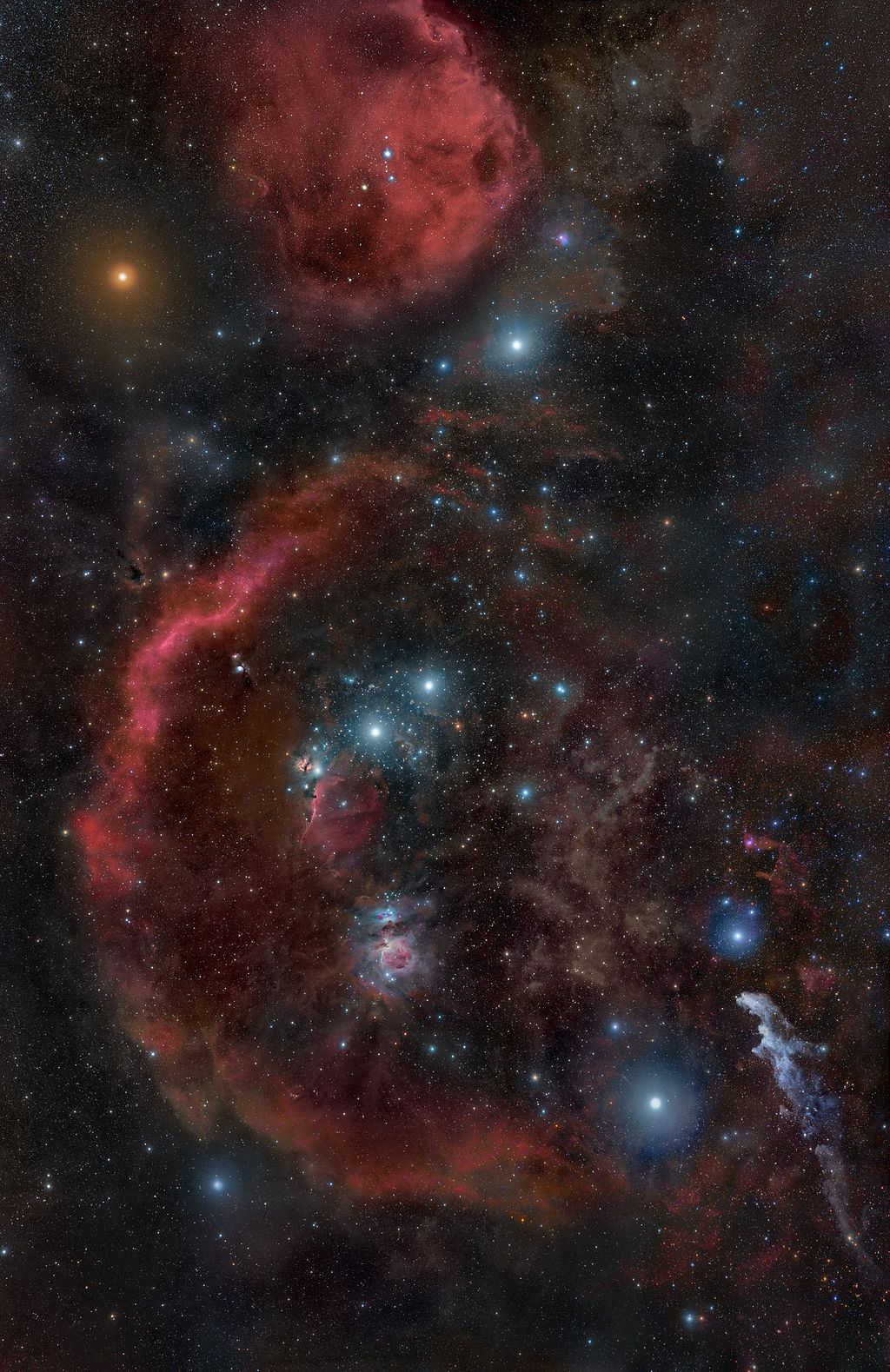
Nebula A cloud of gas and sometimes dust. In some nebulae, stars are formed.
Neptune The eighth planet from the Sun. Neptune is a bright blue globe, streaked by fast-moving clouds.
New Horizons US space probe that became, on 14th July 2015, the first spacecraft to reach Pluto. Launched in 2006, it took detailed images and recorded measurements of the the dwarf planet as it zoomed past just 12,500 kilometres (7800 miles) from Pluto's surface.
Observatory A building where a telescope is housed. Observatories are usually sited on mountaintops where light and air pollution is at a minimum and where viewing is least affected by cloudy skies or atmospheric disturbance.
Orbit The circular or elliptical (oval-shaped) path that one object takes around another object in space. For example, the Moon orbits the Earth, while the Earth orbits the Sun.
Oort Cloud A spherical cloud of icy objects surrounding the Solar System beyond the Kuiper Belt. These icy objects may one day become comets.
PR
Perihelion The point in an object’s orbit when it is closest to the Sun.
Phase The different appearance of an object as it orbits the Earth. The lunar phases refer to our changing view of the Moon throughout the month. When the face pointed towards us is turned away from the Sun we cannot see the moon at all. This is called a New Moon. When it is turned fully towards us we see a Full Moon. In between these phases it passes through crescent, quarter and gibbous phases.
Pioneer missions A series of US missions that sent space probes to Jupiter, Saturn and Venus in the 1970s. Pioneer 10 later became the first man-made object to leave the boundaries of the Solar System.
Planet A large, round object that orbits the Sun.
Planetary nebula A cloud of gas and dust. A planetary nebula is the remnants of a medium-sized star that has shed its outer layers in the final stages of its life cycle.
Planetary system A set of planets held in orbit around a star by the star's gravitational pull. The Solar System is a planetary system. Thousands of other planetary systems, containing exoplanets, have been discovered.
Planetesimal A large lump of rock that orbited the Sun during the formation of the Solar System. Some planetesimals collided with each other, eventually building up to form the eight planets of the Solar System.
Pluto Previously thought to be the ninth planet, Pluto is now classified as a dwarf planet. It measures 2274 km (1412 miles) on average across and is the largest known object in the Kuiper Belt, a region in the Solar System consisting of icy objects.
Polaris A bright star, sometimes called the North Star or Pole Star, around which the stars appear to revolve.
Prominence A flaming arch of gas that leaps off the Sun's surface and out into the corona. .
Red giant A large, old star with a relatively low temperature and a reddish orange colour.
Rosetta A European Space Agency space probe that was launched in March 2004. It reached Comet 67P/Churyumov–Gerasimenko in May 2014 and entered into orbit around the comet. It successfully launched its lander, called Philae, on to the surface of the comet in November 2014. It sent back detailed information about the chemical composition of the comet.
S
Satellite An object that orbits a larger object. The Moon is a natural satellite. Artificial satellites are man-made objects that have been launched into orbit. They can be used for communications, navigation and weather forecasting.
Sirius The brightest star in the night sky. Sirius appears in the constellation Canis Major.
Solar A word that means “about the Sun”.
Solar eclipse The passage of the Moon between the Sun and the Earth, blocking out some or all of the Sun’s light.
Solar System The Sun and all of the objects that orbit (go round) it: the eight planets, their moons, dwarf planets, asteroids, comets and meteoroids, and vast amounts of gas and dust.
Space probe An unmanned spacecraft guided from Earth. Some space probes have passed close to, entered orbit around, or landed on other planets and moons.
Star A giant spinning ball of hot gases. It produces vast amounts of energy in the form of heat and light, which it radiates across space.
Sun A typical star, a spinning ball of hot gas made up almost entirely of hydrogen and helium, that lies at the centre of our Solar System. To us on Earth it is of crucial importance since no life could exist without the energy it gives off. The Sun contains more than 99% of all the matter in the Solar System, planets included.
Sunspot A darker, cooler area that appears temporarily on the Sun’s surface. They usually occur in small groups.
Supercluster A group of clusters of galaxies. Superclusters tend to be stretched into long “strings”, called filaments, that stretch across the Universe.
Supergiant A very large, bright star.
Supernova A colossal explosion of a supergiant at the end of its life cycle. It leaves behind a cloud of gas and dust or, in some cases, a neutron star. The most massive supernovas leave behind a black hole.
TU
Telescope An instrument that makes distant objects appear brighter and closer, allowing the viewer to see details that are not visible with the naked eye. Objects on Earth and in space can be observed using optical telescopes, which collect light from distant objects and use it to produce images. Objects in space can also be observed using radio telescopes, which gather radio waves given off by these objects.
Universe The Universe is made up of everything we know, from the tiniest grain of sand to the most gigantic star. It even includes empty space. Nearly all the matter in the Universe is contained in galaxies, which are grouped into giant groups called superclusters.
Uranus The seventh planet from the Sun. Uranus is a featureless blue globe of gas. It orbits the Sun at a very unusual angle. It is tilted at 98° from the vertical, meaning that it orbits the Sun almost on its side.
WVY
Waning The period between a Full Moon and a New Moon, when the visible part of the Moon becomes smaller and smaller.
Waxing The period between a New Moon and a Full Moon, when the visible part of the Moon becomes larger and larger.
Variable star A star that varies in brightness over time.
Venus The second planet from the Sun. About the same size as the Earth, shrouded in clouds of sulphuric acid, beneath which it is covered with old lava plains and volcanoes. Because its cloud cover reflects light from the Sun, Venus is a very bright object in the night sky.
Viking programme Two US space probes that were sent to Mars in 1975 to search for evidence of life, past or present.
Voyager programme A US space mission that sent space probes to Jupiter, Saturn, Uranus and Neptune in the 1980s and 90s. They sent back data and images of the planets and their moons and rings.
Year The time that it takes an object to complete one full orbit of the Sun.
Consultant: Mike Goldsmith
pics
Without in any way limiting Q-files Ltd’s exclusive rights under copyright, any use of this publication to “train” generative artificial intelligence (AI) technologies to generate text is expressly prohibited. Q-files Ltd reserves all rights to license use of this work for generative AI training and development of machine learning language models.