
EASY READ Space

CITE
We have made every effort to follow citation style rules, but there may be some minor differences. If in doubt, please refer to the appropriate citation style manual.
EASY READ Mars. (2025). In Q-files Encyclopedia, Space, EASY READ Space. Retrieved from
https://www.q-files.com/space/easy-read-space/easy-read-mars
"EASY READ Mars." Space, EASY READ Space, Q-files Encyclopedia, 15 Dec. 2025.
https://www.q-files.com/space/easy-read-space/easy-read-mars.
Accessed 13 Sep. 2026.
EASY READ Mars 2025. Space, EASY READ Space. Retrieved 13 September 2026, from
https://www.q-files.com/space/easy-read-space/easy-read-mars
Space, EASY READ Space, s.v. "EASY READ Mars," accessed September 13, 2026.
https://www.q-files.com/space/easy-read-space/easy-read-mars


Mars
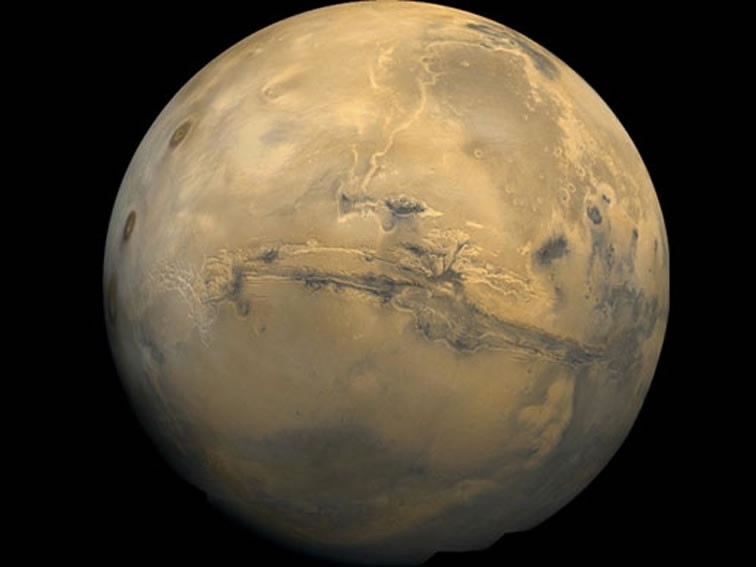
Mars is the fourth planet from the Sun and the second smallest planet in the Solar System after Mercury. It is named after the Roman god of war. Although it is completely barren, Mars is the planet most like Earth. It has volcanoes and valleys; there are four seasons; although temperatures are usually colder, it can be quite warm in summer. Just as on Earth, Mars has ice caps at both north and south poles.
Red Planet

Mars is known as the Red Planet because of the reddish colour of the dust that covers it. This is iron oxide, familiar to us as rust. Sometimes dark areas of rock show up when storms blow away the dust.

Mountains and valleys
There are a number of extinct volcanoes on Mars, some of them huge. They include Olympus Mons, which is about three times as high as the tallest mountains on Earth. It is the highest mountain in the Solar System.

A massive canyon, Valles Marineris, more than four times deeper than the Grand Canyon on Earth and as long as the United States is wide, slices across the Martian surface.
Life on Mars?
It is possible that there was once life on Mars. Dry river beds and old seashores prove that water was once found there. Liquid water is vital for life, so living things could have existed on Mars. Images taken by space probes have shown what looks like liquid water gushing out of the ground and flowing down slopes during the summer months. So it is even possible that microbes may be living today on or beneath the Martian surface near these sources of water.


Craters
The surface of Mars is pitted by thousands of craters. These were made when meteorites and asteroids, rocky objects from space, crashed to the surface billions of years ago. The craters have flat or bowl-shaped floors, with high rims. Many look as if they were made when the ground was wet.
Mars Datafile
Average diameter 6797 km (4222 miles)
Day 24.6 Earth hours
Year 687 Earth days
Distance from the Sun 228 million km (142 million miles) on average
Moons 2
Consultant: Mike Goldsmith
Ready to find out more?
Here is a page in another part of Q-files you might like to explore:
pics
Without in any way limiting Q-files Ltd’s exclusive rights under copyright, any use of this publication to “train” generative artificial intelligence (AI) technologies to generate text is expressly prohibited. Q-files Ltd reserves all rights to license use of this work for generative AI training and development of machine learning language models.