
EASY READ Space

CITE
We have made every effort to follow citation style rules, but there may be some minor differences. If in doubt, please refer to the appropriate citation style manual.
EASY READ Venus. (2025). In Q-files Encyclopedia, Space, EASY READ Space. Retrieved from
https://www.q-files.com/space/easy-read-space/easy-read-venus
"EASY READ Venus." Space, EASY READ Space, Q-files Encyclopedia, 12 Dec. 2025.
https://www.q-files.com/space/easy-read-space/easy-read-venus.
Accessed 13 Sep. 2026.
EASY READ Venus 2025. Space, EASY READ Space. Retrieved 13 September 2026, from
https://www.q-files.com/space/easy-read-space/easy-read-venus
Space, EASY READ Space, s.v. "EASY READ Venus," accessed September 13, 2026.
https://www.q-files.com/space/easy-read-space/easy-read-venus


Venus
Venus is the second planet from the Sun. About the same size as Earth, Venus is sometimes called our sister planet. But these sisters couldn’t be more different. Named after the Roman goddess of love, Venus is probably the nastiest place in the Solar System. If anyone landing on it could resist the heat, they would be suffocated by unbreathable carbon dioxide, burned by sulphuric acid and crushed by air pressure about 90 times that on Earth.


Day and year
Venus spins slowly on its axis (and backwards, the only planet except for Uranus to do so). It actually takes longer to complete one rotation than it does to orbit the Sun. So Venus’s day is longer than its year.
Clouds
Venus is permanently covered in thick clouds. These are made not of water, but droplets of deadly sulphuric acid. Because its cloud cover reflects the light of the Sun from its surface, Venus is a very bright object in the night sky, the brightest after the Moon.

Volcanoes

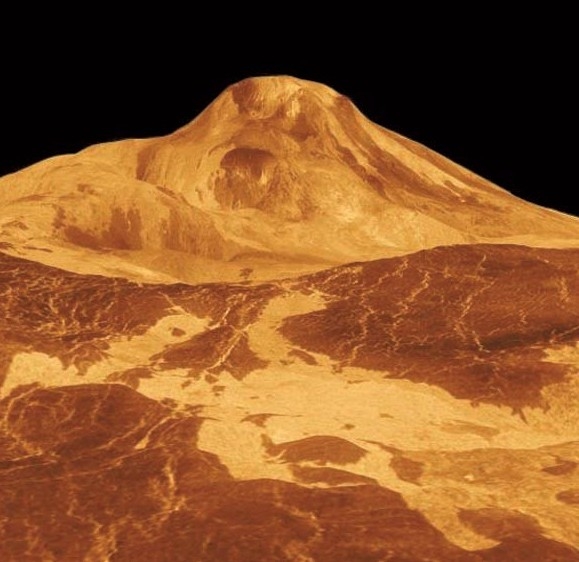
There are many thousands of volcanoes on Venus. Most of the planet’s surface is made up of plains of lava, molten rock from inside the planet that has erupted through volcanoes. Lava flows have cut channels in the ground that look quite similar to river channels. Smaller, dome-shaped volcanoes, known as “pancakes”, can also be found on Venus. These are formed when lava slowly oozes to the surface and cools.

High temperatures
Venus is the hottest world in the Solar System. Its dense atmosphere (the blanket of gases that surrounds it) prevents heat from escaping. The temperature on Venus is always about the same: 490°C (910°F). This is hot enough to melt lead.
Venus Datafile
Average diameter 12,105 km (7519 miles)
Day 243 Earth days
Year 225 Earth days
Distance from the Sun 108 million km (67 million miles) on average
Moons 0
Consultant: Mike Goldsmith
Ready to find out more?
Here is a page in another part of Q-files you might like to explore:
pics
Without in any way limiting Q-files Ltd’s exclusive rights under copyright, any use of this publication to “train” generative artificial intelligence (AI) technologies to generate text is expressly prohibited. Q-files Ltd reserves all rights to license use of this work for generative AI training and development of machine learning language models.