
Canals

CITE
We have made every effort to follow citation style rules, but there may be some minor differences. If in doubt, please refer to the appropriate citation style manual.
Locks. (2026). In Q-files Encyclopedia, Technology, Canals. Retrieved from
https://www.q-files.com/technology/canals/locks
"Locks." Technology, Canals, Q-files Encyclopedia, 13 Mar. 2026.
https://www.q-files.com/technology/canals/locks.
Accessed 9 Nov. 2026.
Locks 2026. Technology, Canals. Retrieved 9 November 2026, from
https://www.q-files.com/technology/canals/locks
Technology, Canals, s.v. "Locks," accessed November 9, 2026.
https://www.q-files.com/technology/canals/locks


Locks
Canals need to be level, so engineering solutions are needed when a canal is built in upland areas. As with railways or motorways, cuttings or tunnels can be dug in order to maintain the canal's path through low hills, with bridges (called canal aqueducts) erected across valleys. To avoid the extra expense of these engineering works, some canals, called contour canals, were built following long, winding routes around hillsides to keep the canal at the same elevation. But in most cases, the construction of a series of "steps" is the only way to take a canal along a straight route across hilly terrain. Vessels can be raised or lowered by lifts or elevators from one step to the other (such as the Falkirk Wheel in Scotland), but in most cases, they use locks. This is as true of narrow inland canals in Britain as it is of the wide canals of Europe or the very largest ship canals like the Panama Canal.
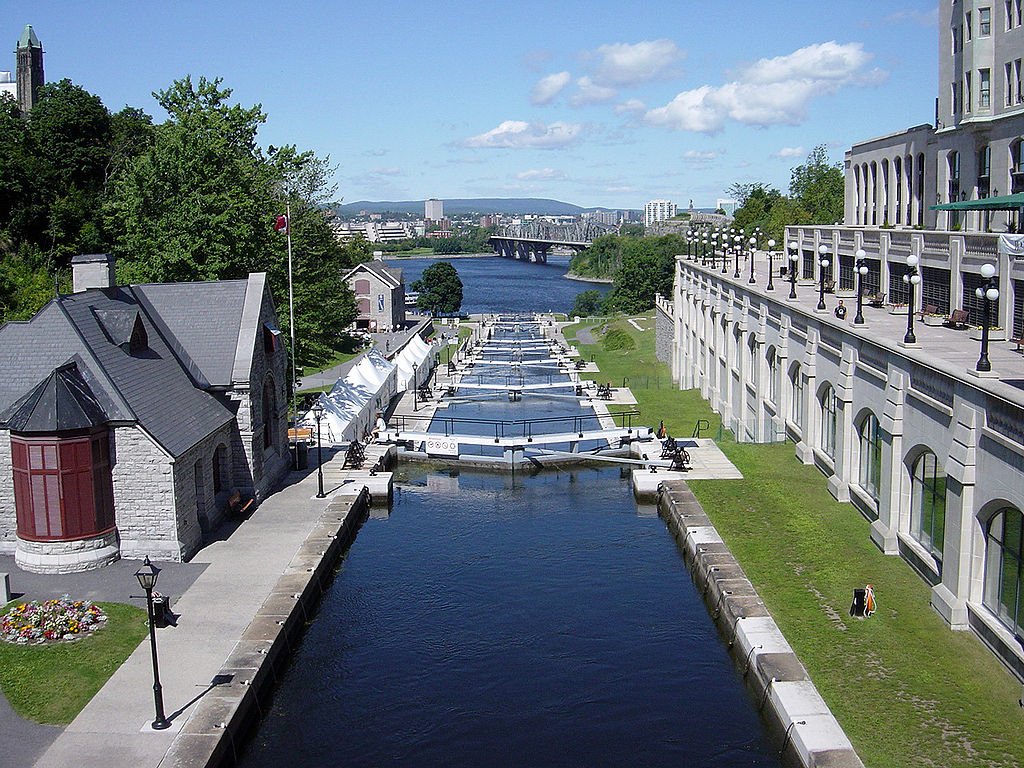
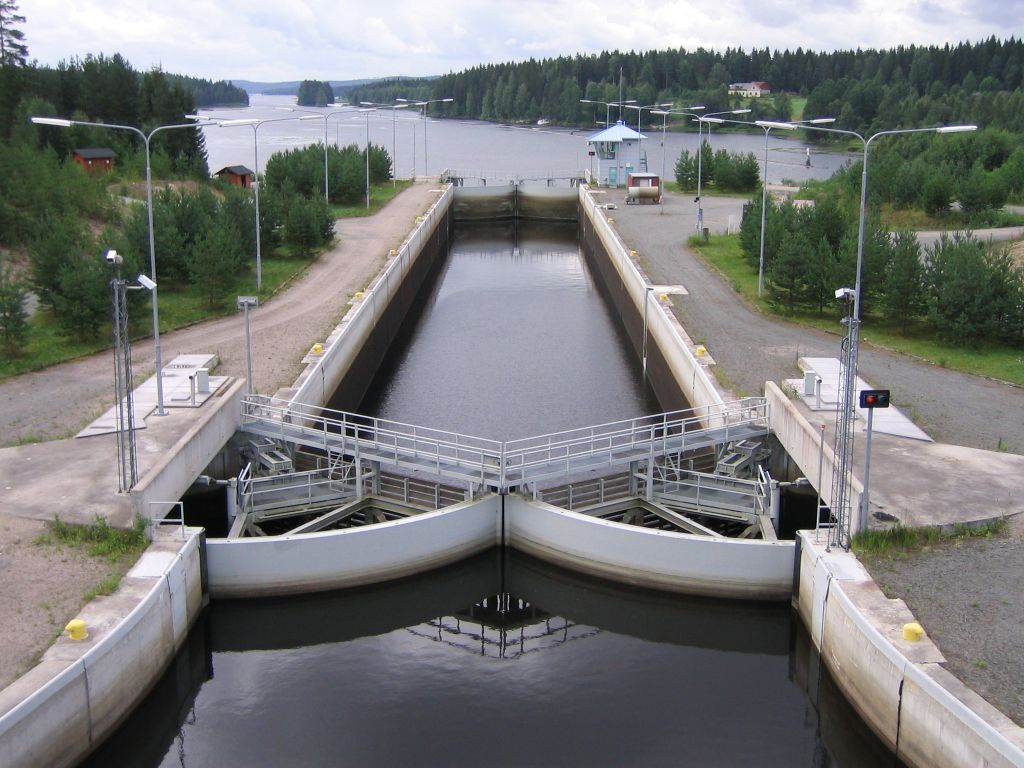

Pound lock
A lock is a device used for raising and lowering vessels between stretches of water of different levels on both rivers and canals. The most common type is the pound lock. This consists of a watertight chamber, called a pound or level, within which the water level can be raised or lowered, connecting two sections of canal at a different elevation, or the canal with a river or the sea. In some places, where the canal runs over a hill, flights of many locks in short succession are built.
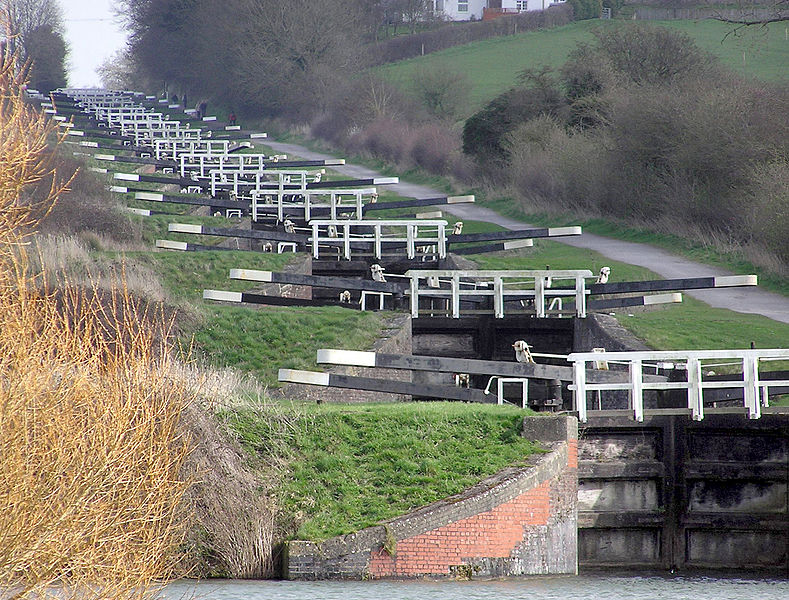
How locks work
The principle of operating a lock is simple. If a boat travelling downstream finds the lock already full of water, the entrance gates are opened and the boat moves into the pound. The entrance gates are then closed behind it. A valve (traditionally, a flat panel or paddle which is lifted by manually winding a rack and pinion mechanism) is opened, draining water from the pound. This lowers the boat. The exit gates are then opened and the boat moves out. If the lock is empty, the boat must wait while the lock is filled with water.
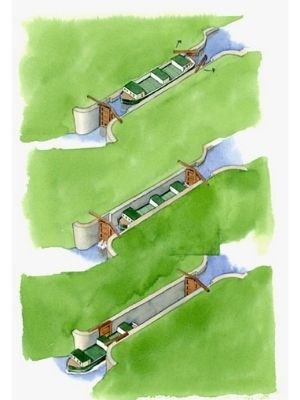
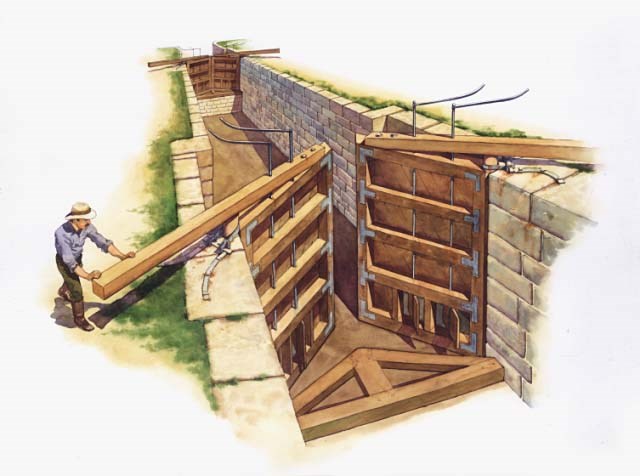
For a boat travelling upstream, the process is reversed: the pound is filled by opening a valve that allows water to enter, raising the boat to the upper level. On large modern canals, especially ship canals, the gates and paddles are too large to be hand operated and are operated by hydraulic or electrical equipment instead.

Lifts
Locks use a lot of water, so where little water is available engineers have come up with other ways of moving boats from one level to another. Boat lifts, such as the Falkirk Wheel in Scotland, use a caisson (watertight chamber) of water in which boats float while being moved between two levels. With an inclined plane, such as at Foxton in Leicestershire (but which is no longer functioning), a caisson is hauled up a steep railway. On the Big Chute, a marine railway on the Trent-Severn Waterway, Ontario, Canada, vessels are transported in a dry carrying frame.


pics
Without in any way limiting Q-files Ltd’s exclusive rights under copyright, any use of this publication to “train” generative artificial intelligence (AI) technologies to generate text is expressly prohibited. Q-files Ltd reserves all rights to license use of this work for generative AI training and development of machine learning language models.