
EASY READ How things work
How does a car engine work?
Many new cars today are electric. They are fitted with batteries that power an electric motor. However, most cars are still powered by engines fuelled by petrol or diesel. These engines are called internal combustion engines. The engine supplies power to turn the wheels. The driver can go faster by pressing the accelerator (or gas) pedal. This increases the flow of fuel to the engine. Gears allow the car to be driven at different speeds without changing the engine speed as much.

Petrol engine
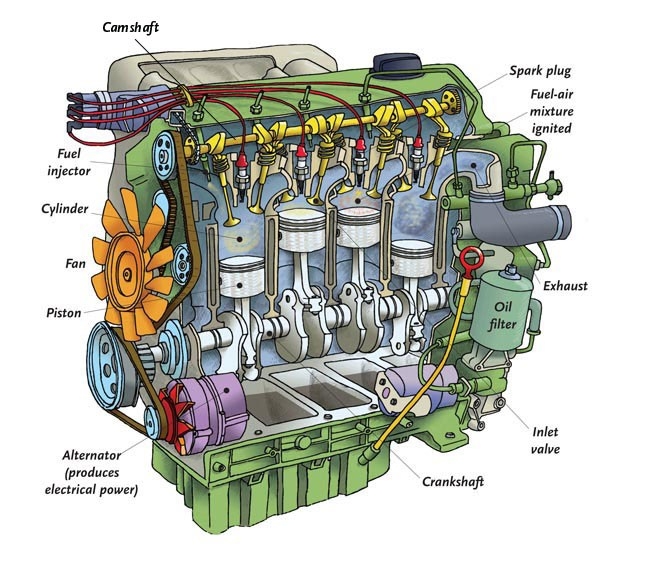
Petrol is drawn from the fuel tank into the engine and sprayed into its cylinders, mixing with air. The petrol-air mixture is ignited by spark plugs, setting off mini-explosions. The hot gases produced force pistons inside the cylinders down.
Four (or more) cylinders spark, one after the other, very quickly. The crankshaft, to which the pistons are attached, turns the up-and-down motion of the pistons into a turning motion. The crankshaft is connected to the wheels, and so the car is driven along.
The four-stroke cycle
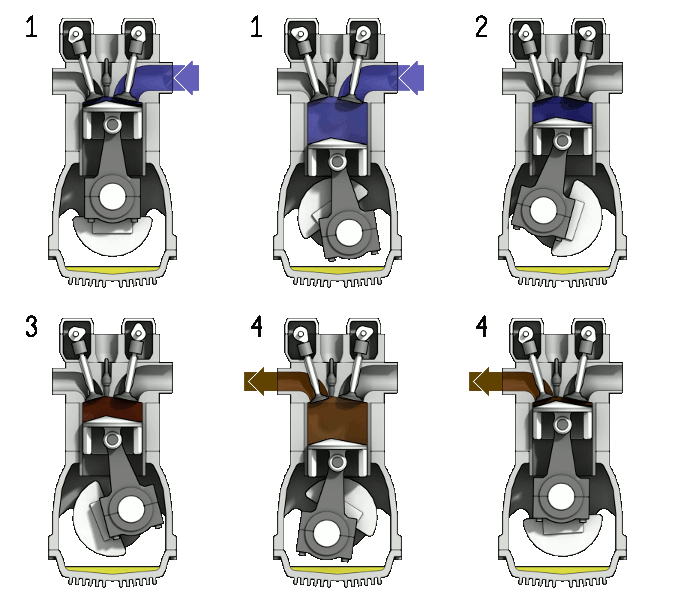
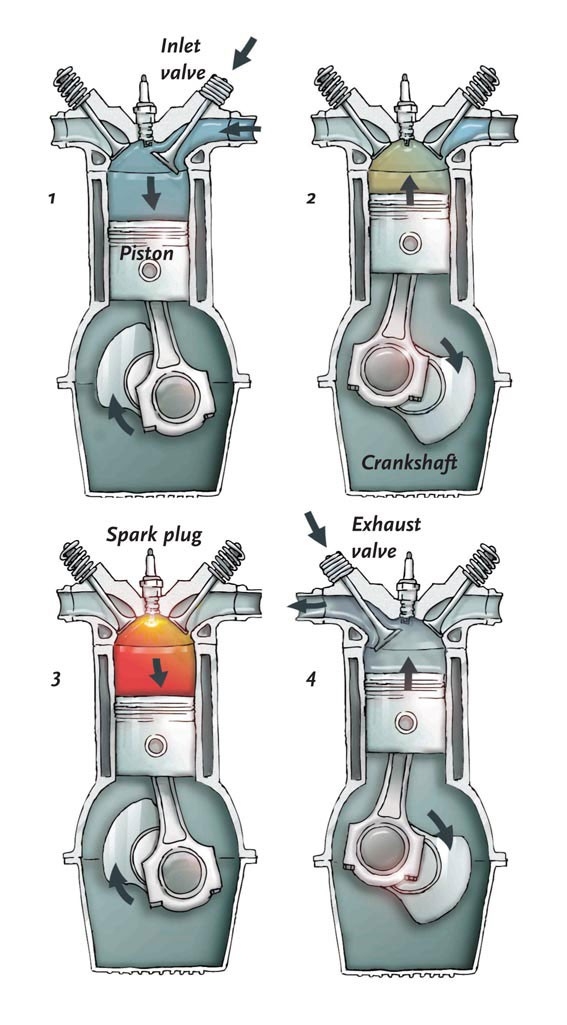
Most petrol engines work on a four-stroke cycle. This is repeated over and over as the pistons move up and down. On the first stroke, as the piston moves down, a valve opens to allow the petrol-air mixture to be sucked into the cylinder. This is the inlet stroke (1). On the second stroke, as the piston moves up, the mixture is squeezed into the top of the cylinder. This is the compression stroke (2).
Now a spark is made by the spark plug, igniting the petrol-air mixture and forcing the cylinder down. This is the ignition stroke (3). On the fourth stroke, the exhaust valve opens to allow waste gases to escape as the piston moves up again. This is the exhaust stroke (4).

Fuel
Most modern motor vehicles are powered by internal combustion engines using either petrol or diesel oil—both fossil fuels—for fuel. But the exhaust gases given off by both these fuels create air pollution. The gases also contain carbon dioxide. Carbon dioxide is a greenhouse gas, which contributes to global warming.
Electric vehicles
An electric vehicle is an alternative to one fuelled by petrol or diesel oil. Instead of an internal combustion engine, the vehicle is fitted with batteries that power an electric motor. The vehicle is “refuelled” by recharging its batteries. No air pollution is emitted directly by the vehicle, and the silent running of the engine cuts down on noise, too.
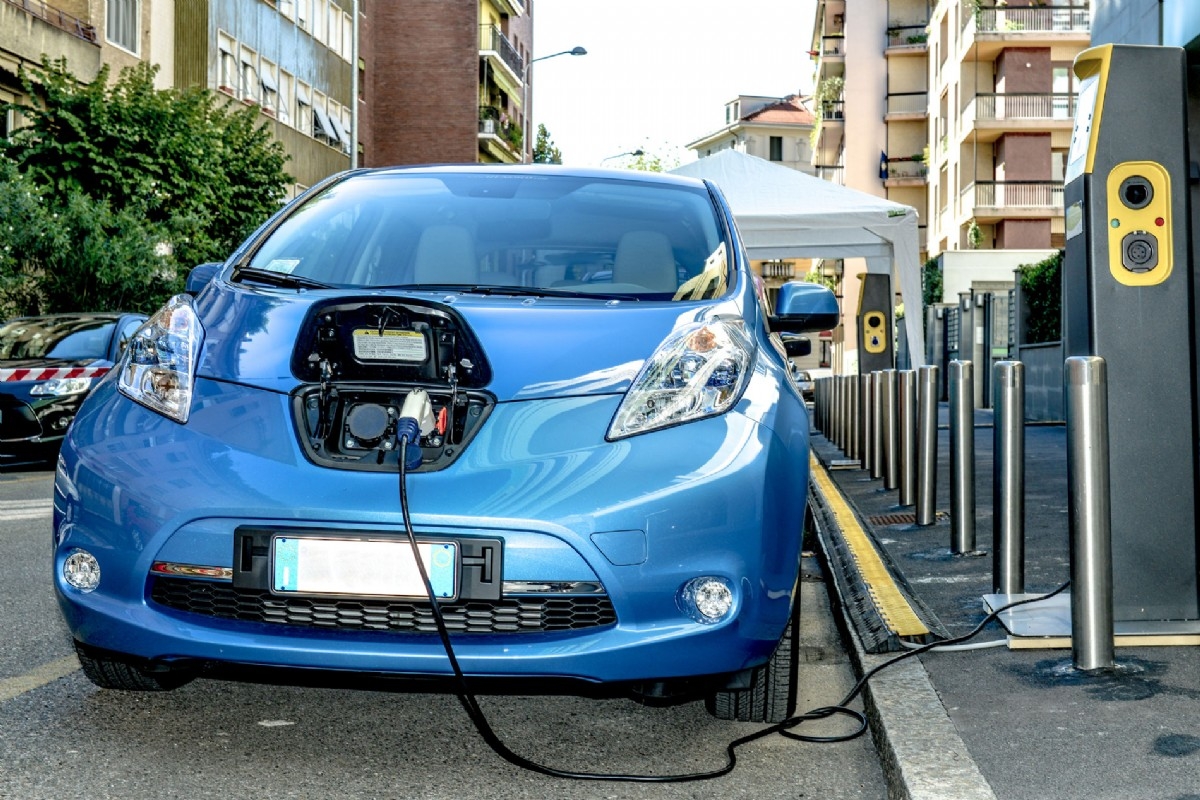
Electric vehicles have a smaller range than petrol or diesel cars between recharging, and the process may take a long time. They also use up more electricity produced by power stations, which may run on fossil fuels.
Consultant: Mike Goldsmith
Ready to find out more?
Here are some pages in other parts of Q-files you might like to explore:
Road transport
Internal combustion engine
Cars
Parts of a car A-Z