
Planet Earth
Earth's magnetic field
The Earth has its own magnetism—an invisible field of magnetic force all around us. Too weak to notice in daily life, the magnetic field affects iron-based materials and other magnets. We can detect it using a magnetic compass. The compass needle is a long, thin magnet that lines itself up with Earth’s magnetism to point north-south. This helps us to read maps and find our way in remote places.

Magnetic poles
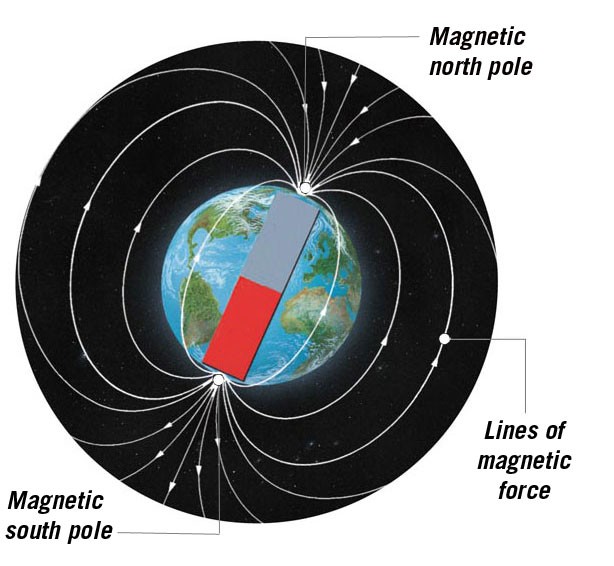
The lines of magnetic force in the Earth's magnetic field run between north and south poles as if there were a bar magnet inside the Earth, tilted at an angle of 11° from its axis of rotation. The North Magnetic Pole is the point on the surface at which the Earth's magnetic field points vertically downwards into the Earth. The Earth's magnetic field changes over time, and both the North Magnetic Pole and the South Magnetic Pole wander around from one year to the next. Luckily, these movements are too slow to affect a compass's usefulness in navigation.
Geomagnetic poles
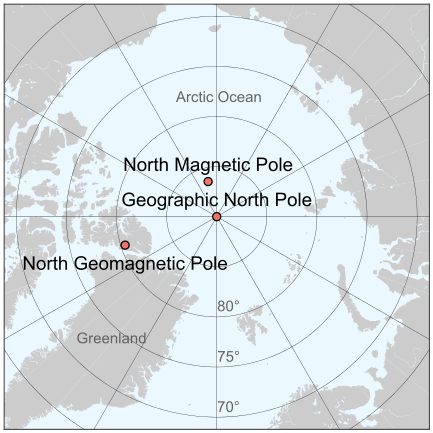
The North and South Geomagnetic Poles are the exact points where the axis of the theoretical "bar magnet" inside the Earth meets the Earth's surface. If the Earth's magnetic field were perfectly symmetrical, then these points would coincide exactly with the North and South Magnetic Poles. However, this is not quite the case, and so the Magnetic and Geomagnetic Poles lie some distance apart. In 2016, the North Geomagnetic Pole was located in Ellesmere Island, Canada, but is slowly drifting away from North America and toward Siberia.
Causes of magnetism
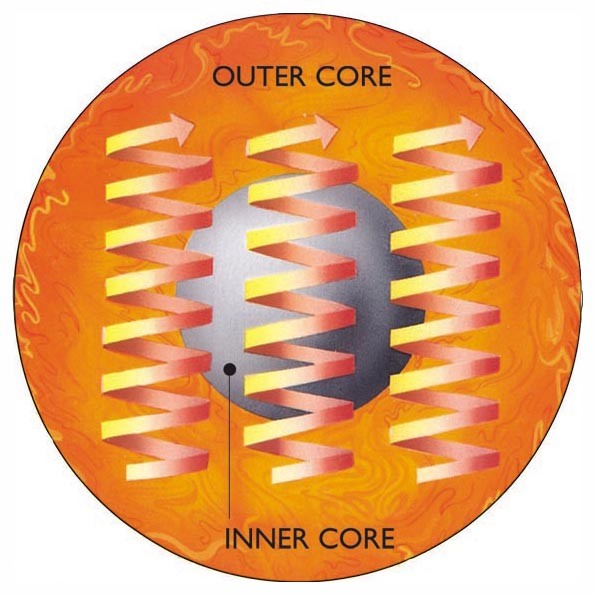
The Earth’s magnetic field is probably created by forces produced in the outer core, a layer of iron that lies some 2900 kilometres (1800 miles) below the surface. Because of extreme pressure at this depth, it is incredibly hot: more than 4000°C (7000°F). At this temperature, the iron is liquid. The iron in the outer core is not, itself, magnetic—no material can stay magnetic at these intensely hot temperatures. It is the convection currents within it that are responsible.
The liquid metal circulates around, moving from the hotter boundary with the inner core to the outer, cooler region and back again. The currents are, themselves, twisted by the spinning motion of the Earth into corkscrew-like patterns, called “rollers”. These giant movements make electricity which, in turn, creates a magnetic field.
Magnetosphere

The Earth’s magnetic field extends into space as the magnetosphere. High-energy particles from the Sun that stream out from the Sun at 1.6 million km/h (1 million mph), known as the solar wind, “blow” against one side of the magnetosphere and make it teardrop-shaped.
Aurorae
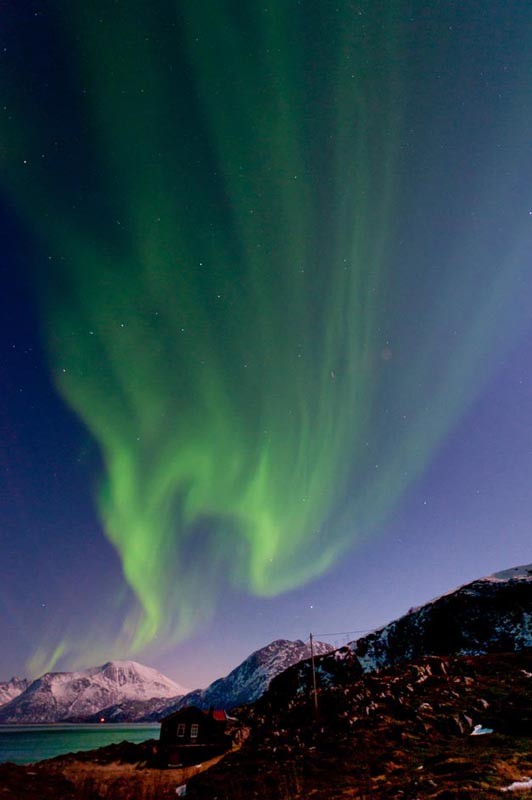
The Earth's magnetic field protects us from the solar wind. Some high-energy particles are attracted by the magnetic poles, however, where they collide with atoms in the atmosphere. This produces giant curtains of glowing light in the night sky, known as aurorae, usually in regions quite close to both north and south poles—sometimes expanding to lower latitudes during a geomagnetic storm, caused by a solar wind shock wave.
Consultant: Ian Fairchild