
EASY READ Famous people

CITE
We have made every effort to follow citation style rules, but there may be some minor differences. If in doubt, please refer to the appropriate citation style manual.
EASY READ Who was Christopher Columbus?. (2025). In Q-files Encyclopedia, History, EASY READ Famous people. Retrieved from
https://www.q-files.com/history/easy-read-famous-people/easy-read-who-was-christopher-columbus
"EASY READ Who was Christopher Columbus?." History, EASY READ Famous people, Q-files Encyclopedia, 5 Dec. 2025.
https://www.q-files.com/history/easy-read-famous-people/easy-read-who-was-christopher-columbus.
Accessed 2 Nov. 2026.
EASY READ Who was Christopher Columbus? 2025. History, EASY READ Famous people. Retrieved 2 November 2026, from
https://www.q-files.com/history/easy-read-famous-people/easy-read-who-was-christopher-columbus
History, EASY READ Famous people, s.v. "EASY READ Who was Christopher Columbus?," accessed November 2, 2026.
https://www.q-files.com/history/easy-read-famous-people/easy-read-who-was-christopher-columbus


Who was Christopher Columbus?
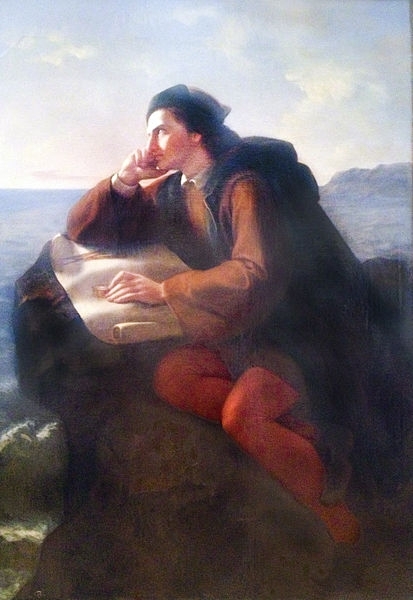
In 1492 Christopher Columbus (1451–1506) sailed west across the Atlantic Ocean. He was hoping to find a sea route to East Asia, the lands of spices and silks. These lands were known to Europeans as the Indies. When Columbus set foot on land after crossing the ocean, he was certain that he had reached the Indies. He had, in fact, landed in the Americas, a continent then unknown to Europeans.

Early life
Christopher Columbus was born in the Republic of Genoa in 1451. In those days, Genoa was an independent state with its own language (he was known as Christoffa Corombo). Columbus went to sea before he was 20. He later travelled to England, and, possibly, Iceland, before moving to work as a trader in Lisbon, Portugal. Hungry for knowledge, Columbus read widely about astronomy, geography and history, including the works of Claudius Ptolemy and the travels of Marco Polo.
Between 1482 and 1485, Columbus sailed along the coast of West Africa, reaching present-day Ghana. His African expedition inspired him to make plans for a great new voyage.
Sailing west
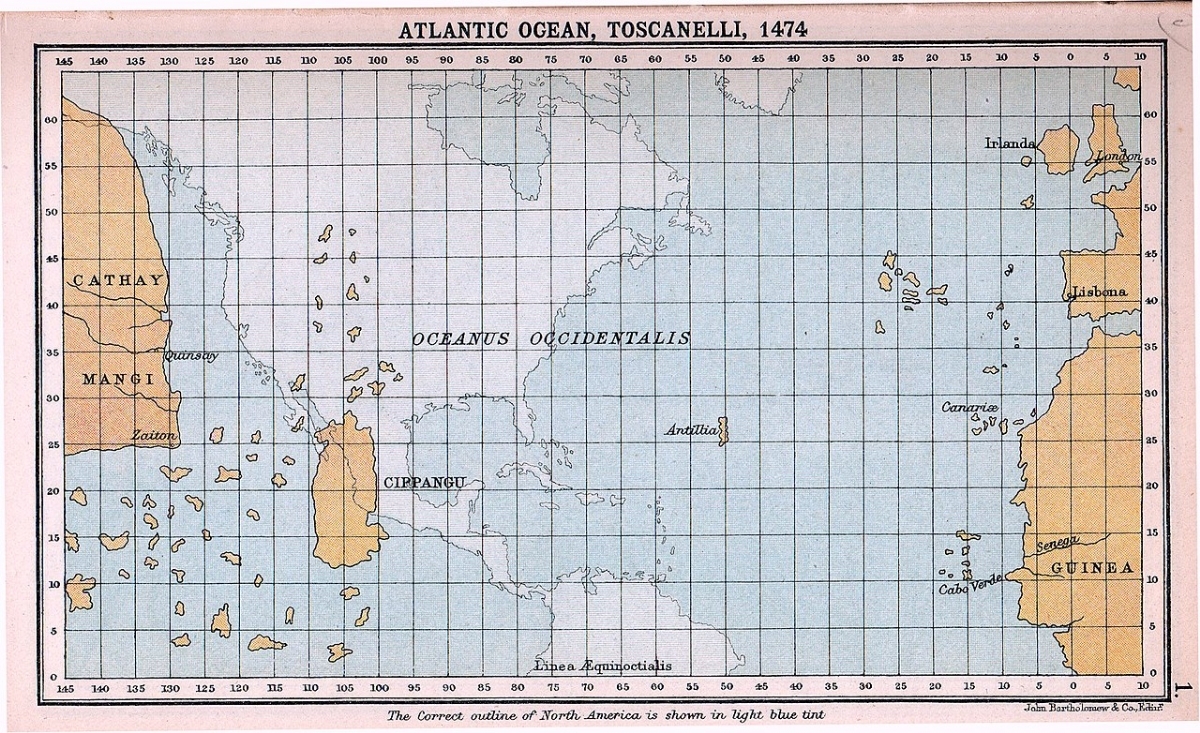
In Columbus's time, Europeans were looking for a trade route to Asia, where valuable goods such as silk and spices could be found. Going by land was too difficult and dangerous, so sea routes were explored. The Portuguese searched for an eastern route around Africa, but Columbus thought there was a quicker way. Knowing the world was round—like most educated people at the time—Columbus worked out that East Asia lay only about 3700 kilometres (2300 miles) travelling west across the Atlantic Ocean (in fact, the distance is about 20,000 kilometres or 12,000 miles).
No one in Europe knew of the existence of the Americas, and Columbus had no idea that his voyage westward would lead him to a new continent.
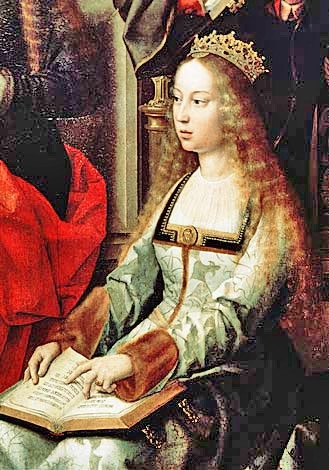
Columbus presented his plan to King John II of Portugal, but the king thought that Columbus had miscalculated the size of the Atlantic Ocean and refused to back him. Columbus then turned to King Ferdinand and Queen Isabella of Spain for help. Eager to compete with Portugal for trade with the Far East, the Spanish monarchs agreed to finance his voyage.
First voyage
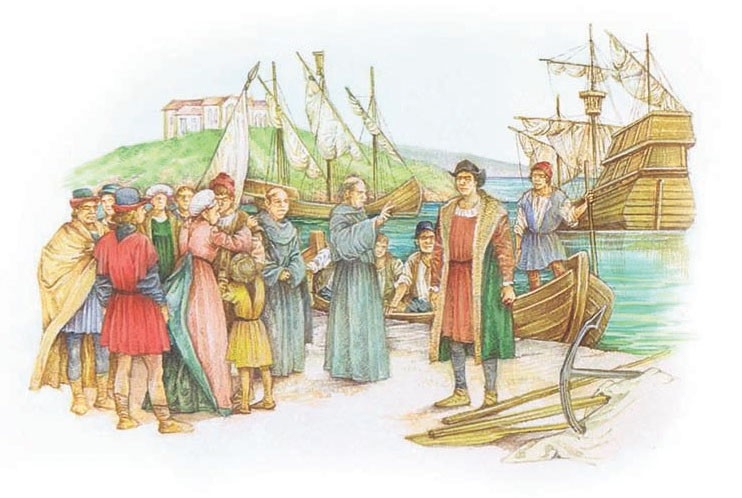
Columbus's fleet sailed from Palos, Spain, 3rd August 1492 with three ships under his command: the flagship Santa María and the Niña and Pinta.

On the voyage, Columbus pretended to his nervous crew they were nearer Spain than they really were.
After several false alarms, land was sighted in October. The crew landed on a tiny island which they named San Salvador (“Holy Saviour”). Here they met friendly natives.
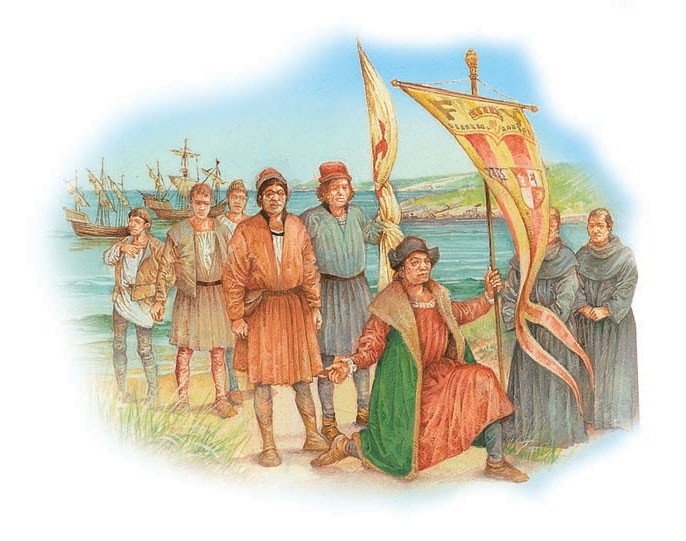
Thinking he had arrived in the East Indies, Columbus called the native peoples “Indians”. He was disappointed, however, not to find the busy Chinese ports he had expected. In fact, Columbus was in what we today call the Bahamas, in the Caribbean Sea. He had reached the Americas.

Cuba and Hispaniola
The men sailed on to Cuba, which was inhabited by the friendly Taino people. The Europeans were amazed to discover that they slept in hanging beds called hammocks and smoked tobacco leaves. In November, the Pinta's crew deserted the expedition, disappointed that no treasure had been found.

In December, the Santa María was wrecked off the island of Hispaniola (today the Dominican Republic and Haiti). He ordered his men to build a fort on the island and left some of them behind before heading back to Spain aboard the Niña. Columbus took some Taino people with him. They were greeted with amazement in the court of Ferdinand and Isabella.
Second voyage
Following Columbus's triumphant return to Spain, Ferdinand and Isabella made him the governor of the new islands he had discovered. Six months later, in September 1493, Columbus set out for Hispaniola once more, this time with a large fleet of 17 ships and a crew of over 1000 men.
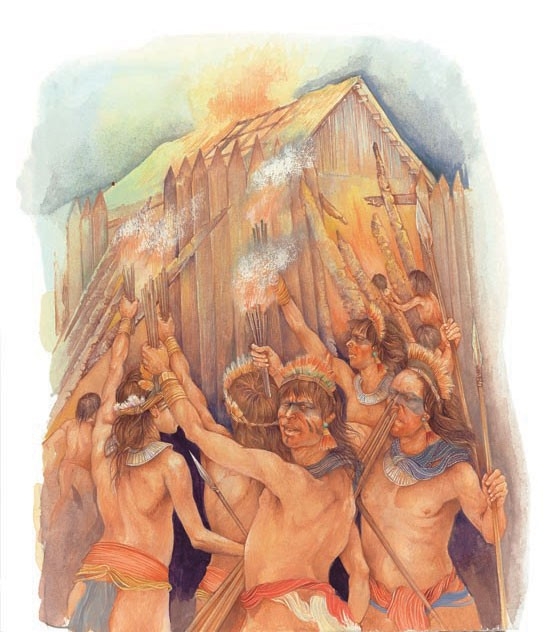
When Columbus arrived, he discovered that the Taino people had destroyed the fort that had been built before he left. They had also killed all of his men. He decided to build a new settlement, but the Tainos rebelled. Many were killed in the battles that followed. Still more died from diseases brought to the islands from Europe.
Before sailing back to Spain, Columbus explored the south coast of Cuba and reached Jamaica.
Third and fourth voyages

Columbus made two more voyages to the Caribbean, still searching for a sea route to the Far East. He discovered the coastline of mainland South America and Central America, but was unable to find a passage through to Asia. Tired and disappointed, Columbus returned to Spain in 1504. He died on 20th May 1506.
Consultant: Philip Parker
Ready to find out more?
Here are some pages in other parts of Q-files you might like to explore:
Christopher Columbus
Age of Discovery
pics

Without in any way limiting Q-files Ltd’s exclusive rights under copyright, any use of this publication to “train” generative artificial intelligence (AI) technologies to generate text is expressly prohibited. Q-files Ltd reserves all rights to license use of this work for generative AI training and development of machine learning language models.