
EASY READ Famous people

CITE
We have made every effort to follow citation style rules, but there may be some minor differences. If in doubt, please refer to the appropriate citation style manual.
EASY READ Who was Thomas Edison?. (2026). In Q-files Encyclopedia, History, EASY READ Famous people. Retrieved from
https://www.q-files.com/history/easy-read-famous-people/easy-read-who-was-thomas-edison
"EASY READ Who was Thomas Edison?." History, EASY READ Famous people, Q-files Encyclopedia, 1 May. 2026.
https://www.q-files.com/history/easy-read-famous-people/easy-read-who-was-thomas-edison.
Accessed 1 Nov. 2026.
EASY READ Who was Thomas Edison? 2026. History, EASY READ Famous people. Retrieved 1 November 2026, from
https://www.q-files.com/history/easy-read-famous-people/easy-read-who-was-thomas-edison
History, EASY READ Famous people, s.v. "EASY READ Who was Thomas Edison?," accessed November 1, 2026.
https://www.q-files.com/history/easy-read-famous-people/easy-read-who-was-thomas-edison


Who was Thomas Edison?
Thomas Alva Edison (1847–1931) was an American inventor. Some of his inventions were improvements on those that already existed. He turned them into versions that could be widely used. His inventions included the earliest sound recording device, called the phonograph, a greatly improved telephone and an electric light bulb that worked better than anything that had gone before.


Early career
Thomas Alva Edison was born in Ohio in 1847, and grew up in Michigan. He did badly at school, so his mother, a teacher, taught him at home. At the age of 12, Thomas was selling snacks and sweets on the railway. By the age of 14, he was producing and selling his own newspaper, the Grand Trunk Herald, on a train. With the money he made he set up a chemistry laboratory at home. (When his mother complained, he moved the chemicals to the locker room on the train where he was working.)
Telegraph operator
In 1862, aged 15, Edison worked full-time as a telegraph operator. At that time, the telegraph was the fastest way to send messages. It worked by sending electrical pulses representing letters in Morse Code along wires. In 1869, Edison made his first invention: an automatic vote-counting machine.

Telephone

Edison’s early success as an inventor meant he was able to set up his own research laboratory in Menlo Park, New Jersey in 1876. There Edison worked out a way to improve the sound of Alexander Graham Bell’s great invention, the telephone.
Bell’s telephone was not very clear. Early users had to shout to make themselves heard. In his invention, Bell used a piece of parchment that vibrated (shook) when sounds were made into it. Edison found that using carbon granules worked much better. This improvement remained a basic part of a phone for the next 100 years.
Phonograph
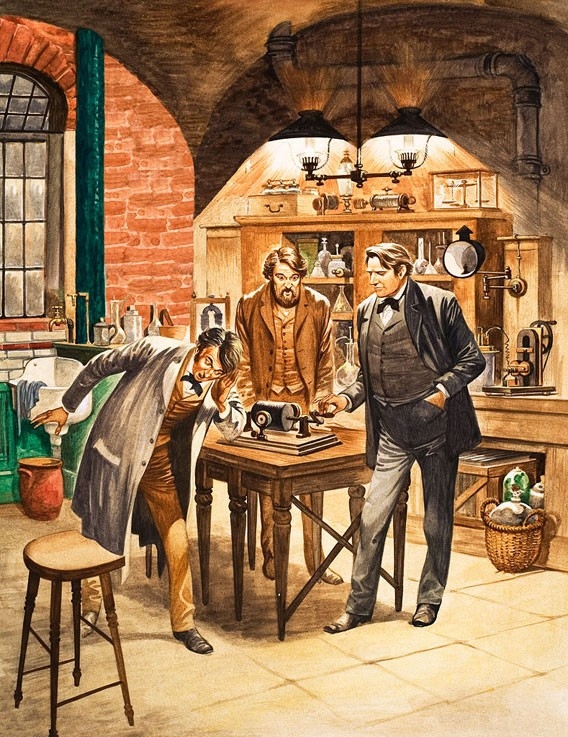
Edison re-used the parts of the improved telephone he invented to create the first recording machine. His phonograph was like a telephone, but the vibrating parts were linked to a steel needle.
As Edison spoke into a horn, the needle "wrote" the pattern of vibrations by etching them on to a piece of tinfoil wrapped round a drum. This was turned at the same time. When the needle was returned to the beginning of the written message and the drum turned again, the pattern etched in the foil made the needle vibrate in the same way. The telephone parts also vibrated and the sound came back out of the horn.
Edison called his new invention the phonograph. The first recorded sound he made on it was heard in 1877, when Edison recited the nursery rhyme “Mary had a little lamb”.
Electric light
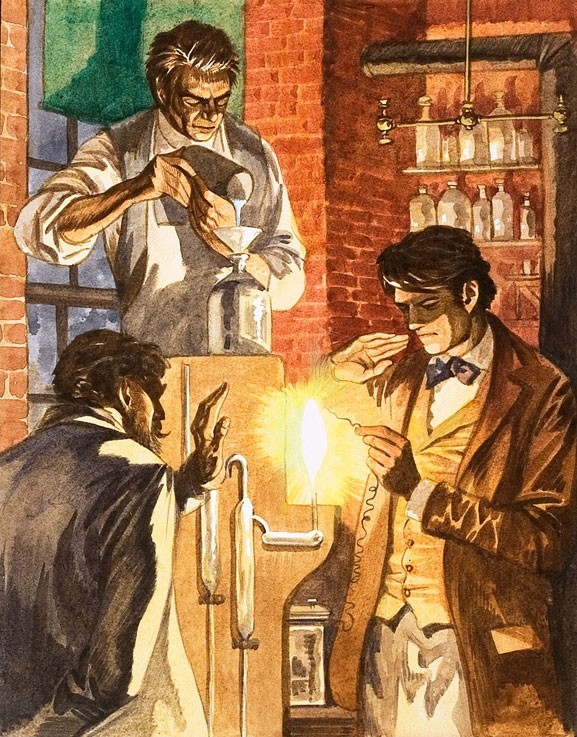
Edison did not invent electric lighting, but the improvements he introduced made his version a success. About the same time as Edison was working on his version, the British inventor Joseph Swan (1828–1914) produced a working electric light bulb. Swan’s light was made by passing an electric current through a carbon filament (a thin strand) inside a glass vacuum. The carbon filament became so hot it glowed—although it needed a lot of electricity to make it do so. Edison's version, which he demonstrated in 1879, used a very fine filament (actually made of bamboo). This needed much less electricity.
Power station

Edison went on to use Michael Faraday’s discovery of how to generate electricity to build a powerful generator. In 1882, the Pearl Street Station, the first power station in the USA, began supplying electricity to light up nearly 100 buildings in Manhattan. All the machinery, including six huge generators, was designed and installed by Edison and his team at the Menlo Park laboratory.

Kinetoscope
Edison continued to work on many inventions almost until his death in 1931. In 1891 he invented an early form of motion picture, the Kinetoscope. It was the first successful moving-picture machine. Only one person at a time could view through an eyepiece as the sequence of photographs on a strip of film wound past.
Ready to find out more?
Here are some pages in other parts of Q-files you might like to explore:
Thomas Edison
Sound recording
Early history of telecommunications
Consultant: Philip Parker
pics

Without in any way limiting Q-files Ltd’s exclusive rights under copyright, any use of this publication to “train” generative artificial intelligence (AI) technologies to generate text is expressly prohibited. Q-files Ltd reserves all rights to license use of this work for generative AI training and development of machine learning language models.