
EASY READ World history

CITE
We have made every effort to follow citation style rules, but there may be some minor differences. If in doubt, please refer to the appropriate citation style manual.
EASY READ What did knights do?. (2025). In Q-files Encyclopedia, History, EASY READ World history. Retrieved from
https://www.q-files.com/history/easy-read-world-history/easy-read-what-did-knights-do
"EASY READ What did knights do?." History, EASY READ World history, Q-files Encyclopedia, 5 Dec. 2025.
https://www.q-files.com/history/easy-read-world-history/easy-read-what-did-knights-do.
Accessed 1 Nov. 2026.
EASY READ What did knights do? 2025. History, EASY READ World history. Retrieved 1 November 2026, from
https://www.q-files.com/history/easy-read-world-history/easy-read-what-did-knights-do
History, EASY READ World history, s.v. "EASY READ What did knights do?," accessed November 1, 2026.
https://www.q-files.com/history/easy-read-world-history/easy-read-what-did-knights-do


What did knights do?
Knights were fighting men of the Middle Ages. They were ranked lower than nobility, but higher than merchants. A knight served a king or lord, promising his loyalty at all times. In return, he received land. He underwent many years of training to learn fighting skills. He was expected to follow a code of chivalry. When not fighting wars, knights took part in tournaments, where jousting contests were held.


Chivalry
Knights were “gentlemen soldiers”. The first knights were soldiers who rode into battle on horseback rather than on foot. This gave them the advantage of speed.
Knights were expected to follow a code of chivalry. This meant they had a duty to defend the weak and show courtesy, especially towards women. Many knights, however, failed to live up to these high standards.
Armour
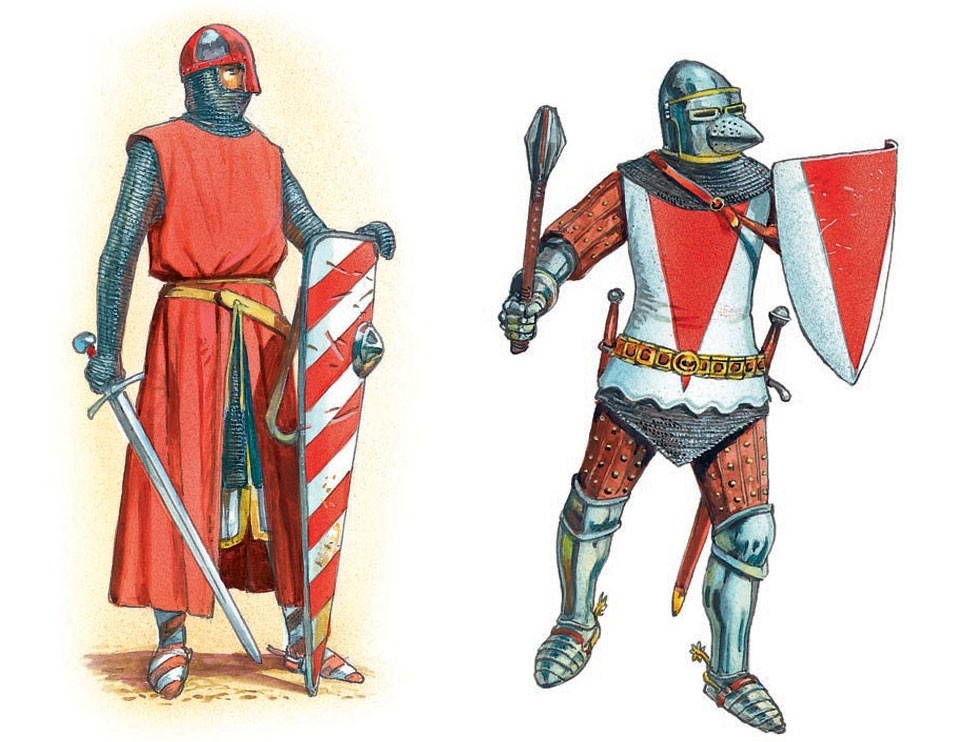
At first, a knight’s armour was made of chainmail, a body suit made of metal rings. By the 1300s, knights wore solid armour plates on their chest, arms and upper legs for extra protection. Their helmets also had a visor to protect the face. This could be raised.
Then, from the late 15th century onwards, knights began to wear a complete suit of metal armour plates. The suits were jointed together so that the knight could still bend his legs and swing his sword or mace.

Battle
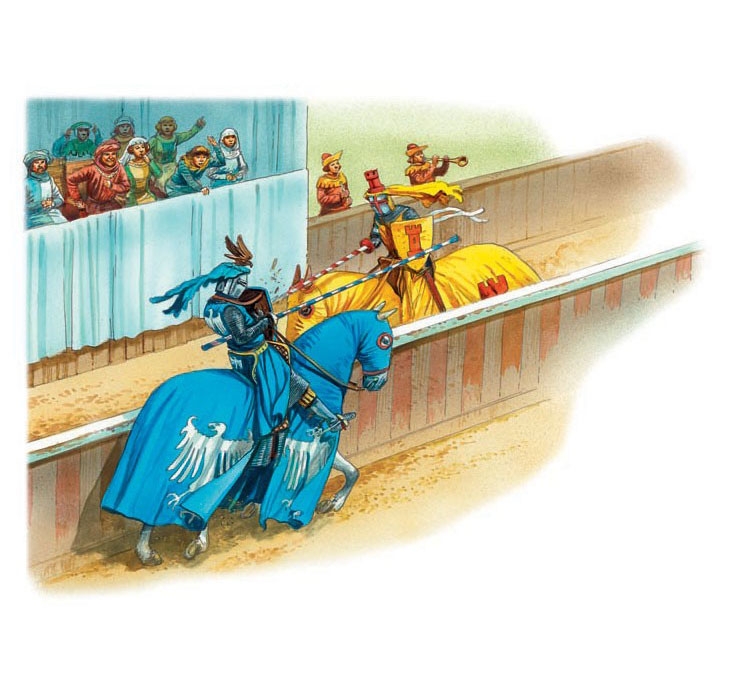
A knight’s horse was itself often well-protected with armour. In battle, a knight would attack his opponent with a lance and knock them from his horse. Then he wielded his sword. Some knights used a mace (a heavy club with spiked ends) against the enemy.


Coat of arms
When wearing full armour, knights tended to look the same. So, to make sure they were not attacked by their own men—or so that they could be identified at a tournament—the knights wore the colours of their own noble family. These were called arms. Their shield, armour and sometimes even their horse were decorated with arms. The surcoat a knight wore over his armour was known as his coat of arms. The design was contained within the shape of a shield.
Tournaments
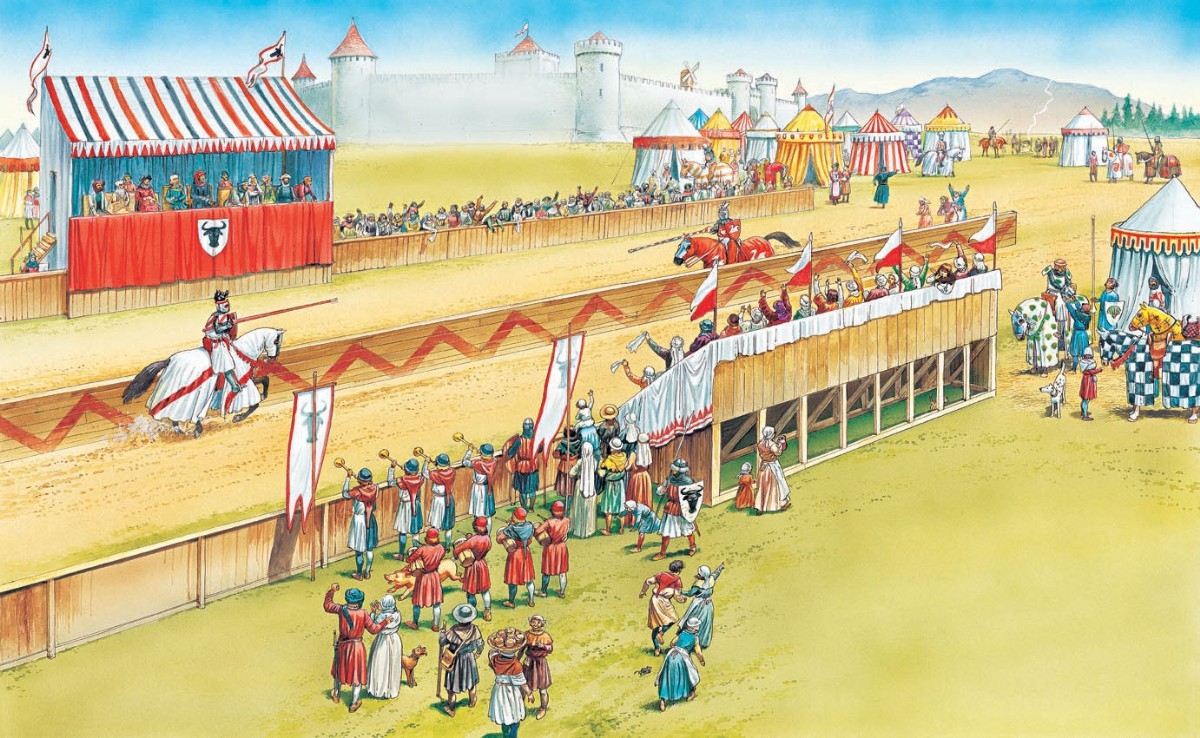
A knight would travel up and down the land fighting mock battles in what were known as tournaments. They were opportunities for a knight to practise his fighting skills in readiness for war, as well as show off his prowess in combat.
Joust
The joust was just one event at a tournament. Two knights, mounted on horseback at a distance of 300 paces apart, charged towards each other either side of a barrier called a tilt. They each aimed to knock their opponent off his horse using a lance, a blunted wooden spear. Points were scored for striking his body, with double points for breaking the lance on his shield or helmet.
Becoming a knight


Only the son of a knight could grow up to be a knight. At the age of 7, he was sent to work in the household of another knight or noble lord as a page. His tasks included helping his master dress and serving food at mealtimes. At 14, the page became a squire, a knight's personal servant. While learning fighting skills from his master, he polished his armour, sharpened his weapons and dressed him for combat.
Ready to find out more?
Here are some pages in other parts of Q-files you might like to explore:
Heraldry
Knights
Knights' armour
Squires
Tournaments
Consultant: Philip Parker
pics
Without in any way limiting Q-files Ltd’s exclusive rights under copyright, any use of this publication to “train” generative artificial intelligence (AI) technologies to generate text is expressly prohibited. Q-files Ltd reserves all rights to license use of this work for generative AI training and development of machine learning language models.