
EASY READ World history

CITE
We have made every effort to follow citation style rules, but there may be some minor differences. If in doubt, please refer to the appropriate citation style manual.
EASY READ When did Kublai Khan rule China?. (2025). In Q-files Encyclopedia, History, EASY READ World history. Retrieved from
https://www.q-files.com/history/easy-read-world-history/easy-read-when-did-kublai-khan-rule-china
"EASY READ When did Kublai Khan rule China?." History, EASY READ World history, Q-files Encyclopedia, 5 Dec. 2025.
https://www.q-files.com/history/easy-read-world-history/easy-read-when-did-kublai-khan-rule-china.
Accessed 13 Sep. 2026.
EASY READ When did Kublai Khan rule China? 2025. History, EASY READ World history. Retrieved 13 September 2026, from
https://www.q-files.com/history/easy-read-world-history/easy-read-when-did-kublai-khan-rule-china
History, EASY READ World history, s.v. "EASY READ When did Kublai Khan rule China?," accessed September 13, 2026.
https://www.q-files.com/history/easy-read-world-history/easy-read-when-did-kublai-khan-rule-china


When did Kublai Khan rule China?
During the 1200s, the Mongols swept into China. Under their leader, Kublai Khan, the Mongols founded a new dynasty, called the Yuan, in 1271. By 1279, the Song dynasty, rulers of China since 960, was no more. Kublai Khan set up his new capital at Cambaluc (modern-day Beijing).


Kublai Khan
Kublai Khan was a wise and tolerant ruler. He allowed different religions, including Buddhism, Islam and Christianity, to be followed by the Chinese people. Muslim scholars, astronomers, doctors and scientists were welcome in the Yuan court.
Kublai organized food stores for times of famine, rebuilt the Grand Canal and improved the roads so that trade could increase. He also introduced a paper currency, called chao. This made collecting taxes much easier.
Xanadu
Kublai Khan’s summer palace at Shangdu (also called Xanadu) was the height of splendour. The great palace had marble and gold walls and its golden ceilings were studded with rubies and diamonds. Kublai Khan encouraged foreigners to visit his magnificent court. They included the young traveller from Venice, Marco Polo.


Marco Polo
Marco Polo arrived from Venice with his father and uncle in 1275. He became Kublai Khan’s loyal servant for 18 years and travelled round the Chinese Empire. Marco saw many wonders. He was most impressed by Kinsai (Hangzhou), “City of Heaven”, with its many canals and bridges. It was a city far larger than any in Europe. Marco later wrote a book about his amazing travels.
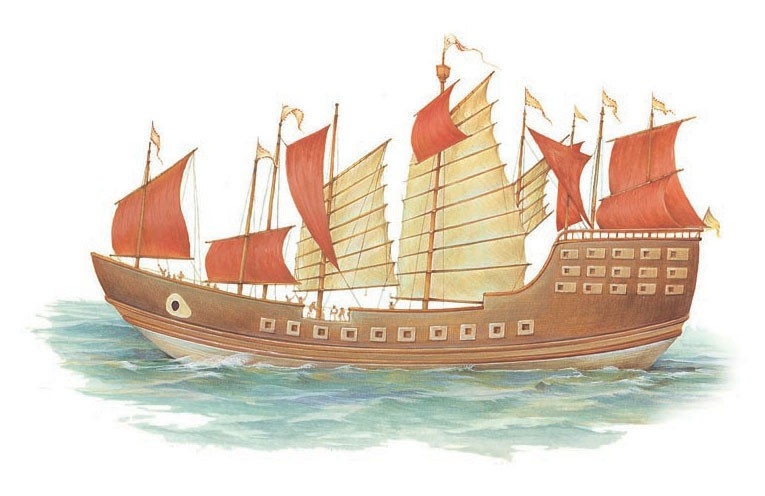
Junks
Marco Polo sailed round the coast of Asia in a sturdy Chinese boat called a junk. Junks had sails supported by bamboo masts. The largest could carry 600 people. During the 15th century, the Chinese explorer Zheng He sailed to India, Arabia and Africa in a large junk said to be 150 metres (500 feet) long. It had nine masts.
End of Mongol rule
Kublai Khan tried to invade Japan, but his fleets were defeated twice. This failure, together with the death of his wife and son, was a serious blow. After Kublai's death in 1294, the Mongol emperors who came after him ruled harshly. Rebellions by the people eventually drove the Mongols out of China. A Buddhist monk, Zhu Yuanzhang, seized power in 1368. He took the name of Emperor Hongwu and founded the Ming dynasty.

Ready to find out more?
Here are some pages in other parts of Q-files you might like to explore:
China in the Middle Ages
Mongol Empire
Marco Polo
Famous leaders A-Z
Consultant: Philip Parker
pics
Without in any way limiting Q-files Ltd’s exclusive rights under copyright, any use of this publication to “train” generative artificial intelligence (AI) technologies to generate text is expressly prohibited. Q-files Ltd reserves all rights to license use of this work for generative AI training and development of machine learning language models.