
EASY READ United States history

CITE
We have made every effort to follow citation style rules, but there may be some minor differences. If in doubt, please refer to the appropriate citation style manual.
EASY READ Where did the Native Americans live?. (2025). In Q-files Encyclopedia, History, EASY READ United States history. Retrieved from
https://www.q-files.com/history/easy-read-united-states-history/easy-read-where-did-the-native-americans-live
"EASY READ Where did the Native Americans live?." History, EASY READ United States history, Q-files Encyclopedia, 5 Dec. 2025.
https://www.q-files.com/history/easy-read-united-states-history/easy-read-where-did-the-native-americans-live.
Accessed 13 Sep. 2026.
EASY READ Where did the Native Americans live? 2025. History, EASY READ United States history. Retrieved 13 September 2026, from
https://www.q-files.com/history/easy-read-united-states-history/easy-read-where-did-the-native-americans-live
History, EASY READ United States history, s.v. "EASY READ Where did the Native Americans live?," accessed September 13, 2026.
https://www.q-files.com/history/easy-read-united-states-history/easy-read-where-did-the-native-americans-live


Where did the Native Americans live?
The Native Americans, also known as American Indians, Amerindians, or First Nations in Canada, were descendants of the first Americans. These were the people who first crossed into Alaska from Siberia in Asia by foot from around 26,000 years ago onwards. They later spread southwards across the continent. By the time Europeans arrived in the Americas at the beginning of the 16th century, there were already millions of Native American people living there.


Tribes
Over the centuries, Native American people branched out to form a patchwork of nations and tribes. Each tribe had its own language, religious beliefs and customs. The people made the best of the various environments they chose to live in: forests, grassy plains, arid scrubland or lush river valleys. Many tribes lived by hunting animals such as buffalo and deer, or by gathering berries, roots and other wild plants. Others were farmers, growing maize, squash, beans and other crops.
The Northeast
The Northeast of what is now the United States was once inhabited by two main groups of Native Americans: the Iroquois and the Algonquians. The Iroquoian tribes were frequently at war with their Algonquian neighbours—or each other. Conflicts worsened when European colonizers arrived and started to supply weapons in return for beaver furs.


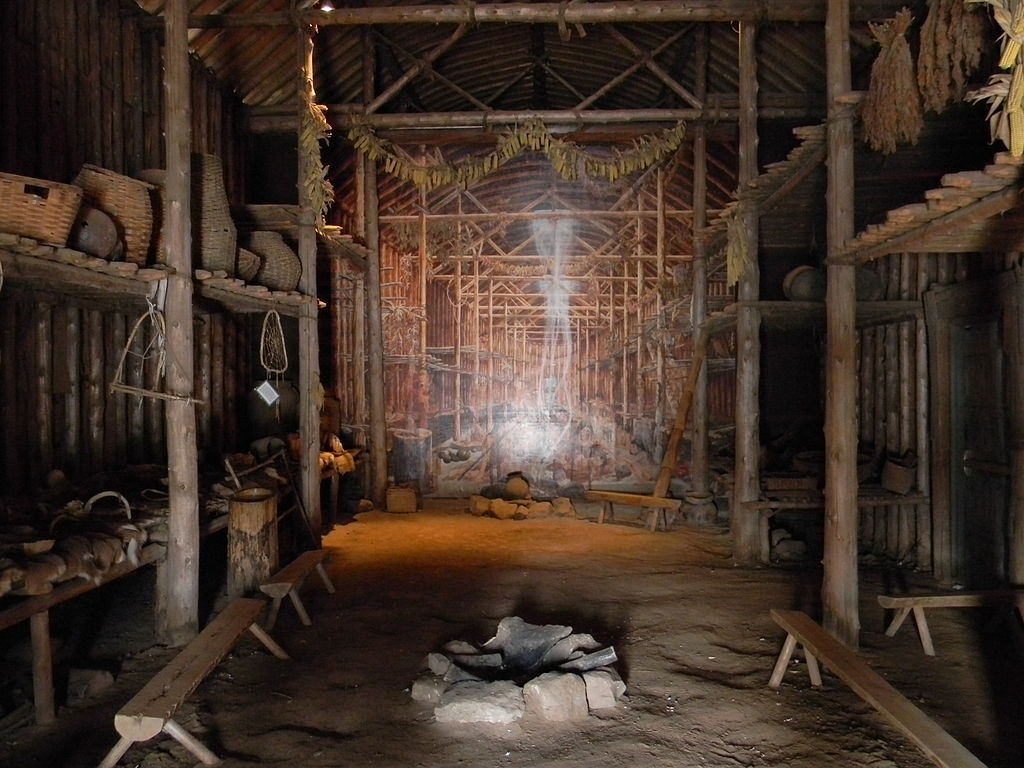
Both Iroquois and Algonquians lived in wooden longhouses surrounded by a high fence called a palisade. Some Algonquian tribes slept in wigwams - shelters - made from bent saplings and covered with deerskins, during the summer months. The people of the Northeast lived by a mixture of hunting (birds, beaver and deer), gathering (nuts, berries and seafood), fishing and farming. Many cultivated maize, beans and squash.
The Southeast
The area of what is now the southeastern United States—north of the Gulf of Mexico and east of the Mississippi—offered fertile farmland and plentiful rain. The Cherokee, a southeastern people, were expert farmers, growing crops such as maize, squash, beans, sunflowers and tobacco. Their houses were made of wooden frames, with mud and grass filling the walls.


Ceremonies took place in the centre of villages. The people danced, prayed, fasted, feasted and played stickball. Stickball was similar to modern lacrosse, but the ball was carried and thrown with two sticks rather than one. The ball was made of a rock covered with animal hide. Versions of stickball were played by many other tribes of the southeast.
The Plains
Buffalo (more correctly, bison) provided the Great Plains tribes, such as the Sioux, Cheyenne and Comanche, with most of their food. The animals' skins, fur and bones were useful for making clothes, tipis (shelters), weapons and tools. To hunt these animals, the hunters herded them towards a strong wooden enclosure, called a corral, they had already built. As the buffalo approached the corral, the hunters prodded them with spears to make them run into it.


The most common dwelling for these buffalo hunters was the cone-shaped tipi. This was a tent made of buffalo skin that could be folded up and carried from one hunting ground to the next, using a sledge called a travois.

The Spanish settlers brought horses to the Plains in the 16th century. Horses quickly became prized possessions among the Plains Indians. A man on horseback could now gallop alongside a running buffalo, bringing it down with a spear or bow and arrow.
The Southwest
Some of the inhabitants of the American Southwest had lived in settlements called pueblos for centuries. These villages were made up of of multi-storey houses built of adobe (dried mud) and stone. Water was scarce, so they looked for supplies deep beneath the ground. These Pueblo peoples grew crops such as maize, beans and squash.


Other southwestern peoples, such as the Navajo and the Apache, settled in the region much later. They were hunter-gatherers rather than farmers. The Navajo lived in shelters called hogans, cone-shaped, wooden-framed structures covered in dried mud. The Apache built wikiups, round shelters with a wooden frame covered in brush or cloth. The Apache and Navajo fought one another frequently.

California
California was, as it is today, a fertile land with a temperate climate. Because of the easy availability of food, a large population of some 300,000 people, made up of more than 300 tribes, lived here peacefully. They did not need to cultivate crops, living instead by hunting, fishing, and gathering. But they did practise “forest gardening”: planting trees, shrubs and plants that provided food.
Northwest
The northwest Pacific coast has a mild climate. The ocean and rivers were full of fish, whales, dolphins, seals, otters and shellfish, so there was no need for the people who lived there to travel in search of other game. The local peoples built large villages housing hundreds. People were ranked according to both how closely they were related to the village’s chief and how many possessions, including canoes, shells, skins, canoes and slaves, they had.
Some northwestern peoples carved totem poles. From the start of the 19th century, craftworkers carved giant monuments from large trees; some stood up to 18 metres (60 feet) tall. The carvings depicted family stories, animals and historical events.


The arrival of Europeans
The way of life for nearly all Native Americans changed forever following the arrival of Europeans. Even before Europeans started to settle in the Americas, Native Americans perished in their millions from diseases such as smallpox, influenza, measles and plague. These were introduced by European explorers and sailors during the 16th century. Unlike Europeans, Native Americans had no immunity to these diseases. Up to 90% of the native population was wiped out.
As European settlement expanded in the 19th century—especially in the fertile southeastern North America—the Native Americans were forced from their lands. They were to move west of the Mississippi River, where, at first, few white settlers chose to venture. Meanwhile, in lands ruled by the Spanish, the Southwest and California, the Native Americans who survived disease were forced to work for the Spanish colonists as slaves.


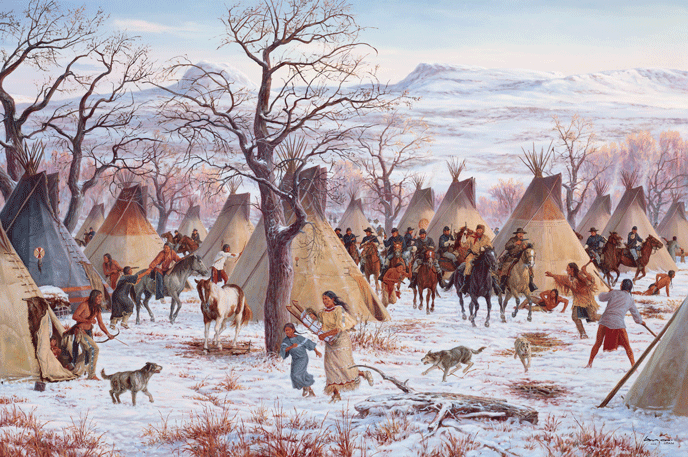
In the 19th century, as the United States expanded all the way to the Pacific Ocean, white Americans started to settle in the West, too. The Native Americans who lived on the Great Plains, the Plains Indians, did not want to move from their homelands and fought bitterly against American government troops who tried to force them off. This conflict, which was at its fiercest from the 1860s until around 1890, is known today as the American Indian Wars.
Consultant: Philip Parker
Ready to find out more?
Here are some pages in other parts of Q-files you might like to explore:
Native Americans
Timeline of Native American history
Sioux
Iroquois
pics
Without in any way limiting Q-files Ltd’s exclusive rights under copyright, any use of this publication to “train” generative artificial intelligence (AI) technologies to generate text is expressly prohibited. Q-files Ltd reserves all rights to license use of this work for generative AI training and development of machine learning language models.