
EASY READ United States history

CITE
We have made every effort to follow citation style rules, but there may be some minor differences. If in doubt, please refer to the appropriate citation style manual.
EASY READ When did Europeans start to settle in North America?. (2025). In Q-files Encyclopedia, History, EASY READ United States history. Retrieved from
https://www.q-files.com/history/easy-read-united-states-history/easy-read-when-did-europeans-start-to-settle-in-north-america
"EASY READ When did Europeans start to settle in North America?." History, EASY READ United States history, Q-files Encyclopedia, 5 Dec. 2025.
https://www.q-files.com/history/easy-read-united-states-history/easy-read-when-did-europeans-start-to-settle-in-north-america.
Accessed 30 Oct. 2026.
EASY READ When did Europeans start to settle in North America? 2025. History, EASY READ United States history. Retrieved 30 October 2026, from
https://www.q-files.com/history/easy-read-united-states-history/easy-read-when-did-europeans-start-to-settle-in-north-america
History, EASY READ United States history, s.v. "EASY READ When did Europeans start to settle in North America?," accessed October 30, 2026.
https://www.q-files.com/history/easy-read-united-states-history/easy-read-when-did-europeans-start-to-settle-in-north-america


When did Europeans start to settle in North America?
Soon after Columbus first landed in the Americas in 1492, Europeans set off to explore what they called the “New World”. The Italian Amerigo Vespucci sailed down the eastern coast of South America. By 1502 he realised that the lands Columbus had discovered were part of a new continent. We get the name "America" from his first name. Spain conquered vast parts of Central and South America and claimed them for its empire: "New Spain". Meanwhile, other European countries, England, France and the Netherlands, claimed lands in eastern North America.

French colonies
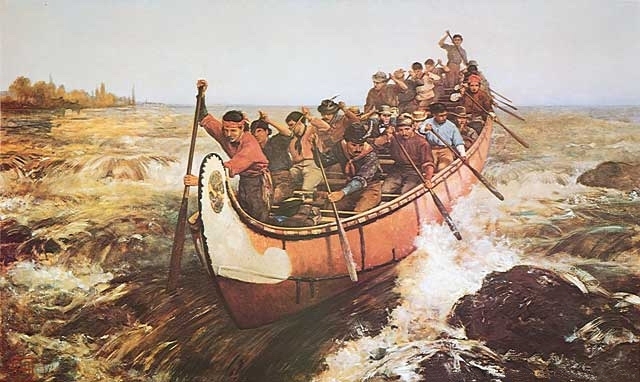
During the first half of the 16th century, French explorers arrived on the northeast coast of North America. Some ventured up the St Lawrence River, claiming all the lands they discovered for France. By the 1600s people had begun to settle in the lands known as “New France” (now southeastern Canada). The colonists lived by trading furs with Native Americans.

The vast American interior still remained unexplored. Frenchman René-Robert de la Salle was keen to expand French territory. He travelled south down the Mississippi River, reaching its mouth in 1682. La Salle placed a wooden cross in the ground and proudly claimed the entire Mississippi lowlands for France. He named it Louisiana in honour of King Louis XIV.
Spanish colonies
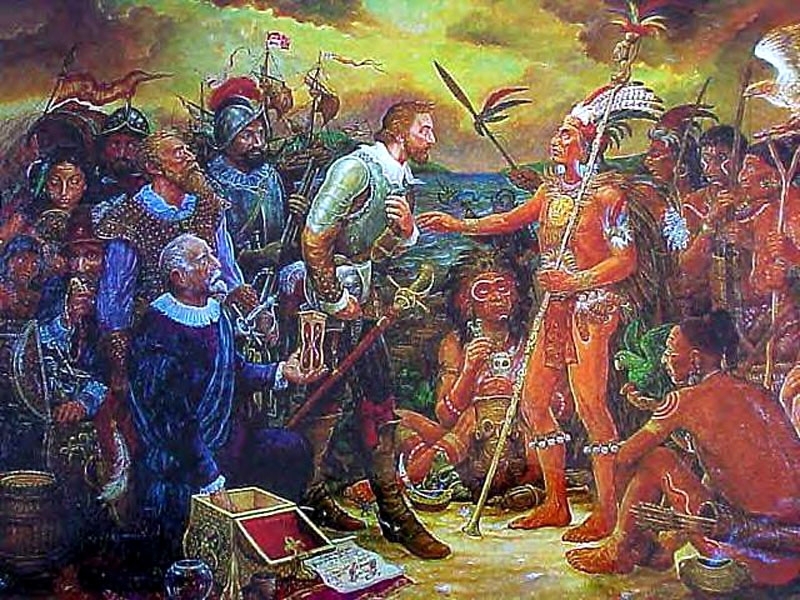
Following their conquest of the Aztecs in 1521, Spain claimed much of what is now the southwestern United States, as well as Mexico. The territory became part of New Spain. Spanish explorers journeyed inland, up the Pacific coast and around the shores of the Gulf of Mexico. The first Spanish settlement, Saint Augustine, was founded in Florida in 1565. By 1610, another was established at Santa Fe in New Mexico. But, finding no gold or silver in these lands, most settlers from Spain headed for Mexico instead.

English colonies
The first permanent English settlement in North America was Jamestown, Virginia. It was founded in 1607. In the early days many settlers died, but the survivors were eventually able to make a living from growing and selling tobacco.
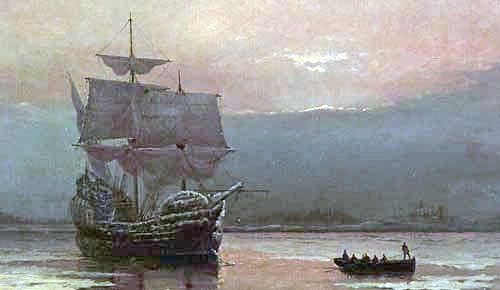
Other groups of colonists came to North America searching for the freedom to practise their religion. The first to arrive, the Pilgrims, sailed on a ship called the Mayflower and settled in Plymouth, Massachusetts, in 1620. Much larger numbers of Puritans settled in what became known as New England between 1629 and 1642. From the 1680s onwards, British and German people flocked to Pennsylvania, a colony set up by Englishman William Penn and offering religious freedom.
Dutch colonies
Nieuw-Nederland, or New Netherland, was a colony founded by Dutch settlers in 1614. The colony's capital, New Amsterdam, founded in 1625, was at the southern tip of the island of Manhattan. The town was captured by the English in 1664. They took full control of the colony ten years later and renamed it New York.


French and Indian War
The French and Indian War (1754–63) was fought in North America between Britain and France. The British and French colonists argued over who should own the lands around the Great Lakes region. The French were outnumbered by the British, so they made alliances with Native American warriors to help them in battle. But the British were victorious, and took over all France's lands in North America east of the Mississippi River.
Thirteen Colonies
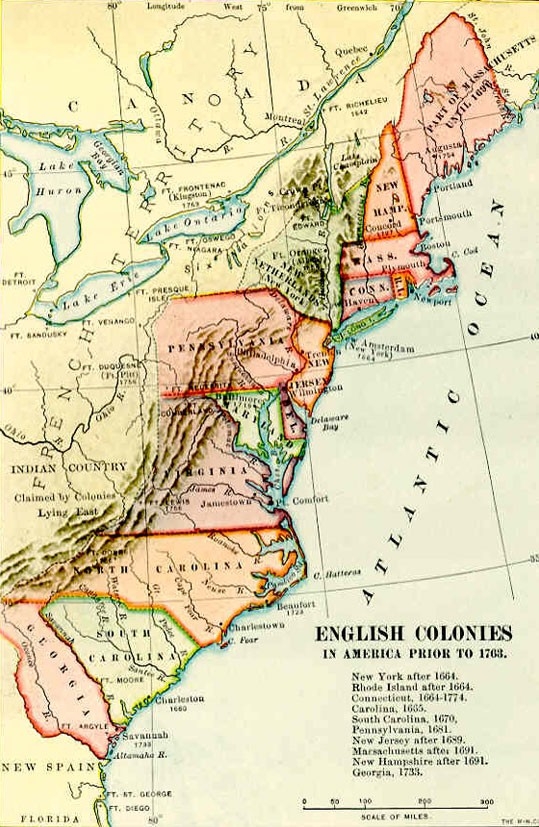
By the early 18th century, a number of separate British colonies had been founded along the east coast (sometimes called the eastern seaboard) of North America. The Thirteen Colonies, as they were called, stretched from New England in the north to Georgia in the south.
Although they remained loyal to Britain, the Thirteen Colonies began to work together to demand their rights. United against the rule of King George III, they declared independence from Britain in 1776 and formed the United States of America.
Consultant: Philip Parker
Ready to find out more?
Here are some pages in other parts of Q-files you might like to explore:
North American exploration
European settlement of America
Timeline of US history
Timeline of Canadian history
pics

Without in any way limiting Q-files Ltd’s exclusive rights under copyright, any use of this publication to “train” generative artificial intelligence (AI) technologies to generate text is expressly prohibited. Q-files Ltd reserves all rights to license use of this work for generative AI training and development of machine learning language models.