
EASY READ United States history

CITE
We have made every effort to follow citation style rules, but there may be some minor differences. If in doubt, please refer to the appropriate citation style manual.
EASY READ Who were the first Americans?. (2025). In Q-files Encyclopedia, History, EASY READ United States history. Retrieved from
https://www.q-files.com/history/easy-read-united-states-history/easy-read-who-were-the-first-americans
"EASY READ Who were the first Americans?." History, EASY READ United States history, Q-files Encyclopedia, 5 Dec. 2025.
https://www.q-files.com/history/easy-read-united-states-history/easy-read-who-were-the-first-americans.
Accessed 13 Sep. 2026.
EASY READ Who were the first Americans? 2025. History, EASY READ United States history. Retrieved 13 September 2026, from
https://www.q-files.com/history/easy-read-united-states-history/easy-read-who-were-the-first-americans
History, EASY READ United States history, s.v. "EASY READ Who were the first Americans?," accessed September 13, 2026.
https://www.q-files.com/history/easy-read-united-states-history/easy-read-who-were-the-first-americans


Who were the first Americans?
The history of the first Americans, the first people who settled in the Americas, dates back to around 26,000 years ago. European settlers came much later, after Christopher Columbus landed in the Bahamas in 1492. The Europeans found a continent inhabited by many hundreds of nations and tribes that make up the Native American population (also known as American Indians, Amerindians or, in Canada, First Nations). They were all descendants of people who had crossed into North America from Siberia during the Ice Ages: the first Americans.


Ice Age wanderers
The Ice Ages began around 2.6 million years ago, and lasted until about 11,500 years ago. During this time, the climate became so cold that ice sheets spread out from the poles and covered huge areas of the world. Humans lived in lands just to the south of the ice sheet, hunting mammoth and other animals. They did not live in one place, but wandered far and wide searching for prey.
During the Ice Ages, so much of the Earth's water had turned to ice that there was very little rain. The oceans shrank, leaving behind new areas of land. In those days it was possible to walk from northeastern Siberia to Alaska—and that is exactly what some people did. They followed their prey who also made their way into North America via this route. Centuries later, as the ice sheets melted, these people, the first Americans, headed south.

Hunter-gatherers
Over the years, people spread out to all parts of the Americas. Some eventually travelled down to the very tip of South America. They lived by hunting mammoths, mastodons, bison, sloths, tapirs—whatever animals they could find living in the forests or on the Great Plains. They used spears. Their stone spearpoints can still be found today. The particular shapes they are carved in give scientists clues to the date when the hunters lived.


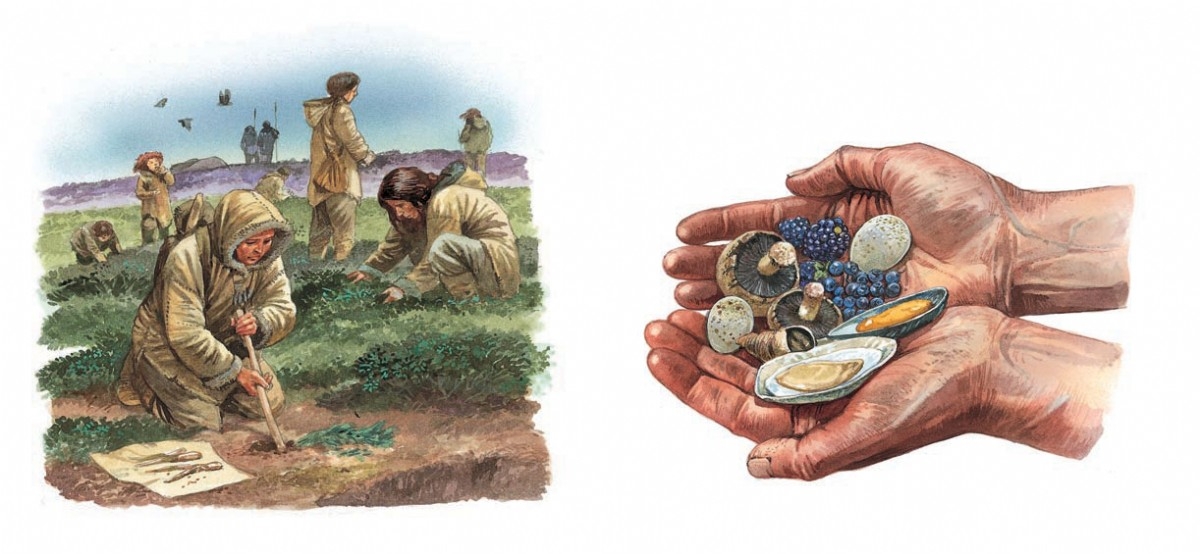
By around 10,000 years ago, mammoths, mastodons and other giant animals had all died out. (Hunters had probably helped them go extinct). In some areas, people became more settled, moving around much less. They started to search for their food—small animals such as deer and rabbits, fish, wild vegetables, nuts, berries and other plants—in their immediate surroundings.
Earth mounds
Thousands of years later, some of the settlements in parts of what is now central and southern United States grew quite large: 1000 or so inhabitants. The people built their houses on top of mounds of earth, grouped around a central "plaza". This flat, open area might have been used for ceremonies of some kind. We know something about these people because of the tools and ornaments they made.


Pueblo people
Some settled peoples turned to growing crops. The first to do so lived around 2000 BC. They started to cultivate maize (later, squash and beans) in what is now the “Four Corners” region of the United States (southeastern Utah, northeastern Arizona, northwestern New Mexico and southwestern Colorado). Because the climate was hot and dry, they dug channels to bring water from the rivers to their crops.
The farmers lived in villages with their families. Spanish explorers—who arrived many centuries later—called these villages pueblos. To begin with, shelters were deep pits covered by roofs made of dried mud and stone. Later, the Pueblo villagers made buildings out of adobe (mudbrick) and stone. They were divided up into rooms. The houses surrounded a central courtyard called a kiva.


Woodland people
People living to the east of the Rocky Mountains started to grow crops later: around 1000 BC. They built earth mounds as burial places for their honoured dead. People lived in villages made of circular wooden houses with bark-covered roofs. They still hunted deer, birds and other small game, and gathered nuts and seeds. But they also cultivated pumpkins, squash and sunflowers in clearings they made in the dense woodland.
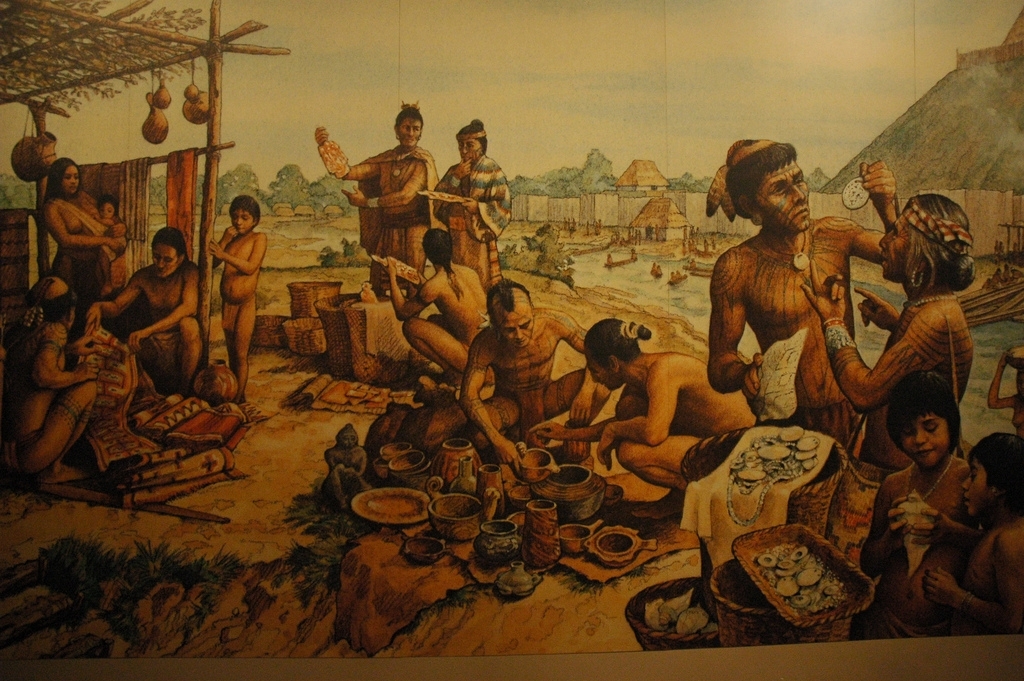
The people traded goods with peoples from other parts of the country: copper from the Great Lakes region and shells from the Gulf of Mexico. Traders travelled along rivers. Craftworkers made necklaces and fine pottery from these new materials.
Mississippians

Beginning around 1000 AD, a patchwork of chiefdoms started to emerge in the Mississippi lowlands. The Mississippians had long cultivated maize in the fertile soils. The plentiful food was enough to feed the population of large cities. Cahokia, in present-day Illinois, grew to become a city of between 20,000 and 30,000 inhabitants. Traders travelled out from Cahokia in all directions to buy and sell goods.
We do not know what happened to the Mississippians and their great civilization. Probably by around the year 1400 the onset of drought—and possibly the outbreak of war—had forced many of the people to move away from their cities. Many Native American tribes are descended from these Mississippian peoples.
Consultant: Philip Parker
Ready to find out more?
Here are some pages in other parts of Q-files you might like to explore:
When did people first settle in the Americas?
Ancient North America
Timeline of Native American history
pics

Without in any way limiting Q-files Ltd’s exclusive rights under copyright, any use of this publication to “train” generative artificial intelligence (AI) technologies to generate text is expressly prohibited. Q-files Ltd reserves all rights to license use of this work for generative AI training and development of machine learning language models.