
Story of humans

CITE
We have made every effort to follow citation style rules, but there may be some minor differences. If in doubt, please refer to the appropriate citation style manual.
When did people first settle in the Americas?. (2026). In Q-files Encyclopedia, Prehistoric, Story of humans. Retrieved from
https://www.q-files.com/prehistoric/story-of-humans/when-did-people-first-settle-in-the-americas
"When did people first settle in the Americas?." Prehistoric, Story of humans, Q-files Encyclopedia, 11 Mar. 2026.
https://www.q-files.com/prehistoric/story-of-humans/when-did-people-first-settle-in-the-americas.
Accessed 6 Aug. 2026.
When did people first settle in the Americas? 2026. Prehistoric, Story of humans. Retrieved 6 August 2026, from
https://www.q-files.com/prehistoric/story-of-humans/when-did-people-first-settle-in-the-americas
Prehistoric, Story of humans, s.v. "When did people first settle in the Americas?," accessed August 6, 2026.
https://www.q-files.com/prehistoric/story-of-humans/when-did-people-first-settle-in-the-americas


When did people first settle in the Americas?
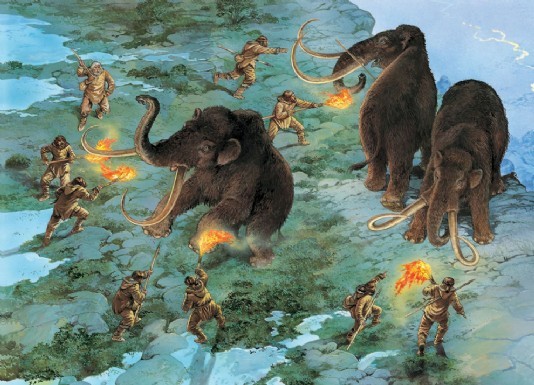
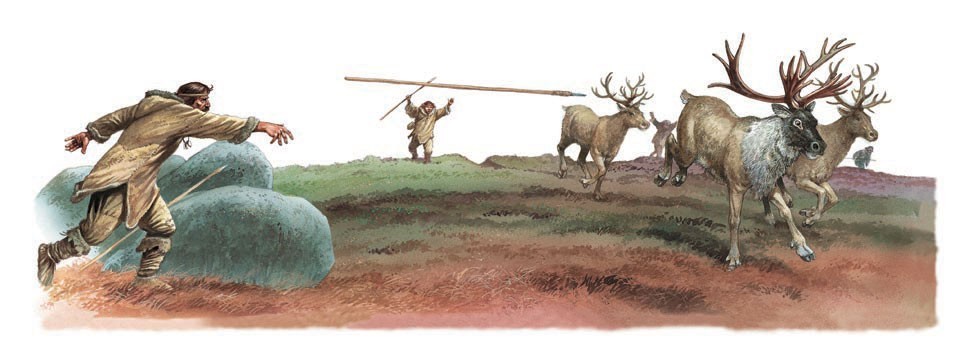
Homo sapiens—modern people—first arrived in North America possibly around 26,500 years ago; the dates are uncertain. During the Ice Ages, the sea level was lower than it is today. It was possible to walk from northeastern Siberia to Alaska. Hunters followed their prey—mammoth, deer and other animals—from Asia into this new land. Over the years, people spread out to all parts of the Americas. Where game was plentiful, in forests and on the Great Plains, Native Americans (sometimes also called American Indians or Amerindians) continued to live by hunting. In some places, they turned to farming the land.
Clovis people
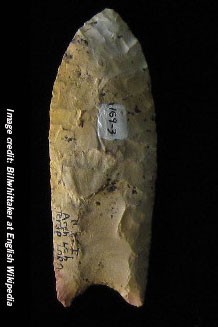
The earliest settlers of the Americas are referred to as Palaeo-Indians by scientists. Until recently, scientists thought that a group of people they call the Clovis people settled in the Americas about 13,000 years ago. The Clovis people are named after the distinctive stone tools found by archaeologists at sites near Clovis, New Mexico, in the 1920s and 1930s. These stone spearheads, known as Clovis points, are fluted (they have long, shallow grooves) on both sides. They have been dated to around 13,000 years ago.
Genetic studies show that Clovis people are the direct ancestors of about 80% of all living Native Americans in North and South America (the remainder are descended from ancestors who migrated to the Americas later).
Earlier settlers
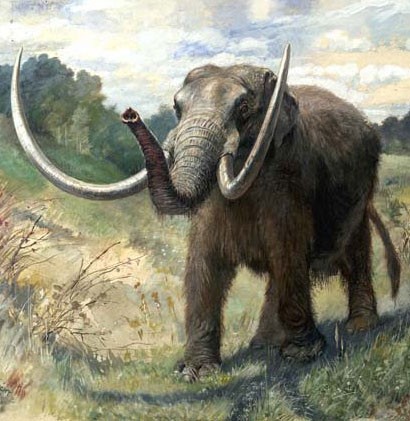
Evidence has now been found of people living in Florida 14,550 years ago—more than 1000 years earlier than previously thought. Stone tools, along with the butchered bones of a mastodon, a kind of prehistoric elephant, have been found at the bottom of the Aucilla River, near Tallahassee. This new evidence offers further proof that humans arrived thousands of years earlier. One of the finds, a mastodon tusk marked with deep grooves, was actually first discovered and dated in the 1980s, but because it was assumed that the Clovis people were the "first Americans", it was ignored.
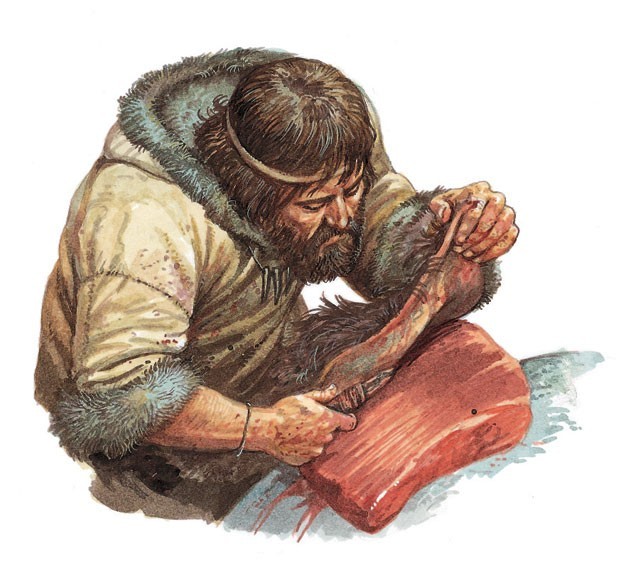
Dung samples also found at the site, called the Page-Ladson site, included chewed-up vegetable matter that allowed for accurate radiocarbon dating. Thousands of years ago, the area contained a water hole where both animals and humans gathered. The mastodon was butchered using small stone knives, known as bifaces, which were found at the scene by archaeologists.
White Sands footprints
A number of other archaeological sites with human remains and hearths (fireplaces used for cooking food) are thought also to date back to earlier than 13,000 years ago. They include Topper in South Carolina and Buttermilk Creek in Texas, but both are unproven.
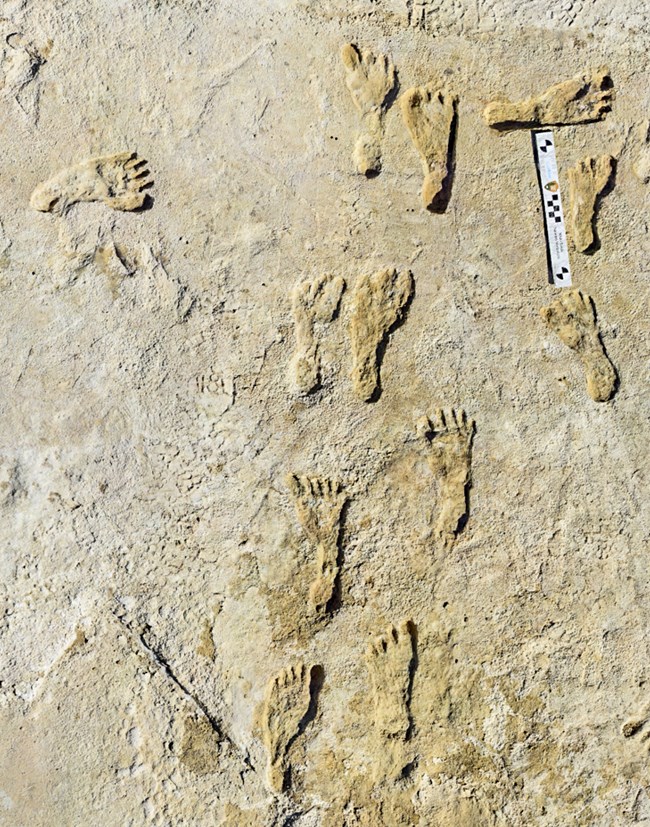
But the most compelling evidence yet that humans found their way south across the continent from Alaska thousands of years earlier emerged in September 2021 (and confirmed in October 2023) with the study of fossil footprints preserved in the rocks at White Sands, New Mexico. Humans who walked along the grassy shore of a vast ancient lake, Lake Otero, left damp footprints which were then covered over by sand. From radiocarbon dating the seeds and pollen from conifer trees found above and below the prints, scientists found that they were made 21,000 and 23,000 years ago—more than 6000 years earlier than previous estimates of human settlement in North America. (Some scientists dispute the results, proposing that the true date is 15,500–13,500 years ago.)
But how would humans reach New Mexico while the last Ice Age was still at its height, with a vast ice sheet covering the north of the continent seemingly blocking their way from Alaska?
Routes south

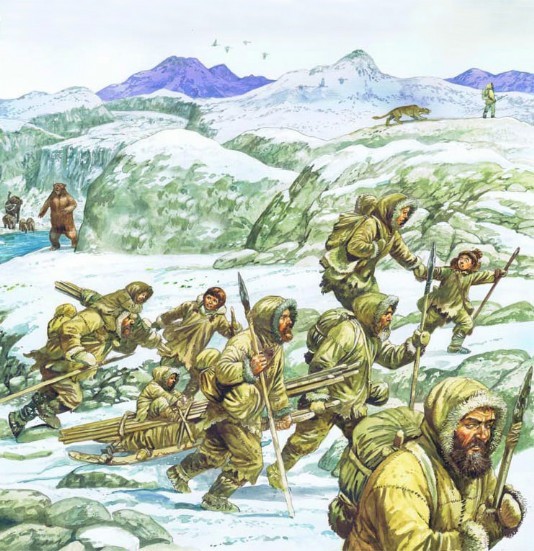
It has long been thought that the first Americans crossed the Beringia land bridge over the Bering Strait from Siberia to Alaska during the Ice Ages, when sea levels were low. They then made their way south through an ice-free corridor east of the Rocky Mountains as the glaciers retreated, around 15,000 years ago.
Some scientists now think Palaeo-Indian migrants could have travelled southwards along the Pacific coastline—possibly by boat for at least part of the way—thousands of years before the inland route opened up. These ancient peoples would then have migrated eastwards into the continent south of the ice sheet. This would explain the presence of the footprints discovered in New Mexico.
Cerutti Mastodon site
Scientists studying the fossil bones of a mastodon discovered in San Diego, California, have found what they claim to be evidence of human activity. The bones, which the researchers propose have been deliberately smashed using cobblestones, date to 130,000 years ago. This suggests some type of hominin (early species of Homo) lived in North America at that time. The findings, from what is called the Cerutti Mastodon site, have yet to be confirmed.
Consultant: Chris Jarvis
Other Q-&-As to explore:
For a full list of all our Q&As, please click here.
If you have a question that you would like to see answered on Q-files, please send us an email to info@Q-files.com or use the contact us page.
pics

Without in any way limiting Q-files Ltd’s exclusive rights under copyright, any use of this publication to “train” generative artificial intelligence (AI) technologies to generate text is expressly prohibited. Q-files Ltd reserves all rights to license use of this work for generative AI training and development of machine learning language models.