
North America

CITE
We have made every effort to follow citation style rules, but there may be some minor differences. If in doubt, please refer to the appropriate citation style manual.
Timeline of Native American history. (2022). In Q-files Encyclopedia, History, North America. Retrieved from
https://www.q-files.com/history/north-america/timeline-of-native-american-history
"Timeline of Native American history." History, North America, Q-files Encyclopedia, 10 Feb. 2022.
https://www.q-files.com/history/north-america/timeline-of-native-american-history.
Accessed 13 Sep. 2026.
Timeline of Native American history 2022. History, North America. Retrieved 13 September 2026, from
https://www.q-files.com/history/north-america/timeline-of-native-american-history
History, North America, s.v. "Timeline of Native American history," accessed September 13, 2026.
https://www.q-files.com/history/north-america/timeline-of-native-american-history


Timeline of Native American history
The first Americans
circa (about) 36,000 years ago An ancestral people living in Arctic Siberia in northeast Asia (a people from whom all Native Americans are descended) start to become isolated from other East Asian groups.
c. 26,500–12,000 years ago Last Glacial Maximum, the period when the ice sheets, formed during the most recent Ice Age, are at their greatest extent. During this period, sea levels are much lower—possibly up to 120 metres (400 feet)—as the world's water becomes “locked up” in the extensive ice.
As a result, a land bridge—actually a continuous expanse of land measuring thousands of kilometres from north to south—exists between Asia and North America, called Beringia. It is a land of tundra and boreal forest. Small, isolated groups of hunter-gatherers from the ancestral Arctic Siberian people migrate from Siberia to Alaska. (It is not known exactly when people reach what is now North America, although remains at the Bluefish Caves, Yukon, are dated to around 24,000 years ago.)

c. 22,000 years ago (or possibly earlier) Vast ice sheets covering northern North America (called the Cordilleran and Laurentide ice sheets) merge together east of the Rocky Mountains, closing off any migration route into the centre of North America. At the same time, glaciers in Alaska bar access to the Pacific coast from Beringia. This begins what archaeologists call the Beringian Standstill: the ancestral Arctic Siberian people who have migrated from northeast Asia cannot progress any further east or south, and so remain living in Beringia and Alaska.
c. 20,000 years ago The ancestral Arctic Siberian people splits into two branches: one gives rise to a people known as the Ancient Beringians; the other gives rise to the ancestors of all other Native Americans, who later expand into the rest of the Americas. (Some scientists believe that this split occurs while the ancestral people are still living in northeastern Asia, thousands of years earlier.)


c. 15,000 years ago The Beringian Standstill ends. People are now able to start migrating south along the west coast of the Americas as the coast becomes ice-free. Fossil footprints in White Sands National Park, New Mexico, date from an earlier time, 23,000–21,000 years ago, indicating that at least some people have managed to migrate earlier, possibly before the ice sheets merged.
c. 13,000–12,000 years ago The giant ice sheet that has been covering much of northern North America starts melting. An ice-free corridor to the interior of North America opens up.
c.13,000–11,000 years ago Clovis culture: the Clovis people hunt mammoths, mastodons, gomphotheres (all prehistoric elephants), bison, giant sloths, tapir and horses, as well as a number of smaller animals.
c. 11,000–10,000 years ago People living on the Great Plains start to hunt bison. Called Folsom people, they travel around in small family groups, settling in camps for a few days before moving on.
Archaic period
c. 8000 BC The Archaic period begins. The climate becomes warmer and drier, and the last prehistoric “megafauna” (giant animals such as mastodons) die out. Most people still travel around hunting big game, but some groups become more settled and start to find their food locally, for example, small game, fish, wild vegetables and other plants. The Archaic period lasts until around 1000 BC.
c. 8000–1200 BC During this period, known as the Oshara Tradition, the people living in the American Southwest are nomadic hunter-gatherers. They hunt rabbits, deer, antelope and bighorn sheep using stone-tipped spears.
c. 3500 BC Watson Brake, a cluster of 11 earthwork mounds (in present-day Ouachita Parish, Louisiana), is built. They pre-date the first pyramids of Egypt by about 800 years.
c. 3000 BC Palaeo-Eskimos, another people from Arctic Siberia, cross the Bering Strait to Alaska. They are the ancestors of today’s Arctic peoples, including the Inuit, Yupik and Aleut.

c. 2200–700 BC Poverty Point culture: some people start to settle in villages in the lower Mississippi Valley near the coast of the Gulf of Mexico. At Poverty Point in northeastern Louisiana, they build large earthen mounds arranged around a central plaza.
c. 2100 BC Maize from Mexico is introduced in what is now the southwestern United States
c. 2000 BC Some people in what is now the southwestern US begin producing rock paintings, called petroglyphs.
c. 1200 BC Ancestral Puebloans (once known as the Anasazi) establish their culture in the present-day “Four Corners” region of the United States (southeastern Utah, northeastern Arizona, northwestern New Mexico and southwestern Colorado). They cultivate maize and squash.
Farmers and traders

c. 1000–200 BC Adena culture flourishes in the central Ohio valley, beginning what is called the Woodland period. The Adena build large burial mounds and live in villages made of wooden huts. For their food, they hunt, gather nuts and seeds and cultivate pumpkins, squash and sunflowers. They also trade with other peoples.
c. 200 BC Maize is introduced into what is now the eastern United States.
c. 200 BC–400 AD Hopewell culture: a variety of different peoples living along the rivers of today's northeastern and midwestern United States. They build up an extensive trading network.
c. 700–1400 The Mogollon people live in southern New Mexico and Arizona, western Texas and northern Mexico.
c. 700–1200 Coles Creek culture in the Lower Mississippi Valley: the people build flat-topped platform mounds arranged around central plazas. They live by hunting and gathering, as well as by cultivating native plants such as goosefoot, sunflower, marshelder and squash.
c. 850 Ancestral Puebloans start to build multi-storey villages, or “great houses”, out of adobe (mudbrick), stone and other local materials. The buildings were divided up into numerous rooms, and surround a central space called a kiva.

c. 1000 Viking explorers encounter Native Americans in northern Newfoundland. These may have been ancestors of the Beothuk or Dorset inhabitants of Labrador and Newfoundland. The Vikings call them skraelings.

c. 1000–1500 Mississippian culture: a number of chiefdoms flourish in the Ohio and Mississippi valleys and throughout the southeast United States. Cahokia, in present-day Illinois, a city of 20,000–30,000 people which is at its peak in about 1250, is a major religious centre and trading hub. The Mississippians build flat-topped earthwork mounds and temples. They cultivate maize on a large scale.
c. 1150 With the onset of drought, the Ancestral Puebloans begin to abandon their villages in what is now the southwestern United States.
c. 1450 Iroquois League is formed from a confederation of five Iroquois nations: Cayuga, Mohawk, Oneida, Onondaga and Seneca.
c. 1400 Drought, and possibly warfare, forces many Mississippian peoples to start moving away from their cities.
The arrival of Europeans
1513 The first official European expedition to North America is led by Spanish conquistador Juan Ponce de León, who lands in Florida and claims the region for Spain. He encounters the Calusa people, who are hostile.
16th century The Spanish bring horses to Mexico. Some of the horses escape and began to breed and increase their numbers in the wild. Native American tribes adopt the use of the animals to carry goods for exchange with neighbouring tribes, to hunt buffalo (bison) and to conduct horse raids.

1539–42 Spanish explorer Hernando de Soto encounters a number of Mississippian peoples on his journey through the present-day southeastern United States.
1609–10 French explorer Samuel de Champlain, fighting alongside his Native American allies, the Huron and the Alqonquians, defeats the Mohawks, an Iroquois tribe, in present-day New York state and southwestern Quebec.
1610–46 The Anglo-Powhatan Wars: three wars are fought between the English settlers of the Virginia Colony, and Indians of the Powhatan Confederacy. The first war (1610–14) is ended by the Peace of Pocahontas; the second is begun by the Indian Massacre of 1622, in which the Powhatan kill around a quarter of the Virginian colonists; the third (1644–46) ends when Opechancanough, chief of the Powhatan Confederacy, is captured and killed.
1614–20 Dutch and English seafarers and traders visiting New England introduce diseases (such as smallpox, influenza, typhus and measles) to which the Native Americans have no immunity, resulting in epidemics that wipe out as many as 90% of the indigenous population. The Wampanoag and neighbouring Massachusett tribes are particularly hard hit.
1620s Settlers arrive in present-day Massachusetts from England. They depend initially on the native Wampanoag tribes for survival (who teach the Europeans how to fish and grow crops). The Wampanoag trade furs for the copper kettles, arms and metal tools of the colonists.
1628 The Mohawks defeat the Mahicans, an Algonquian tribe, pushing them east of the Hudson River. This marks the start of the Beaver Wars.
1630s–1701 Beaver Wars: tribes of the Iroquois Confederacy, attempting to take control of the fur trade with Europeans, wage war against the Huron, Algonquians and their French allies. During the wars, the Iroquois defeat several other large tribal confederacies, including the Huron, Neutral, Erie, Susquehannock and Shawnee, and become a dominant power in the Great Lakes region.
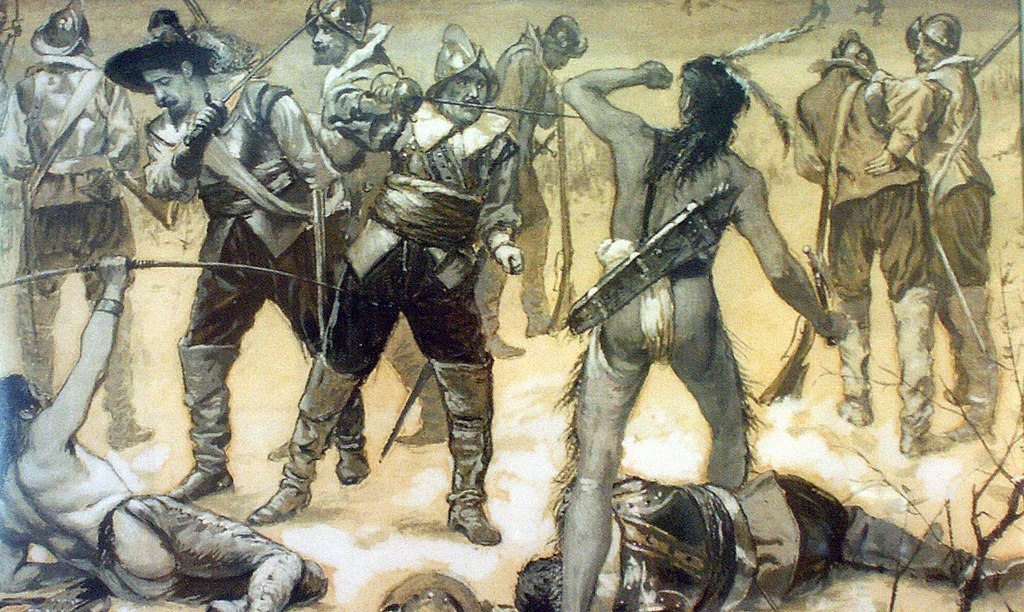
1636–38 The Pequot War in New England is fought between the Pequot tribe and the English colonists along with their Native American allies, the Narragansett and Mohegan tribes.
1676–78 King Philip's War is fought between Native American inhabitants of present-day southern New England (the Wampanoag, Narragansett and others) and the English colonists and their Native American allies. The war is named after the main leader of the Native American side, Metacomet, who was known to the English as King Philip. He was the chief of the Wampanoag Nation.
mid-17th century Tribes living in Ohio Valley, including the Osage, Kaw, Ponca and Omaha peoples, are driven west by the warring Iroquois claiming their hunting grounds. They re-settle in present-day Kansas, Nebraska, Arkansas and Oklahoma.


1754–63 French and Indian War: Native Americans fight on both sides of the conflict, using their alliances with either the French or British to battle with their traditional native enemies.
1769 Native peoples from local tribes in California are forced to work in Spanish missions.
1783 Treaty of Paris: Following their defeat in the American Revolutionary War, the British cede vast territories east of the Mississippi to the newly-independent United States, without consulting with the Native Americans who lay claim to these lands.
American Indian Wars
1785–95 The Northwest Indian War is fought between the United States and a confederation of Native American tribes, supported by the British, for control of the Northwest Territory, an area lying between the Ohio River and the Great Lakes that which was once held by the British before the American Revolutionary War. Following their defeat at the Battle of Fallen Timbers in 1794, the tribes are forced to cede extensive territory, including much of present-day Ohio, to the US by the Treaty of Greenville in 1795.

1811–13 Tecumseh's War, fought between the US Army and an Native American confederacy led by the Shawnee leader Tecumseh in Indiana Territory. The Native Americans are defeated and Tecumseh is killed at the Battle of the Thames in present-day Ontario, Canada.
1813–14 Creek War is fought in Alabama, Georgia and Mississippi between US state militias and “Red Stick” Creek Indians. After the Creeks’ defeat, large areas of land in southern Georgia and central Alabama are taken from them.
1817–18 First Seminole War fought by the US Army against the Seminole Indians in Florida.
1830 President Andrew Jackson signs the Indian Removal Act, which authorizes the forced removal of Native Americans living in the east to lands west of the Mississippi River.
1834 The area of present-day Oklahoma is set aside by the US government as Indian Territory. The US government force the people of the "Five Civilized Tribes" (Cherokee, Choctaw, Chickasaw, Creek and Seminole) to abandon their lands east of the Mississippi and move to this new territory, which is already occupied by Osage and Quapaw tribes.
1835–42 Second Seminole War, or Florida War; following their defeat in the war, many Seminoles are removed to Indian Territory.
1838 More than 15,000 Cherokee are forced to march from Georgia to Indian Territory. Around 4000 Indians die from disease and starvation on what is called the “Trail of Tears”.

1845 New York newspaper editor John L. O’Sullivan coins the phrase, "Manifest Destiny”, justifying the territorial expansion of the United States westwards into lands inhabited by Native Americans.

1849–86 Apache Wars, a series of armed conflicts between the US Army and various Apache nations fought in the southwest. They are triggered by white settlers' encroachment on traditional Apache lands to raise livestock, crops and to mine minerals.
1855–58 Third Seminole War results in the forced removal of most of the remaining Seminoles from Florida.
1862 The Dakota War, also known as the Sioux Uprising, is fought between the United States Army and several bands of Dakota (the eastern Sioux) in Minnesota. The war begins with Dakota attacks on hundreds of settlers and immigrants, causing many to flee. After the Dakota surrender to the US army, many are executed or expelled from Minnesota.
1876 The Great Sioux War is fought between the US Army and the Lakota Sioux and Northern Cheyenne over ownership of the Black Hills in South Dakota. During the conflict, US troops under George A. Custer are crushed by a combined Lakota-Northern Cheyenne-Arapaho forces under Sitting Bull at the Battle of Little Big Horn (Battle of the Greasy Grass).

1886 The surrender of the Apache leader Geronimo in 1886 effectively marks the end of the Apache Wars.
1890 Last major battle of the Indian Wars occurs at Wounded Knee in South Dakota, where US troops massacre a party of more than 150 Lakota men, women and children led by Spotted Elk.
Recognition and protest
1911 Ishi, thought to be the last Native American to live most of his life without contact with European-American culture, is discovered near Oroville, California.
1924 Indian Citizenship Act grants American citizenship to all Native Americans born in the United States and its territories (who were not already citizens through marriage, military service or by accepting land allotments.)

1956 The Indian Relocation Act is passed. It is intended to encourage Native Americans in the United States to leave Indian reservations and assimilate into (become part of) the general American population.
1973 Wounded Knee incident on the Pine Ridge Indian Reservation. Frustrated by their tribal leaders and the failure of federal government to enforce treaty rights, about 300 Oglala Lakota take control of Wounded Knee. They are later joined by Indian activists from around the country. After gunfire and several deaths, the occupation is called off.
1975 The Indian Self-Determination and Education Assistance Act is passed, recognizing the right of Native Americans for self-determination.
1982 Constitution Act, part of the Constitution of Canada, recognizes and affirms existing aboriginal and treaty rights in Canada, protecting the activities, practices and traditions of First Nations, Inuit and Métis (mixed indigenous and European ancestry) peoples.
2009 An "apology to Native Peoples of the United States" is issued by the US government. It states that the US "apologizes on behalf of the people of the United States to all Native Peoples for the many instances of violence, maltreatment, and neglect inflicted on Native Peoples by citizens of the United States."
2016 Dakota Access Pipeline protests in reaction to the approved construction of the Dakota Access Pipeline in the northern United States. A number of Native Americans in Iowa and the Dakotas, including the Meskwaki and several Sioux tribal nations, oppose the oil pipeline, which they say will threaten sacred burial grounds as well as the quality of water in the area. The pipeline is completed and becomes operational in 2017.

Consultant: Steve Gallo
pics

Without in any way limiting Q-files Ltd’s exclusive rights under copyright, any use of this publication to “train” generative artificial intelligence (AI) technologies to generate text is expressly prohibited. Q-files Ltd reserves all rights to license use of this work for generative AI training and development of machine learning language models.