
Russia

CITE
We have made every effort to follow citation style rules, but there may be some minor differences. If in doubt, please refer to the appropriate citation style manual.
Russian Empire. (2025). In Q-files Encyclopedia, History, Russia. Retrieved from
https://www.q-files.com/history/russia/russian-empire
"Russian Empire." History, Russia, Q-files Encyclopedia, 3 Oct. 2025.
https://www.q-files.com/history/russia/russian-empire.
Accessed 22 Sep. 2026.
Russian Empire 2025. History, Russia. Retrieved 22 September 2026, from
https://www.q-files.com/history/russia/russian-empire
History, Russia, s.v. "Russian Empire," accessed September 22, 2026.
https://www.q-files.com/history/russia/russian-empire


Russian Empire
The modern history of Russia, beginning in the late 17th century, is largely the story of the Romanov ruling house of tsars—and the attempts made to overthrow them. For long periods of history the Romanovs ruled unchallenged, but in 1905 they were shaken by a popular uprising, and in 1917 they were finally overthrown. This period is also marked by a massive expansion of the Russian Empire west into Europe and east into Siberia and central Asia.

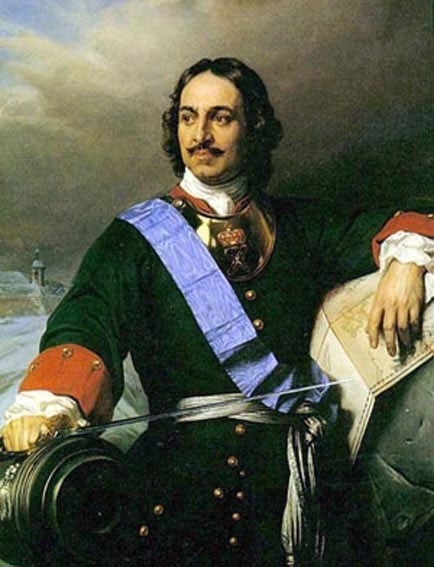
Peter the Great
Perhaps the greatest Romanov ruler of Russia was Peter the Great. He reigned from 1682 until his death in 1725. An extremely tall man with great energy, he dragged Russia into the modern world. In 1697–98 he travelled in disguise throughout Western Europe, learning about manufacturing, how to build ships and new cities, and how to modernize his country along western lines. When he returned to Russia, he set about building a new capital city at St Petersburg (founded in 1703) on the Baltic Sea—then, as now, one of the most beautiful cites in Europe.

During Peter's reign, the Russian Empire expanded enormously. Russia had no access to an ice-free coast, so in 1696 his armies captured Azov on the Black Sea from the Ottomans, although he later had to return it. More successfully, he fought in the lengthy Great Northern War of 1700–21 against Sweden, eventually gaining access to the Baltic Sea. The Russian Empire also expanded west into Poland and east into central Asia. At home, Peter took control of the church, enlarged and professionalized the army, set up a navy, founded schools and colleges, supported industry and reformed government.

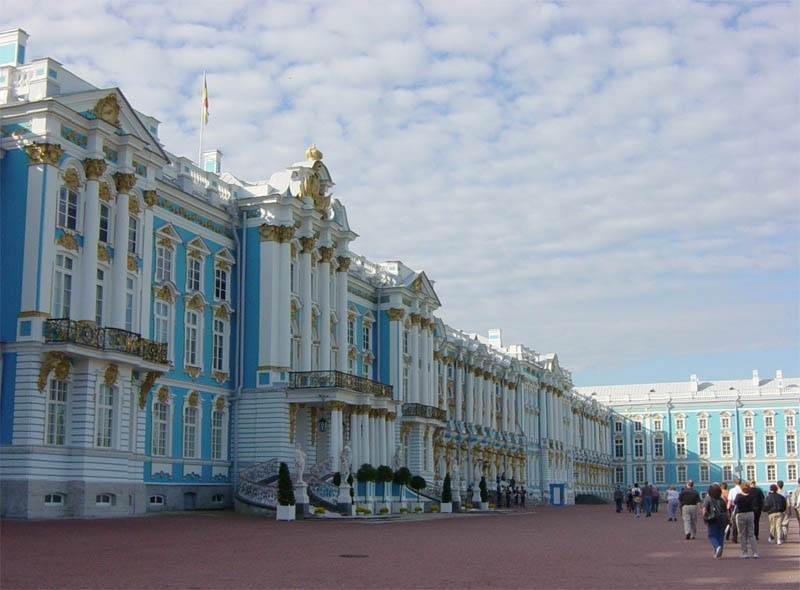
After Peter
After his death, various close members of his own family succeeded Peter. His second wife Catherine I, ruled as a figurehead for powerful officials between 1725–27. His niece Anna succeeded Peter's grandson, Peter II, in 1730, to be followed briefly in 1740 by Ivan VI. One year later, Peter’s daughter Elizabeth seized the throne. She reigned for 21 years as Empress Elizabeth, establishing Moscow University and abolishing the death penalty except for high treason.
Catherine the Great
Catherine the Great was remarkable because not only was she a powerful female leader, but she was not even born in the country she ruled. Catherine was born a minor princess in Prussia in Germany in 1729 and in 1745 married Peter, who became Tsar Peter III of Russia in 1762. Catherine quickly forced him to abdicate (give up the throne) and later commanded his guards to strangle him. Catherine then became Empress of Russia in her own right.

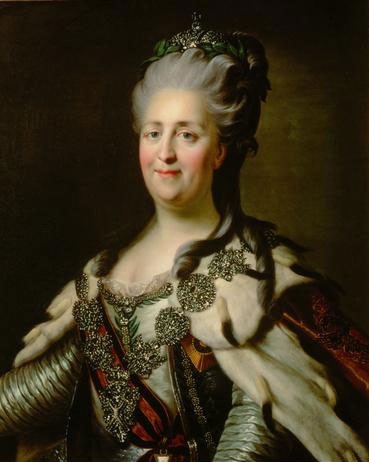
During Catherine’s reign (1762–96), Russia’s empire expanded further, gaining access to the Black Sea (an ice-free coast at last), acquiring the Crimean Peninsula and most of Poland. Her reign is often described as the Golden Age of Russia and was marked by the construction of many new buildings in an elegant classical style. However, most ordinary Russians were serfs (peasants) living in terrible poverty. An uprising in 1774 was put down by the government with great severity. Afterwards, Catherine increased control over the serfs even further.

War with Napoleon
Tsar Alexander I (1801–25), came to the throne after the assassination of his father Paul I, Catherine's successor. His main focus was on how to deal with Napoleon, the powerful French leader. Fearing the growth of French power in Europe, Alexander joined forces with Britain and Austria against Napoleon. But Napoleon defeated the Russians and Austrians at the Battle of Austerlitz in 1805, and then the Russians again at Friedland in 1807. By the Treaty of Tilsit of that year, Alexander became Napoleon's ally. He made use of this alliance to expand Russian territory, fighting a war against Persia (1804–13) for control of the Caucasus, much of it previously under Persian rule. He also seized Finland from Sweden in 1809, and acquired Bessarabia (modern Moldova) from Turkey following the Russo-Turkish War, 1806–12.


But Napoleon and Alexander eventually fell out. In June 1812, Napoleon invaded Russia with 600,000 troops of the Grand Army. Napoleon’s army won the Battle of Borodino in September, and arrived in Moscow not long after. But when the long, bitterly cold Russian winter set in, the Grand Army was forced to retreat and thousands of troops died in the harsh conditions. Fewer than 30,000 of Napoleon's men returned to their homeland. As the French retreated, the Russians pursued them to the gates of Paris. Following Napoleon’s defeat, Alexander was hailed as a hero across Europe. In 1814 he formed the Quadruple Alliance with Britain, Austria and Prussia.
Expansion of empire
Russia continued to expand during the 1800s, gaining Georgia in 1801, Finland in 1809, Poland in 1815, the central Asian khanates from 1822 to 1873, the far eastern province of Amur in 1858, and the Caucasus by 1878. The building of the Trans-Siberian Railway was begun in 1891 to link this vast empire together.

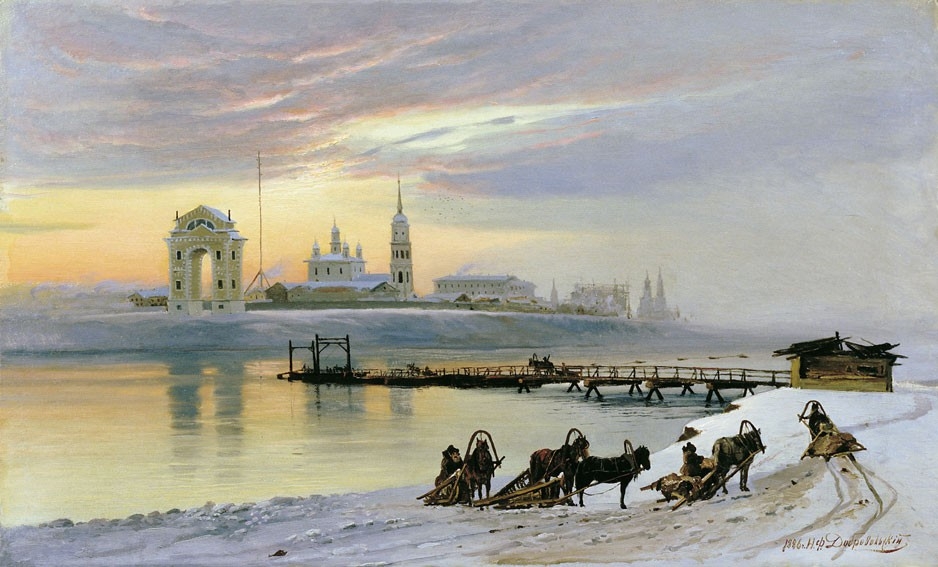

Crimean War
The Russians aimed to dominate the Ottoman Empire so that it could export its grain and other products across the Black Sea and through the Bosporus Strait (which ran through Ottoman territory) into the Mediterranean Sea. They thus encouraged the Balkan Slavs to rebel against their Ottoman rulers. This policy brought Russia into conflict with Britain and France who together fought Russia in the Crimean War of 1853–56.
Liberation of the serfs
While the Industrial Revolution took hold across the world, Russia remained a backward country. Its wealthy nobility gained their wealth from serfs or slaves who worked the land, and did not invest in industry. In 1861 Tsar Alexander II liberated the serfs and began to move Russia towards becoming a more industrial power. New factories were set up and the development of manufacturing industries was encouraged.

Dictators
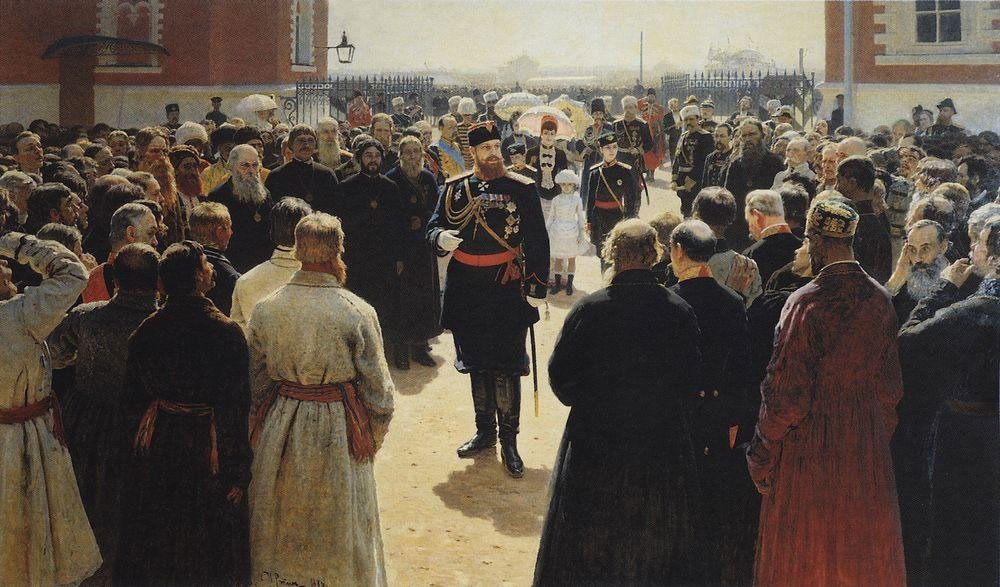
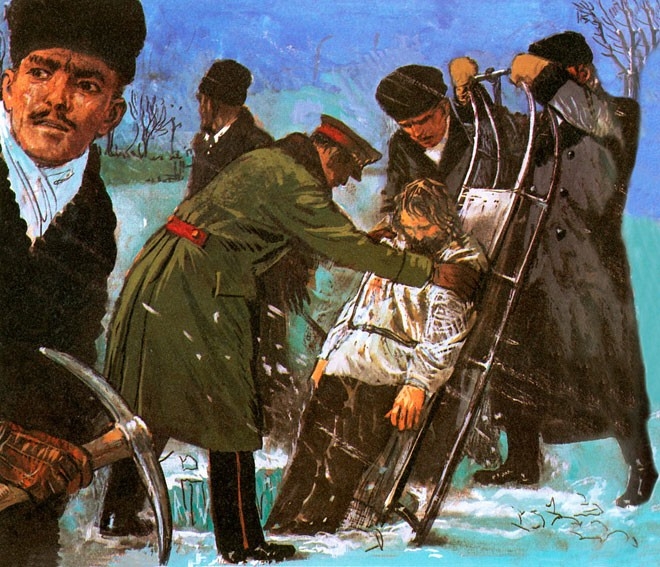
Alexander’s policies were not popular, but any discontent was contained by a large secret police. In 1881 Alexander was assassinated by a revolutionary. His successor, Alexander III (1881–94) continued his father’s policies, expanding Russian industry in Siberia. But Alexander rejected many of his father’s political reforms and ruled as a dictator, as did his own son Nicholas II (1894-1917).
Tsar Nicholas II
In 1905, Tsar Nicholas II ruled over Russia's vast empire, which stretched from central Europe to the Pacific Ocean, from the Arctic to the Middle East. The empire was home to nearly 150 million people, including more than 100 different nationalities. Nicholas believed that the tsar held absolute power as given to him by God, and that the people would remain naturally loyal to him. But he did little to help his subjects. The peasants of Russia, as well as the poor working class, lived in extremely bad conditions.
The 1905 Revolution

In 1904 Russia went to war with Japan over control of Korea and Manchuria, but was heavily defeated. These defeats furthered discontent at home. On 22nd January 1905, a crowd of unarmed demonstrators marched to present a petition to Tsar Nicholas II in St Petersburg. However, the soldiers protecting the tsar's palace opened fire on the protesters. Hundreds of people were killed. This event, known as Bloody Sunday, sparked a revolution. Revolts and uprisings across Russia forced the tsar to concede civil rights and agree the establishment of a parliament, though with limited rights.

Rasputin
Grigori Rasputin (1869–1916) was born the son of a peasant and never attended school. He married in 1887 and his wife had three children. In 1892 he abruptly left his family and joined a monastery, where he became a devout Orthodox Christian and learned to read and write. He soon became known as a psychic and faith healer. In 1905 he was presented to Tsar Nicholas II and, in April 1907 was invited to inspect the Tsarevich (heir to the throne), Alexei, who was suffering from one of his many bouts of haemophilia, a disease that prevents blood from clotting. The next day the Tsarevich began to recover, for which Rasputin gained much praise.
After having helped the Tsarevich again in 1912, Rasputin became an important advisor to the Empress Alexandra, who trusted his advice about her son and other issues. His closeness to the royal family attracted much controversy, and he soon had many enemies who were jealous of his influence. In December 1916 Rasputin’s enemies finally exacted revenge when they lured him to a building in St Petersburg, laced his food with large quantities of cyanide (a poison) and shot him dead. His body was then thrown into the River Nevka.

The 1917 Revolution
In Russia, the financial cost of fighting World War I, severe food shortages and high casualties, deepened public distrust of Tsar Nicholas II and his government. Unhappiness was increased by some terrible defeats in the war, such as at the Battle of Tannenberg in 1914, when German forces killed and wounded 50,000 Russian soldiers and captured a further 100,000. In February 1917, rioters in Petrograd (the new name for St Petersburg) were joined by soldiers. This led to the formation of a new Provisional Government, which forced the tsar to give up his throne.
In a deliberate attempt to weaken Russia even further, Germany allowed a revolutionary called Vladimir Ulyanov, known as Lenin (1870–1924), to return from exile in Switzerland. Lenin led a second revolutionary uprising in Russia in October 1917, seizing control of the government. He then opened peace talks with Germany and Austria-Hungary, signing a peace treaty on 3rd March 1918. Tsar Nicholas and his family were executed in July 1918.

Consultant: Philip Parker
pics
Without in any way limiting Q-files Ltd’s exclusive rights under copyright, any use of this publication to “train” generative artificial intelligence (AI) technologies to generate text is expressly prohibited. Q-files Ltd reserves all rights to license use of this work for generative AI training and development of machine learning language models.