
EASY READ The human body

CITE
We have made every effort to follow citation style rules, but there may be some minor differences. If in doubt, please refer to the appropriate citation style manual.
EASY READ What does the heart do?. (2026). In Q-files Encyclopedia, Life, EASY READ The human body. Retrieved from
https://www.q-files.com/life/easy-read-the-human-body/easy-read-what-does-the-heart-do
"EASY READ What does the heart do?." Life, EASY READ The human body, Q-files Encyclopedia, 24 Mar. 2026.
https://www.q-files.com/life/easy-read-the-human-body/easy-read-what-does-the-heart-do.
Accessed 13 Sep. 2026.
EASY READ What does the heart do? 2026. Life, EASY READ The human body. Retrieved 13 September 2026, from
https://www.q-files.com/life/easy-read-the-human-body/easy-read-what-does-the-heart-do
Life, EASY READ The human body, s.v. "EASY READ What does the heart do?," accessed September 13, 2026.
https://www.q-files.com/life/easy-read-the-human-body/easy-read-what-does-the-heart-do


What does the heart do?
The heart lies at the centre of what is called the circulatory system. This is the network of blood vessels that reaches to all parts of the body. The heart sucks in oxygen-filled blood from the lungs, then pumps it around the body through arteries. Meanwhile, veins bring used-up blood, containing carbon dioxide, back to the heart. The heart sends this blood to the lungs to get rid of the carbon dioxide and take in fresh oxygen. The cycle begins again.

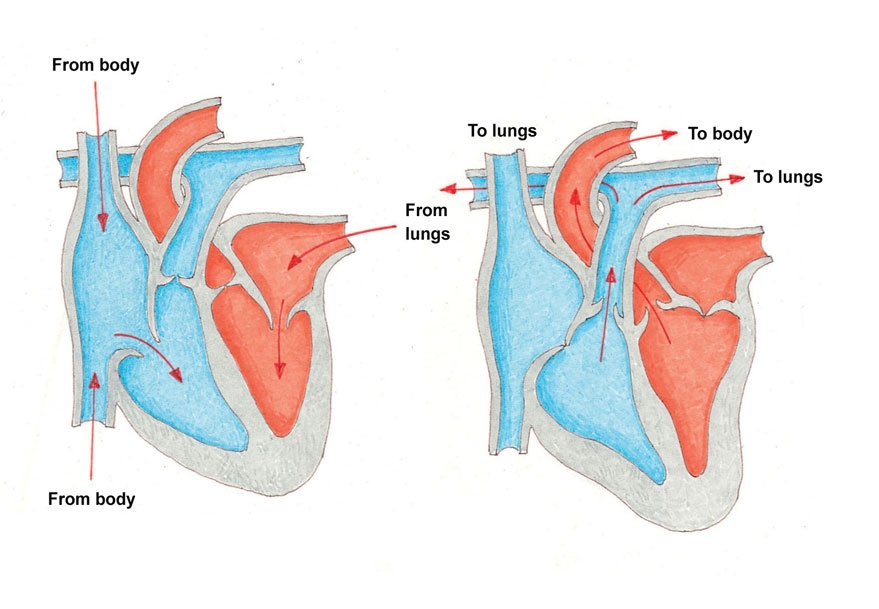
How the heart works
About the size of your fist, the heart is a powerful pump. As the muscles of the heart relax, blood enters its various “chambers”. Oxygen-filled blood from the lungs fills the red chambers in the diagram (left). At the same time, carbon-dioxide-filled blood from the rest of the body enters the blue chambers.
The heart then squeezes and pumps the blood out. The oxygen-filled blood goes to the rest of the body, while the carbon-dioxide-filled blood goes to the lungs.
Heart beat
Flaps inside the heart called valves stop any blood leaking backwards. The thump-thump sound of your heart beating is the sound of the valves snapping shut. When you sit still, your heart beats around 70 times a minute. When you exercise, your muscles need more food and oxygen. The heart speeds up so it can pump blood faster.

Consultant: Kristina Routh
Ready to find out more?
Here is a page in another part of Q-files you might like to explore:
pics

Without in any way limiting Q-files Ltd’s exclusive rights under copyright, any use of this publication to “train” generative artificial intelligence (AI) technologies to generate text is expressly prohibited. Q-files Ltd reserves all rights to license use of this work for generative AI training and development of machine learning language models.