
EASY READ The human body

CITE
We have made every effort to follow citation style rules, but there may be some minor differences. If in doubt, please refer to the appropriate citation style manual.
EASY READ What are blood vessels?. (2026). In Q-files Encyclopedia, Life, EASY READ The human body. Retrieved from
https://www.q-files.com/life/easy-read-the-human-body/easy-read-what-are-blood-vessels
"EASY READ What are blood vessels?." Life, EASY READ The human body, Q-files Encyclopedia, 24 Mar. 2026.
https://www.q-files.com/life/easy-read-the-human-body/easy-read-what-are-blood-vessels.
Accessed 30 Oct. 2026.
EASY READ What are blood vessels? 2026. Life, EASY READ The human body. Retrieved 30 October 2026, from
https://www.q-files.com/life/easy-read-the-human-body/easy-read-what-are-blood-vessels
Life, EASY READ The human body, s.v. "EASY READ What are blood vessels?," accessed October 30, 2026.
https://www.q-files.com/life/easy-read-the-human-body/easy-read-what-are-blood-vessels


What are blood vessels?
Blood travels along thousands of tubes, called blood vessels. Blood vessels that take blood away from the heart are called arteries. Blood vessels that take blood towards the heart are called veins. The arteries and veins in your body are like a road network. There are “motorways” (the main blood vessels) as well as “lanes” and “tracks”, tiny vessels called capillaries that reach all the cells in the body. Altogether, your blood vessels are about 100,000 kilometres (60,000 miles) long, or more than twice the distance around the world.
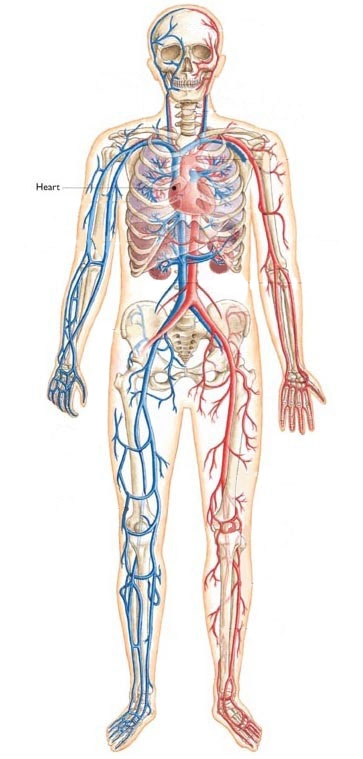
Veins

Veins carry blood containing carbon dioxide and other wastes from the cells towards the heart. The larger veins have valves inside them. These are “doors” that open and close rather like canal locks. The valves ensure that blood cannot leak back.
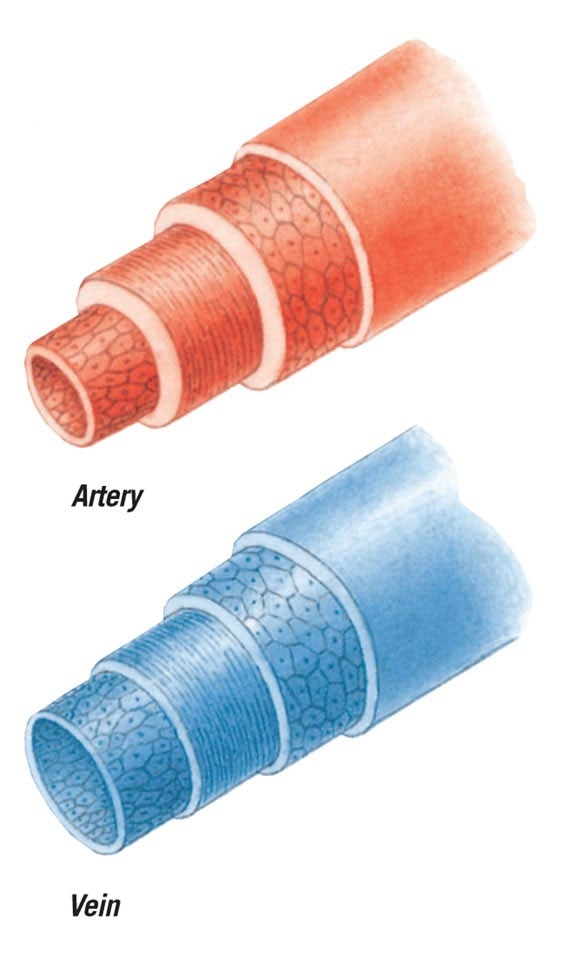
Arteries
Bright red blood containing oxygen and nutrients flows from the heart to the body's cells through your arteries. Arteries have much thicker walls than veins because they carry blood pumped under high pressure from the heart.
You can feel the heart's pumping action by placing your fingers on the inside of the wrist, a point where a main artery lies close to the surface of your skin.
Capillaries
Each capillary is only one hundredth of a millimetre wide. The walls are extremely thin. These enable oxygen and nutrients in the blood to seep through to the cells and carbon dioxide and other waste to pass the other way into the capillaries.

Consultant: Kristina Routh
Ready to find out more?
Here is a page in another part of Q-files you might like to explore:
pics
Without in any way limiting Q-files Ltd’s exclusive rights under copyright, any use of this publication to “train” generative artificial intelligence (AI) technologies to generate text is expressly prohibited. Q-files Ltd reserves all rights to license use of this work for generative AI training and development of machine learning language models.