
Universe
Big Bang
Scientists believe that the Universe began in a single momentous event. This was a sudden burst of energy called the Big Bang which took place about 13.8 billion years ago. It is hard to imagine that before the Big Bang, no matter or energy existed. There was no such thing as time. During this incredible burst, all energy, space—even time itself—were created in an instant. Scientists think that in the first trillion-trillion-trillionth of a second of its existence, the Universe grew 100 trillion trillion times larger. It then slowed down its expansion enormously.
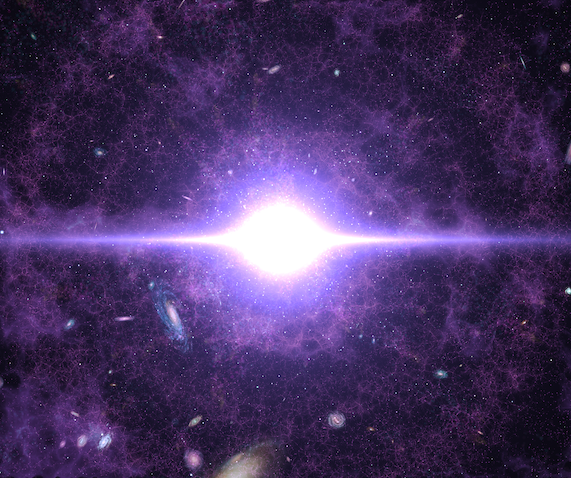
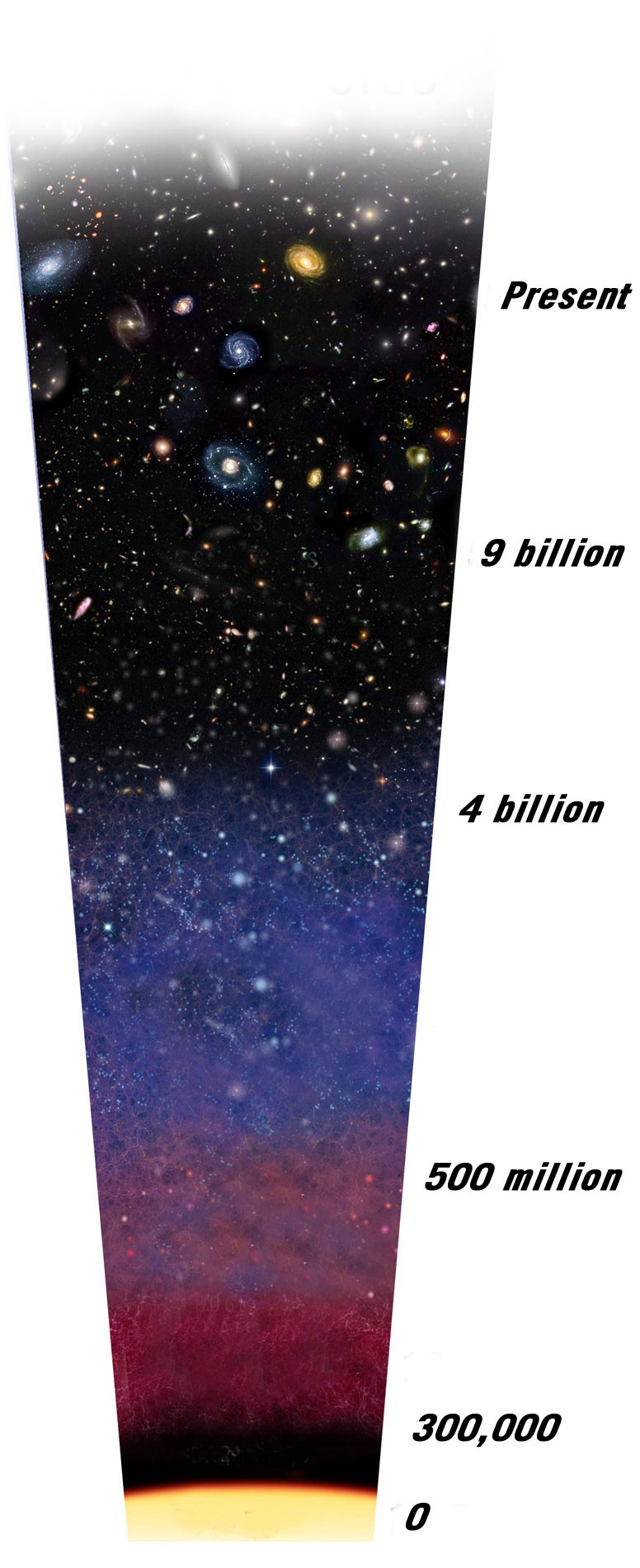
Universe timeline
Millionths of a second old The first subatomic particles have formed.
One second old Protons and neutrons, the subatomic particles that form the nuclei of atoms, start to form.
Three minutes old The temperature drops below 1 billion °C. Protons and neutrons come together to form the nuclei of hydrogen and helium atoms.
300,000 years old The first atoms, those of hydrogen and helium, are formed when atomic nuclei finally "capture" electrons.
500 million years old The first galaxies and stars are formed.
4 billion years old The Milky Way Galaxy starts to form.
9 billion years old The Solar System comes into existence.
Formation of matter
In the first few millionths of a second, the particles that make up atoms, the building blocks of all matter, were formed. It took hundreds of thousands of years for the first atoms, those of the gases hydrogen and helium, to come together. By this time, the searing heat of the Big Bang had cooled, space had expanded and the gases began to spread out. Gradually, however, gravity drew the gases together, leaving vast regions of empty space in between.
Formation of galaxies
About half a billion years after the Big Bang, following a period of cooling known as the "dark ages", clouds of gas started to form into galaxies. Matter inside the galaxies went on clumping together until stars were created. Our own Sun was born in this way about 4.6 billion years ago. Its family of planets, including our Earth, was formed from the debris spinning round the infant Sun. With many billions of stars and planets forming in the same way across the Universe, it seems almost certain that life will have also evolved elsewhere.


The Universe's fate
In the 20th century, some astronomers thought that vast amounts of invisible dark matter in the Universe may exert sufficient gravity to halt its expansion and cause the galaxies to compress together to a single point in a “Big Crunch”. We now know that dark energy in the Universe is actually causing its expansion to accelerate, so the Big Crunch seems certain not to happen. It may be that the Universe will carry on expanding and cooling forever (something described as the “Big Chill”, “Big Freeze” or the “Heat Death of the Universe”). Alternatively, it may be that matter is finally destroyed in a “Big Rip”.
Background radiation
Cosmic Microwave Background (CMB) is the electromagnetic radiation (light, heat, etc.) left over from an early stage in the development of the Universe. The space between stars and galaxies is dark when viewed through an optical telescope, which uses visible light. But when the sky is viewed with a radio telescope, there is a faint background glow, revealing the presence of radiation. The glow is strongest when detecting microwave radiation.
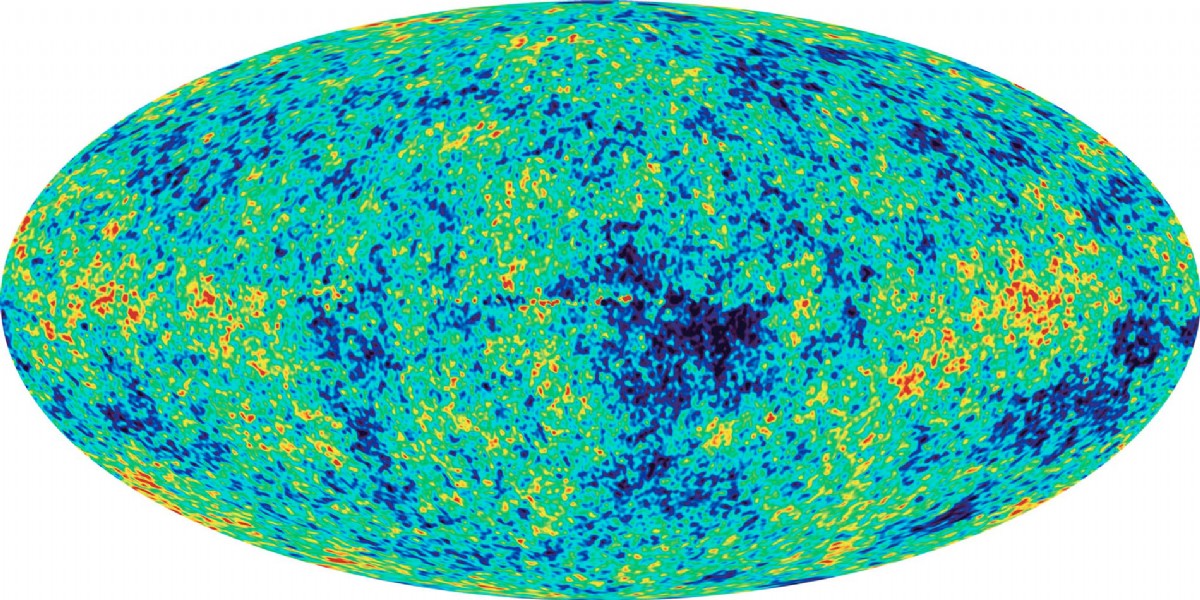
The map of CMB across the sky is like a snapshot of the Universe when it was just 380,000 years old. It reveals tiny differences in temperature, highlighting areas, described as ripples, that have very slightly higher densities of matter. These were the "seeds" from which today's stars and galaxies came into existence much later.
Standard cosmological model

A description of the origin and evolution of the Universe, along with mathematical explanations of the physical processes behind it, make up what scientists call a "model" of the Universe. The standard cosmological model (sometimes called the Lambda cold dark matter model or LCDM) of the Universe—one which most (but not all) scientists accept today—is based on Einstein’s General Theory of relativity.

Scientists test this model by making observations. Powerful telescopes such as the James Webb can view objects nearly 14 billion light years away. The radiation they detect was emitted just 380,000 years after the Big Bang. It is as if we are gazing into the past to survey the Universe in its infancy.
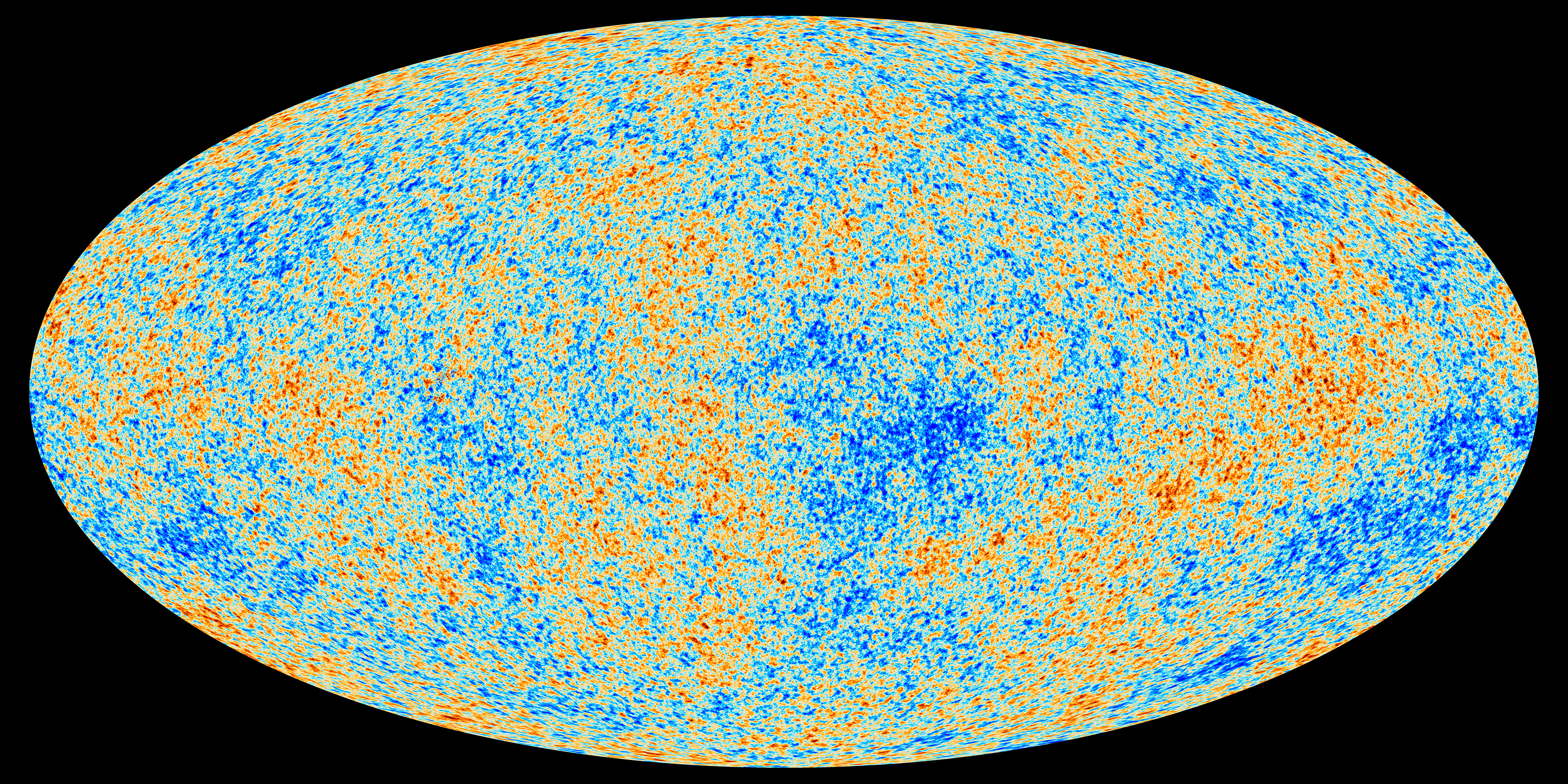
When the first ultra-precise maps of the CMB were released by the European Space Agency’s Planck Observatory in March 2013 (below), it seemed they fitted the predictions of the standard model very accurately. But some cosmologists now say that these maps do not agree with measurements of the more recent Universe. Using gravitational lensing techniques, they have found there to be less clumping and clustering of galaxies that maps of the early Universe suggested would be the case. This raises the question of whether the standard model is correct.
Consultant: Mike Goldsmith