
Universe

CITE
We have made every effort to follow citation style rules, but there may be some minor differences. If in doubt, please refer to the appropriate citation style manual.
Gravitational waves. (2026). In Q-files Encyclopedia, Space, Universe. Retrieved from
https://www.q-files.com/space/universe/gravitational-waves
"Gravitational waves." Space, Universe, Q-files Encyclopedia, 25 Mar. 2026.
https://www.q-files.com/space/universe/gravitational-waves.
Accessed 3 Nov. 2026.
Gravitational waves 2026. Space, Universe. Retrieved 3 November 2026, from
https://www.q-files.com/space/universe/gravitational-waves
Space, Universe, s.v. "Gravitational waves," accessed November 3, 2026.
https://www.q-files.com/space/universe/gravitational-waves


Gravitational waves
In February 2016, a team of US scientists announced that they had detected gravitational waves. These are the ripples in “space-time” that were predicted a century ago by the great German scientist Albert Einstein (1879–1955) in his General Theory of Relativity. Clear signals from the waves had been picked up by LIGO, or the Advanced Laser Interferometer Gravitational-Wave Observatory. The team used detectors in Washington and Louisiana to spot passing gravitational waves produced, they believe, by the collision of two black holes.


Ripples in space and time
Gravitational waves are like the ripples on a pond created when a pebble is thrown into it. The pond is made not of water, but space and time (what Einstein called space-time). If, instead of a pebble, something really massive is thrown into that “pond”—such as two black holes colliding—the resulting ripples would spread out across the Universe. These ripples—gravitational waves—would stretch and squeeze space, and everything within it, as they went.
Space-time
Space and time are closely linked. Space-time can bend; it can change its shape in response to the presence of matter and energy. Einstein showed that gravity, instead of being viewed as the pull exerted by another object, could be seen as the bending of space-time around that object, exactly in the same way that a person can bend a trampoline when standing on it, causing passing bodies to fall in towards it.
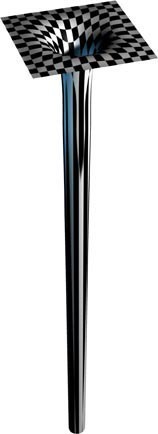
A massive object in space-time creates a large “dent” into which light and matter would fall. The denser the object, the greater the dent. So the Sun makes only a shallow dent, whereas a black hole, the relic of a supergiant star that has exploded to become the densest object of all, creates a dent so deep that nothing, not even light, could escape from it.
A good way to picture this event would be to imagine a star in space as a ball on a rubber sheet. A massive object like a star would bend space and anything close to it will fall in towards it. If the ball were so heavy that the sheet stretched into a long, deep tube, the result would be a black hole.

Colliding black holes
A black hole that stays motionless does not make waves, just as if you stood still in a pond you would not produce waves either. But if you, or a black hole, were to start jumping around, then waves would be created immediately. So if Einstein was correct and space-time really does exist, scientists would expect to see waves—what they call gravitational waves—spreading out across space whenever a black hole gets shaken up. That would definitely happen if one black hole were to crash into another black hole.
Detecting gravitational waves
And this is exactly what the LIGO team say they have discovered. Their detectors have picked up gravitational waves from two vast black holes, one 29 times more massive than the Sun, the other 36 times more massive, crashing together at close to the speed of light. About three times the Sun's mass was converted into gravitational waves in a fraction of a second.

LIGO used lasers inside two 4-kilometre (2.5-mile) pipes to record the minuscule changes in the pipes’ lengths caused by the gravitational waves created by that huge collision.
The black holes collided 1.3 billion years ago. The gravitational waves have therefore been travelling through space for 1.3 billion years. When they arrived at Earth on 14th Sept 2015, they caused a change in length of 1/10,000 of the width of a proton particle, which LIGO detected.
Consultant: Mike Goldsmith
pics
Without in any way limiting Q-files Ltd’s exclusive rights under copyright, any use of this publication to “train” generative artificial intelligence (AI) technologies to generate text is expressly prohibited. Q-files Ltd reserves all rights to license use of this work for generative AI training and development of machine learning language models.