
Universe

CITE
We have made every effort to follow citation style rules, but there may be some minor differences. If in doubt, please refer to the appropriate citation style manual.
Black holes. (2026). In Q-files Encyclopedia, Space, Universe. Retrieved from
https://www.q-files.com/space/universe/black-holes
"Black holes." Space, Universe, Q-files Encyclopedia, 25 Mar. 2026.
https://www.q-files.com/space/universe/black-holes.
Accessed 13 Sep. 2026.
Black holes 2026. Space, Universe. Retrieved 13 September 2026, from
https://www.q-files.com/space/universe/black-holes
Space, Universe, s.v. "Black holes," accessed September 13, 2026.
https://www.q-files.com/space/universe/black-holes


Black holes
Black holes are tiny regions of space with a force of gravity so strong that nothing, not even light, can escape from them. All bodies in space have a gravitational pull, the force that attracts other things towards them. The greater an object, the stronger its pull and the harder it is to escape from it. A rocket must go faster than 40,270 km/h (25,020 mph) to escape Earth’s gravity. It would have to exceed 2.22 million km/h to escape from the Sun, which is a far more massive object than Earth. What if an object were so massive, something would need to travel faster than the speed of light to escape its pull? But we know that nothing can travel faster than light, so light itself could never escape. That object is a black hole.
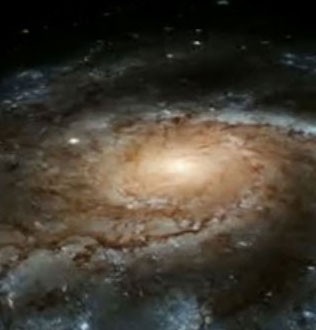

Super-dense bodies
Where might such a massive object be found? Very large stars, some with more than 10 times the mass of the Sun, burn up their fuel in a much shorter time—a few million years, compared to the Sun’s 10 billion years. They swell into massive supergiants before blasting apart in incredibly powerful explosions called supernovas. If the supernova's remaining core is more than about three times the mass of the Sun, it compresses in seconds down to a black hole.
A deep dent in space
The great German physicist Albert Einstein (1879–1955) found another way to explain how space, light and matter would behave close to a black hole. In his General Theory of Relativity of 1915, Einstein proposed that the gravitational pull of an object would result in the “curving” of space, in the same way that a person can curve a trampoline.
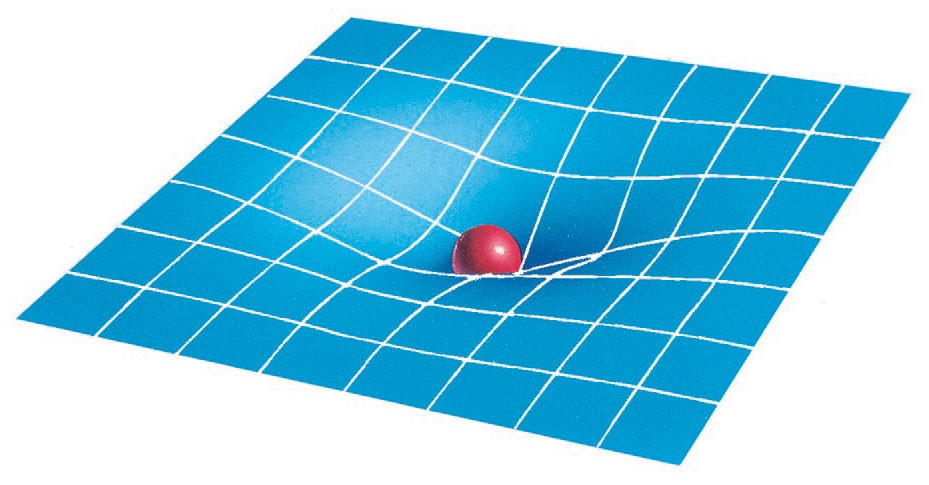
A massive object creates a large “dent” in space into which light and matter would fall. The denser the object, the greater the dent. So the Sun would make only a shallow dent, whereas a supergiant star would create a very deep dent. A black hole, the densest object of all, creates a dent so deep that nothing can escape from it.
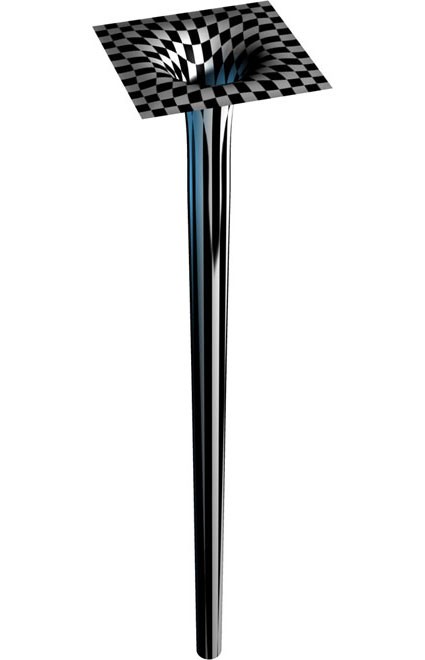
A good way to picture this event is to imagine a star in space as ball on a rubber sheet. A massive object like a star will “bend” space and anything close to it will fall in towards it. If the ball were so heavy (the relic of a supergiant star) that the sheet stretched into a long, deep tube, the result would be a black hole.
Detecting black holes
Black holes are invisible, but it is possible to detect them by studying their effects. Astronomers observing a star called Cygnus X-1 saw that it was giving off enormous amounts of energy (a sure sign of violent activity in the Universe). They discovered that this huge, hot blue star was being dragged by an unseen object with a huge gravitational pull. That unseen object, astronomers now believe, is a black hole, which is tearing gas from the star. The gas forms a whirling disc before plummeting into the black hole. As it falls, it travels faster and faster until it moves almost at the speed of light itself. Close to the hole, the gas becomes so hot it emits massive amounts of energy.

Supermassive
black holes
A supermassive black hole (SMBH) is the largest type of black hole. Its mass is at least a hundred thousand times the mass of the Sun, although some are millions, or even billions, times the mass of the Sun. A supermassive black hole is a spherical region of space surrounded by matter—dust and gas—spiralling into it, attracted by its enormous gravitational pull. A jet of high-energy particles, ejected by the black hole's spin, spurts out into space.
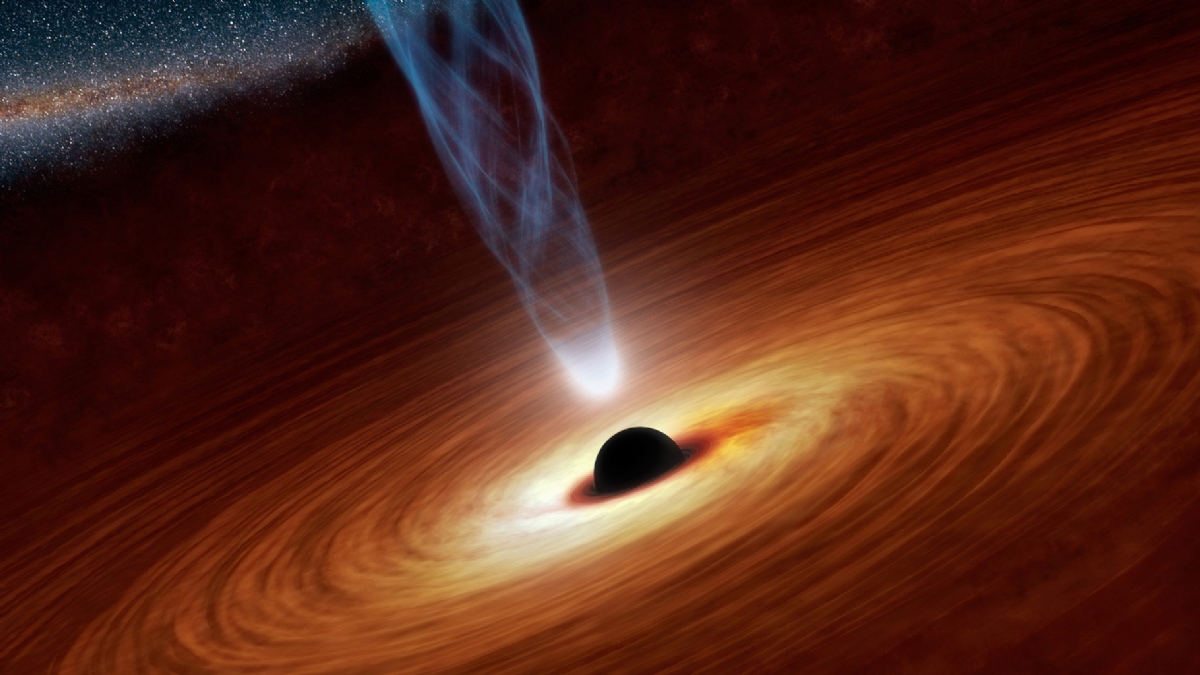
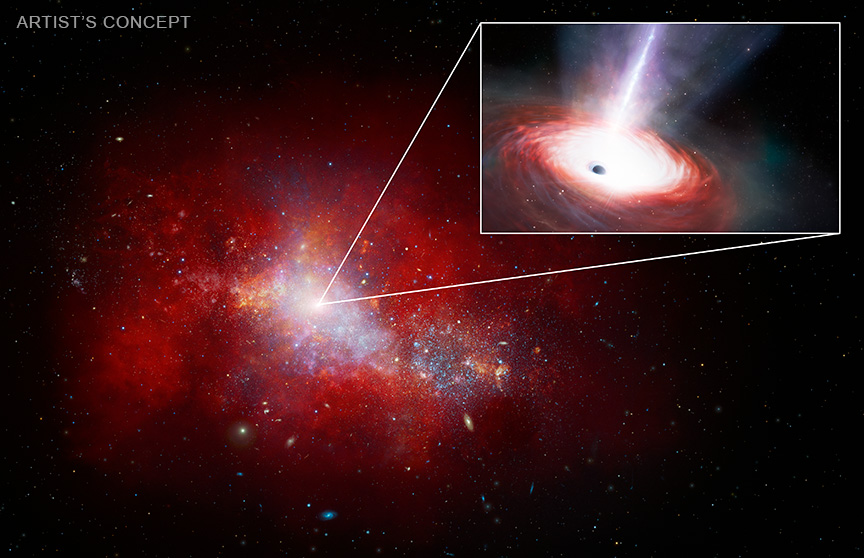
Supermassive black holes lie at the heart of every galaxy, including our own Milky Way Galaxy where Sagittarius A* is located. They form not from an exploding star but from the collapse of vast clouds of dust and gas. Astronomers are not yet able to explain the existence of very distant supermassive black holes which came into existence soon after the Big Bang—and therefore long before the first stars had time to collapse.
LID-568, a supermassive black hole discovered using the James Webb Space Telescope in 2024, is consuming matter at 40 times the maximum speed scientists previously thought possible.
First image
In April 2019 the first ever image of a black hole was revealed. The image was of the Messier 87 galaxy, which lies 55 million light years from Earth. It shows a bright orange halo of dust and gas, and the shape of a supermassive black hole at the heart of the galaxy. It has an estimated mass equivalent to that of 6.5 billion times that of our Sun. The image was captured by the Event Horizon Telescope (EHT), a network of eight radio telescopes located in different parts of the globe, including Antarctica, Spain and Chile.


The halo is the black hole’s accretion disc, a fuzzy ring of gas and dust. The EHT detected radiation emitted by particles heated to billions of degrees Celsius swirling around the black hole at close to the speed of light before they disappear into it. The black hole itself cannot be seen. Instead, the image is of the region around it in which light is bent out of sight—the closest we can get to actually viewing a black hole. Hidden deep inside this region, the black hole’s boundary, known as the event horizon (from which the EHT takes its name), measures just under 40 billion kilometres across.
Quasars
The activity at the centre of our Galaxy is as nothing compared to that of quasars. These objects look like stars, but they lie at incredible distances from us: the farthest quasars are 13 billion light years away. To be visible at that distance means they must be giving off immense amounts of energy. Quasars are the centres of extremely violent galaxies, called active galaxies, containing supermassive black holes, weighing up to 100 billion Suns. The brilliant light comes from the disc of hot gas and dust spiralling into the black hole at the core of a quasar. The incredible energy blasts jets of particles—the component parts of atoms—out into space.

Consultant: Mike Goldsmith
pics


Without in any way limiting Q-files Ltd’s exclusive rights under copyright, any use of this publication to “train” generative artificial intelligence (AI) technologies to generate text is expressly prohibited. Q-files Ltd reserves all rights to license use of this work for generative AI training and development of machine learning language models.