
Universe

CITE
We have made every effort to follow citation style rules, but there may be some minor differences. If in doubt, please refer to the appropriate citation style manual.
Expansion of the Universe. (2026). In Q-files Encyclopedia, Space, Universe. Retrieved from
https://www.q-files.com/space/universe/expansion-of-the-universe
"Expansion of the Universe." Space, Universe, Q-files Encyclopedia, 17 Apr. 2026.
https://www.q-files.com/space/universe/expansion-of-the-universe.
Accessed 13 Sep. 2026.
Expansion of the Universe 2026. Space, Universe. Retrieved 13 September 2026, from
https://www.q-files.com/space/universe/expansion-of-the-universe
Space, Universe, s.v. "Expansion of the Universe," accessed September 13, 2026.
https://www.q-files.com/space/universe/expansion-of-the-universe


Expansion of the Universe
It was only about 100 years ago that scientists first realised that the Universe extended far beyond our own Milky Way Galaxy and contained many other galaxies besides our own. US astronomer Edwin Hubble, who made that discovery, went on to show that the Universe is expanding in all directions. He also estimated the rate of this expansion, calling it the Hubble Constant. Knowing how fast the Universe is expanding is important to astronomers because it tells them a great deal about the origin, age, evolution and eventually the fate of the Universe. For this reason, astronomers have sought to calculate an exact value for the Hubble Constant. But two different methods of measuring it give two different results. Despite the use of ever more precise technology, the discrepancy persists, leading some even to question whether the laws of physics need to be re-examined.


Henrietta Leavitt
At the beginning of the 20th century, most astronomers thought that the Universe consisted entirely of the Milky Way Galaxy. There was little understanding of its size: only the distances to the closest stars could be found, using the parallax method (recording the changing position of a star, and noting the difference in the viewing angle).
Studies undertaken by American astronomer Henrietta Swan Leavitt in 1912 opened the way for measuring the distances of stars that lay much further away. Leavitt examined photographic plates of the Small Magellanic Cloud, a hazy patch of light in the night sky (which today we know to be a small galaxy orbiting our own Milky Way). She focused her attention on types of stars later called Cepheid variables. These are stars that vary in brightness, or "pulse", over a regular period.

Having identified 26 Cepheids, in 1912 Leavitt reported an extraordinary discovery. She had found a mathematical relationship between the Cepheids’ pulsation periods and their apparent brightness (as seen from Earth): the brighter the star, the longer the interval between two consecutive points of maximum brightness. This is known today as Leavitt's Law.


Leavitt realised that, while no one knew the distance to the Small Magellanic Cloud, all of its stars must lie at roughly the same distance from Earth. Therefore, the intrinsic, or actual, brightness (also known as absolute luminosity) of the Cepheids she found in it could be worked out from their apparent brightness as recorded on the photographic plates. By calculating the distance to another Cepheid that lay relatively close to Earth (and so could be measured by the parallax method), Leavitt thus obtained a kind of measuring rod. This could be used for measuring vastly greater astronomical distances. Leavitt referred to Cepheid variables—stars of known brightness—as "standard candles". Her discovery led to a complete change in the understanding of the scale and nature of the Universe.
Edwin Hubble
In 1919, Hubble began his observations at the Mount Wilson Observatory, California, leading to a discovery that would completely change what we know about the Universe. The 2.5-metre (100-inch) Hooker Telescope, then the world's most powerful telescope, had recently been installed at the observatory. Training it on tiny smudges of light amid the stars (known at the time as "spiral nebulae"), Hubble identified Cepheid variables in several of them, including the Andromeda Nebula and Triangulum Nebula. Calculating their distances using Leavitt's Law, he proved, in 1924, that these nebulae were far too distant to be part of the Milky Way. The spiral nebulae were, in fact, other entire galaxies that lay beyond our own galaxy.


Hubble-Lemaître Law
Hubble now turned his attention to estimating the distances to other galaxies and to determine whether they were moving away from Earth. To do so, he combined the galaxies' distances he had measured using Leavitt's Law with measurements of the galaxies' redshifts, drawing on the work of another American astronomer, Vesto Slipher.
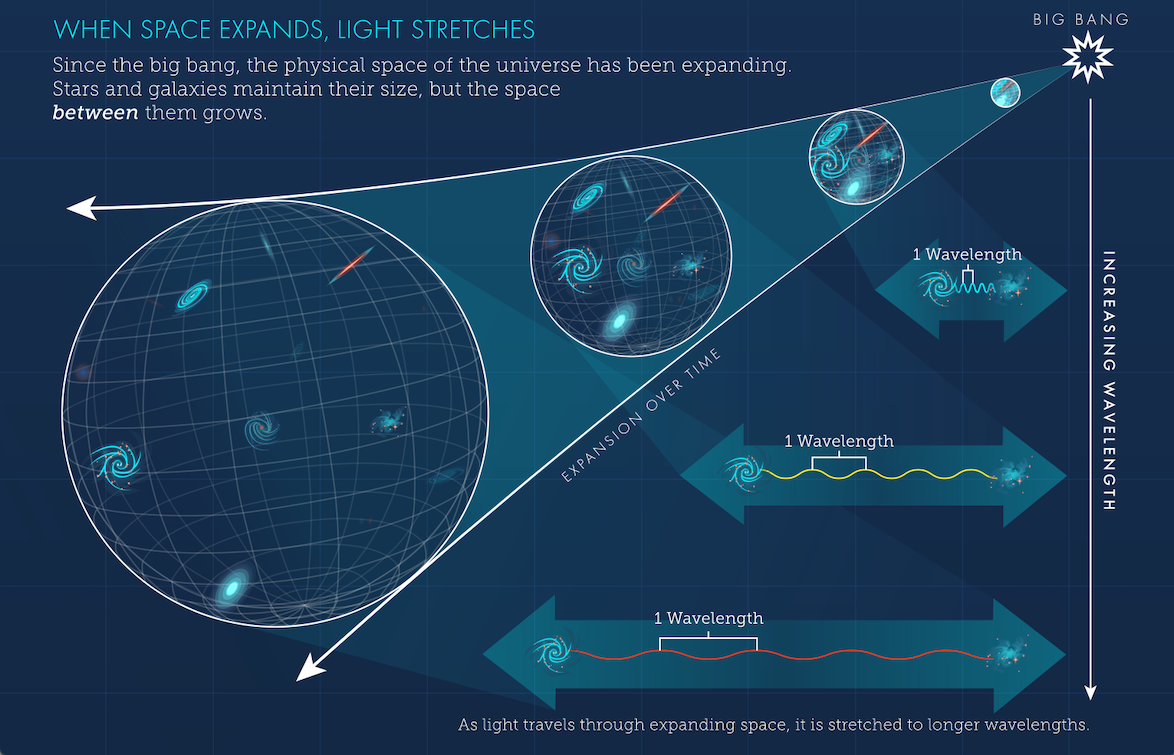
A redshift is a shift in the frequency of light waves emitted by a bright object as it moves away from the observer, towards the red end of the spectrum of light. The faster it retreats, the redder it becomes.
Hubble discovered there is a relationship between the galaxies' distances and the speed at which they appeared to be moving away from Earth, as revealed from their redshifts. In 1929 he proposed what came to be known as Hubble's Law: the farther away a galaxy is from Earth, the faster it is moving away from us. The movement of the galaxies relative to each another is due to the expansion of the Universe. The rate at which it expands is known as the Hubble Constant.
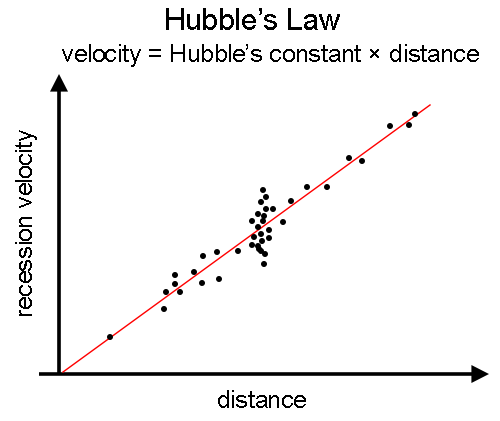

Two years earlier, in 1927, Belgian priest and physicist Georges Lemaître had also noticed that galaxies' speeds were proportional to their distance as the Universe expands, and suggested a value for the rate it was doing so. He worked independently from Hubble and his work was not widely known at the time. Lemaître's contribution was eventually fully acknowledged in 2018, when Hubble's Law was officially renamed the Hubble-Lemaître Law.
Hubble used observations of Cepheids as standard candles to measure the distance to some 46 galaxies and come up with a value of the Hubble Constant for himself. The result he obtained, however, was much greater than that calculated by today's astronomers (see below), because he greatly underestimated the galaxies' distances.
Today's astronomers now know that it is only galaxy clusters that move apart as the Universe expands. Held together by gravity, the galaxies within a cluster (such as our own Milky Way, part of the Local Group) do not move away from each other.
Finding the Hubble Constant
Since Hubble's own estimate of the Hubble Constant was published in 1929, there have been many attempts to provide a more accurate measure. One method has focused on measuring the distances of other galaxies and working out how fast they are speeding away from each other. This is known as the Late Universe approach, because it measures distances to galaxies as observed today, using what is called the cosmic distance ladder (see below).

The other method involves studying changes in the pattern of radiation, called the cosmic microwave background, that formed just after the Big Bang 13.8 billion years ago. This is known as the Early Universe approach.
Cosmic distance ladder

Today, astronomers are able to measure distances to galaxies lying at extreme distances from Earth with incredible accuracy. The process involves use of what is known as the cosmic distance ladder. This starts with measuring accurate distances to nearby galaxies and then moving on to measuring the distances to galaxies farther and farther away.
The first rung of the cosmic distance ladder uses measurements of distances to Cepheid variables, a method pioneered by Henrietta Leavitt (see above). By measuring the period of a Cepheid at an unknown distance, its actual brightness (absolute luminosity) can be calculated and compared with its apparent brightness (as seen from Earth). The difference between the two brightnesses is used to calculate the distance to the star and therefore to the galaxy hosting it.


Beyond about 60 million light years, Cepheids are too dim to find, however. So, in order to calculate distances to more distant galaxies, astronomers take the next rung of the ladder. They look for extremely bright exploding stars called type IA supernovae in galaxies that also contain Cepheids. Type IA supernovae can also act as standard candles because their absolute luminosity is proportional to their varying brightness. The Cepheids, whose distances are already determined, can be used to measure the absolute luminosity of the supernovae in the same galaxy. Astronomers then look for type IA supernovae in other, more distant galaxies to measure their distances.

Calculating the speeds at which distant galaxies are moving away from Earth is the final rung of the ladder. To do this, astronomers work out how much the light from these galaxies has redshifted (see above). Once the distances and speeds have been recorded for a number of galaxies, the rate of expansion of the Universe can be calculated.
This method has now been applied to extremely distant galaxies that are only possible to view with the most powerful, modern telescopes, such as the James Webb Space Telescope.
Data received from these telescopes indicate a rate of expansion (the Hubble Constant) of around 73.5 km per second per megaparsec. A megaparsec is the equivalent of 3.3 million light years. Thus for each 3.3 million light years that a galaxy is distant from us, it will move away an extra 73.5 km (45.6 miles) per second faster from us.
Cosmic microwave background

A different method for arriving at the Hubble Constant comes from measuring temperature fluctuations (irregular rising and falling) of the cosmic microwave background (CMB), the leftover radiation from when the Universe was still young. Ever since the discovery of the CMB in 1964, it has been generally accepted by scientists that the Universe originated in a hot, dense state (known as the Big Bang) and has been expanding ever since. The rate of expansion has depended on the type of matter and energy present in the Universe.
Surveys of the CMB have allowed scientists to plot the timeline of the evolution of the expanding Universe since the Big Bang. As a result, they have developed what is known as the standard cosmological model (otherwise known as the Lambda cold dark matter model, or LCDM).
According to this model, the Universe is thought to have expanded at different rates over the course of its existence. The very earliest expansion, called inflation, saw the Universe suddenly expand hugely in a minuscule fraction of a second after the Big Bang. This expansion decelerated to much slower rates until around 9.8 billion years after the Big Bang (4 billion years ago), when it began to gradually expand more quickly. It is still doing so today. Many scientists think it is the existence of dark energy that explains this later acceleration.


The CMB has been surveyed with increasing accuracy. The European Space Agency’s Planck Observatory, which mapped the CMB from 2009 to 2013, has taken the most precise measurements of temperature fluctuations ever recorded. The method produces an expansion rate of 67.4 km per second per megaparsec. However, this is a significantly lower rate than that found by the Late Universe approach, which is 73.5 km per second per megaparsec (see above).
In other words, the Universe today, as measured by the cosmic distance ladder, is expanding faster than we would predict based on our observations of the CMB in the Early Universe.
Hubble Tension
Astronomers had expected that the two different values for the Hubble Constant would match up more exactly as new measurements with ever finer precision were carried out. But this has not happened: the discrepancy between the two has persisted and, if anything, become greater since new techniques were adopted in the 2020s. This has come to be known as the “Hubble Tension”.
The Late Universe measurement tells us how fast the Universe is expanding today, while the Early Universe measurement is based on a model of the Universe soon after it came into being (the standard model) and how fast it ought to have expanded since then. Assuming the instruments and methods used to measure the Hubble Constant are accurate—and they have been independently confirmed by different research teams—the 6 km/sec difference between the two measurements probably means that the current standard model is incomplete in some way.
If the higher value of the Hubble Constant, 73.5 km per second per megaparsec, is correct, it would mean that the Universe has been expanding faster than previously thought, and that the Universe must be younger than its currently accepted age of 13.8 billion years—"only" around 12.7 billion years old. However, we know that some stars are 12 billion years old, and few astronomers believe they could have formed so early in the life of the Universe.

Astronomers have put forward a number of different ideas for how the standard model could be adjusted to explain the discrepancy. One proposes that the Universe contains certain types of subatomic particles—some still unknown to science—that travel close to the speed of light. These would affect the speed of the Universe’s expansion. Called dark radiation, the particles may include a kind already known: neutrinos. Another idea is that there was an intense burst of dark energy soon after the Big Bang, causing the Universe to expand faster than currently thought.
The resolution to this disagreement is an ongoing area of active research.
Consultant: Mike Goldsmith
pics

Without in any way limiting Q-files Ltd’s exclusive rights under copyright, any use of this publication to “train” generative artificial intelligence (AI) technologies to generate text is expressly prohibited. Q-files Ltd reserves all rights to license use of this work for generative AI training and development of machine learning language models.