
Art

CITE
We have made every effort to follow citation style rules, but there may be some minor differences. If in doubt, please refer to the appropriate citation style manual.
Pablo Picasso. (2026). In Q-files Encyclopedia, Culture, Art. Retrieved from
https://www.q-files.com/culture/art/pablo-picasso
"Pablo Picasso." Culture, Art, Q-files Encyclopedia, 13 May. 2026.
https://www.q-files.com/culture/art/pablo-picasso.
Accessed 21 Sep. 2026.
Pablo Picasso 2026. Culture, Art. Retrieved 21 September 2026, from
https://www.q-files.com/culture/art/pablo-picasso
Culture, Art, s.v. "Pablo Picasso," accessed September 21, 2026.
https://www.q-files.com/culture/art/pablo-picasso


Pablo Picasso
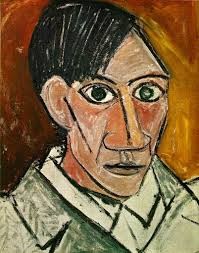
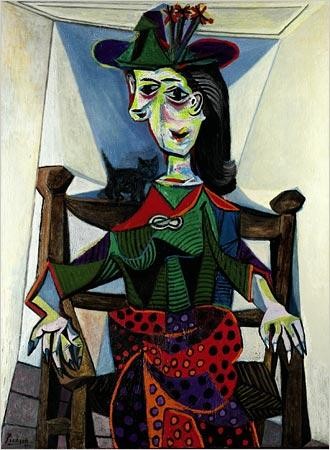
The Spanish artist Pablo Picasso (1881–1973) was the most famous artist of the 20th century. He spent most of his life in France. Over the course of a long career, lasting nearly 80 years, he produced thousands of paintings, drawings, prints, sculptures and ceramics. Many of his portraits are painted in a distinctive style with the face rearranged and both eyes on the same side of the head. He transformed modern art several times over, developing new techniques and styles, including Cubism, and leaving behind him some of the most celebrated artworks of modern times.

Early life
Pablo Ruiz y Picasso was born in Malaga, Spain on 25th October 1881. His father was a painter who taught his son how to draw figures and paint in oils. His family moved to Barcelona, where he entered the School of Fine Arts in 1895. In 1897, aged 16, Picasso went to the Royal Academy of San Fernando, a major art school in Madrid. He disliked its formal education, however, and soon left, preferring to spend his time studying the paintings in Madrid's Prado art museum.
Paris
In 1900, already an accomplished painter, Picasso moved to Paris, where he began to sell his work and became increasingly successful. In 1918 he painted the first of several stage sets for the Russian choreographer (director of ballet) Serge Diaghilev and his revolutionary Ballets Russes. By now Picasso was internationally famous. He remained in Paris during the occupation of the city by Nazi German forces from 1940 to 1944, before moving to the south of France in 1946. There he died in the village of Mougins, near Cannes, France, on 8th April 1973, aged 91. Picasso had many lovers. He was married twice and had four children.
Early styles
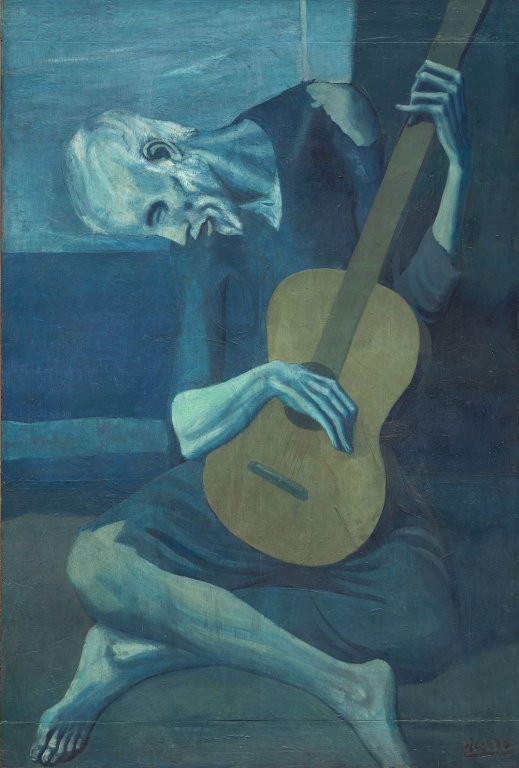
Picasso had begun to develop his own distinctive style already in the 1890s. His paintings looked fairly realistic, although he was already experimenting with "unnatural colouring". In what is known as his Blue Period, between 1901 and 1904, Picasso painted sombre portraits of mothers with children and beggars in shades of blue and blue-green. The gloomy nature of these works reflected his sadness on hearing of the death of a close friend.
Picasso's mood lightened by about 1904. He then embarked on what was called his Rose Period (1904–6), in which he painted circus people and acrobats in a brighter, more cheerful colour scheme of oranges and pinks, to express his new, sunnier mood. Picasso then became influenced by African art, in particular masks.
Cubism and later styles
Working with the French artist Georges Braque (1882–1963), Picasso created the new style of Cubism. The painting that gave rise to Cubism was called Les Demoiselles d’Avignon, which Picasso painted in 1907.
The painting shows five naked women, their bodies rearranged into odd angles and surfaces. In some Cubist paintings, he stuck fragments of newsprint and wallpaper to the painting, the first time collage had been used in fine art. After the end of World War I in 1918 Picasso returned to a more traditional, formal style known as Neoclassicism. Towards the end of his life, Picasso changed styles once again, painting a series of works based on the works of great painters from previous centuries such as Velazquez, Goya, Delacroix and Manet.

Guernica
In 1937 Pablo Picasso was asked by the Spanish government to produce a large painting for the Spanish Pavilion at the Paris World Fair. At that time, the Spanish Republican government was fighting a vicious civil war against the Nationalist forces of General Franco, who was supported by Nazi Germany. On 26th April 1937, German bombers attacked the Basque town of Guernica, killing around 1600 people. In response, Picasso painted a vast anti-war painting in black, grey and white. The nightmarish image shows severed heads, wounded horses, bulls—Picasso was a great fan of bullfights—and people in great distress.
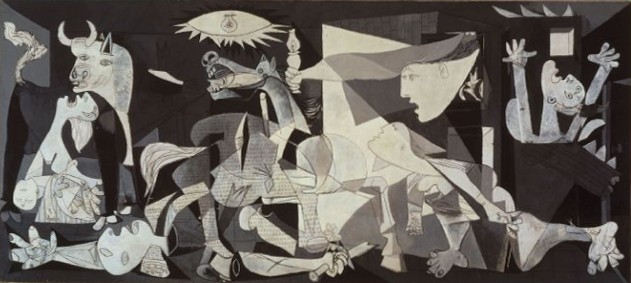

After the Fair, the painting went on tour to Scandinavia and England, where it raised funds for the Republican government. It then went to the USA. Picasso stated that Guernica was never to return to Spain until the country became a democracy again. Franco died in 1975, and Spain did indeed become a democracy. The painting duly returned from the USA to Spain in 1981 and now hangs in the Museo Nacional Centro de Arte Reina Sofia in Madrid.
Picasso's later works were a mixture of styles. Always daring and experimental, his creations became more colourful and expressive. He also produced many works of sculpture, including well-known public sculptures such as what became known as the Chicago Picasso, unveiled in the city in 1967.
Consultant: Philip Wilkinson
pics
Without in any way limiting Q-files Ltd’s exclusive rights under copyright, any use of this publication to “train” generative artificial intelligence (AI) technologies to generate text is expressly prohibited. Q-files Ltd reserves all rights to license use of this work for generative AI training and development of machine learning language models.