
EASY READ The Earth

CITE
We have made every effort to follow citation style rules, but there may be some minor differences. If in doubt, please refer to the appropriate citation style manual.
EASY READ Earth glossary. (2026). In Q-files Encyclopedia, Earth, EASY READ The Earth. Retrieved from
https://www.q-files.com/earth/easy-read-the-earth/easy-read-earth-glossary
"EASY READ Earth glossary." Earth, EASY READ The Earth, Q-files Encyclopedia, 1 May. 2026.
https://www.q-files.com/earth/easy-read-the-earth/easy-read-earth-glossary.
Accessed 30 Oct. 2026.
EASY READ Earth glossary 2026. Earth, EASY READ The Earth. Retrieved 30 October 2026, from
https://www.q-files.com/earth/easy-read-the-earth/easy-read-earth-glossary
Earth, EASY READ The Earth, s.v. "EASY READ Earth glossary," accessed October 30, 2026.
https://www.q-files.com/earth/easy-read-the-earth/easy-read-earth-glossary


Earth glossary
Abyssal plain A flat region of the ocean floor, covered by a thick layer of mud and other sediments.
Atmosphere The blanket of gases surrounding the Earth that enables life to exist.
Climate A long-term pattern of weather.
Condensation The process by which a gas becomes liquid.
Continental drift The slow movement of continents around the globe.
Continental shelf The part of a continent that lies beneath ocean waters.
Core The innermost portion of the Earth.
Crust The thin, rocky outer layer of the Earth.
Desert An area of very low rainfall.
Earthquake A shaking or trembling of the ground, caused by the sudden movement of part of the Earth's crust.
Erosion The wearing away of the Earth's surface by water. ice, or wind.
Evaporation The process by which a liquid becomes gas.
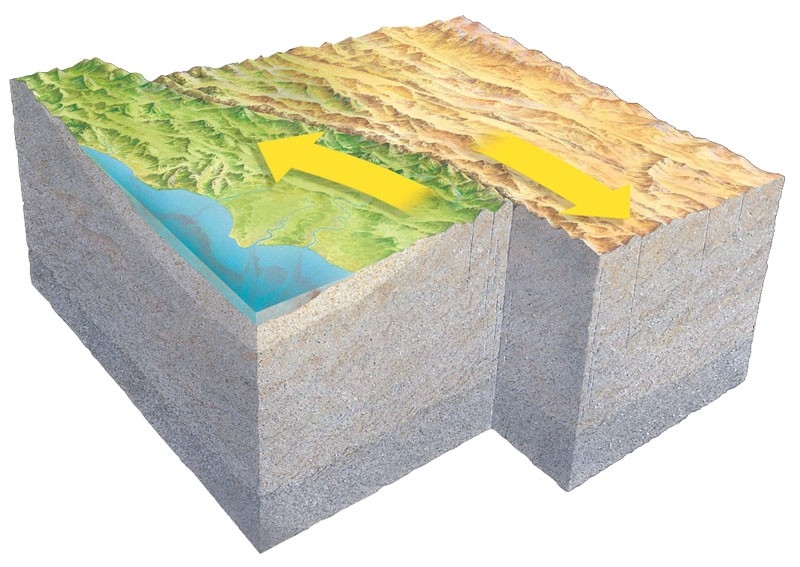
Fault A crack in the Earth's crust, along which there is movement of one side relative to the other.
Fold A bend or buckle in rock caused by intense pressure.
Fossil The ancient remains or traces of a once-living thing, usually found preserved in rock.
Geyser A natural fountain of hot water or steam blasted out through a hole in the crust. It erupts when underground water is heated by hot, volcanic rocks.
Glacier A mass of ice that moves slowly downhill. It is made from layers of snow that collect in basins between high mountain peaks.
Global warming The gradual rise in the temperature of the Earth. It is caused by the build-up of greenhouse gases through human activity: burning fossil fuels, such as oil, coal and gas.
Greenhouse effect The warming of the Earth caused by certain gases in the atmosphere that trap some of the Sun’s heat. These gases, such as carbon dioxide and methane, are called greenhouse gases.
Hurricane A massive, spinning storm of wind and rain.
Igneous rock A type of rock formed from magma that has cooled and hardened.
Lava Magma that has reached the Earth's surface through volcanoes or fissures, cracks in the crust.
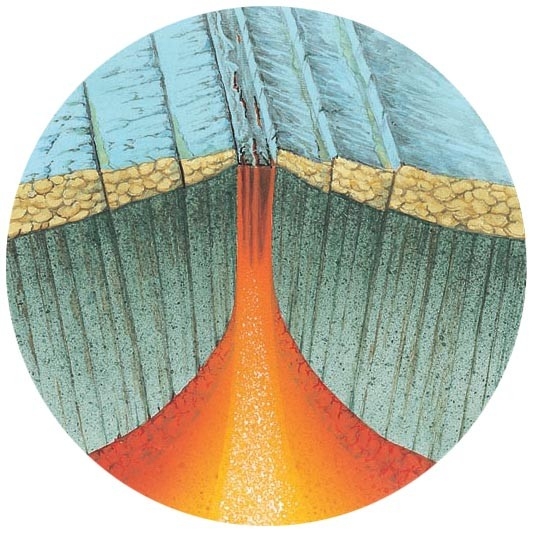
Magma Hot melted, or molten, rock that is formed mainly in the Earth's upper mantle, but also deep in the crust.
Mantle The layer of the Earth that lies between the crust and outer core.
Metamorphic rock A rock that has changed due to intense pressure or heat. Metamorphic rocks can form from igneous rocks, sedimentary rocks, or even other metamorphic rocks.
Meteor A mass of rock or metal that has entered the Earth's atmosphere, often forming a streak of light as it burns.
Mid-Oceanic Ridge A long mountain range under the ocean, where magma rises to the Earth's surface.
Monsoon Winds that change direction between summer and winter. In summer the monsoon winds bring torrential rain with them.
Ocean The vast body of salt water that covers approximately 71% of the Earth's surface.
Ocean current The movement of ocean waters around the Earth.
Ocean trench A long, narrow, deep valley in the ocean floor.
Rift valley A steep-sided valley produced when a block of land slips down between two faults.
Rocks The hard materials that make up the Earth’s crust. They are themselves made up from a solid mixture of chemical substances called minerals.
Sea The smaller part of an ocean which is partly enclosed by land—for example, the Mediterranean Sea or North Sea.
Seamount An underwater mountain that is formed by volcanic eruptions.
Seasons Time periods in the year, marked by changes in the weather.
Sedimentary rock A type of rock that is formed by the pressing together of rock fragments and/or the remains of living things.
Sediments Eroded rock fragments that are transported by wind, water or ice. Sand, gravel, silt and mud are all types of sediment.
Subduction The process by which the edge of one tectonic plate slips beneath another. The place where this occurs is called a subduction zone.
Tectonic plates The large slabs into which the Earth's surface is divided.
Tornado A twisting column of air in which winds swirl at high speed. As it moves it destroys everything in its path.
Volcano An opening in the Earth's crust through which magma erupts. The name is usually used to describe a cone-shaped mountain with a central vent and a crater at the summit.
Water cycle The process by which water circulates from the land or oceans to the atmosphere and back again.
Wind Air moving from one place to another. The Sun makes some regions of air warmer than others. When warm air rises, cooler air flows in to take its place. This is wind.
Consultant: Ian Fairchild
pics
Without in any way limiting Q-files Ltd’s exclusive rights under copyright, any use of this publication to “train” generative artificial intelligence (AI) technologies to generate text is expressly prohibited. Q-files Ltd reserves all rights to license use of this work for generative AI training and development of machine learning language models.