
EASY READ The Earth

CITE
We have made every effort to follow citation style rules, but there may be some minor differences. If in doubt, please refer to the appropriate citation style manual.
EASY READ Why do volcanoes erupt?. (2026). In Q-files Encyclopedia, Earth, EASY READ The Earth. Retrieved from
https://www.q-files.com/earth/easy-read-the-earth/easy-read-why-do-volcanoes-erupt
"EASY READ Why do volcanoes erupt?." Earth, EASY READ The Earth, Q-files Encyclopedia, 6 Mar. 2026.
https://www.q-files.com/earth/easy-read-the-earth/easy-read-why-do-volcanoes-erupt.
Accessed 13 Sep. 2026.
EASY READ Why do volcanoes erupt? 2026. Earth, EASY READ The Earth. Retrieved 13 September 2026, from
https://www.q-files.com/earth/easy-read-the-earth/easy-read-why-do-volcanoes-erupt
Earth, EASY READ The Earth, s.v. "EASY READ Why do volcanoes erupt?," accessed September 13, 2026.
https://www.q-files.com/earth/easy-read-the-earth/easy-read-why-do-volcanoes-erupt


Why do volcanoes erupt?
A volcano is an opening in the Earth’s crust through which magma (molten rock) erupts. Some volcanoes are cone-shaped mountains with a crater at the summit. Others can be just a crack in the ground, called a fissure. A volcano may erupt lava, ash, dust, fumes, gas and lumps of rock called volcanic bombs.

Explosive eruptions

Some volcanoes erupt in spectacular explosions. The erupted magma, called lava, is blown to fragments (ash) and powder (dust) by the force of the explosion. The volcano shoots this ash and dust high into the air. Over time, many layers of powdered lava pile up to form a cone-shaped, steep-sided mountain. The eruptions of Vesuvius in AD 79 and Mount St Helens in 1980 are examples of explosive eruptions.

Hawaiian eruptions
In other volcanic eruptions, the lava oozes out gently, like boiling syrup. It spreads out over a wide area. As it cools it tuns into solid rock. Hawaiian eruptions are named after the volcanoes on the Hawaiian Islands in the Pacific, which erupt like this. Mount Etna in Sicily is another example of a Hawaiian eruption.
Strombolian eruptions
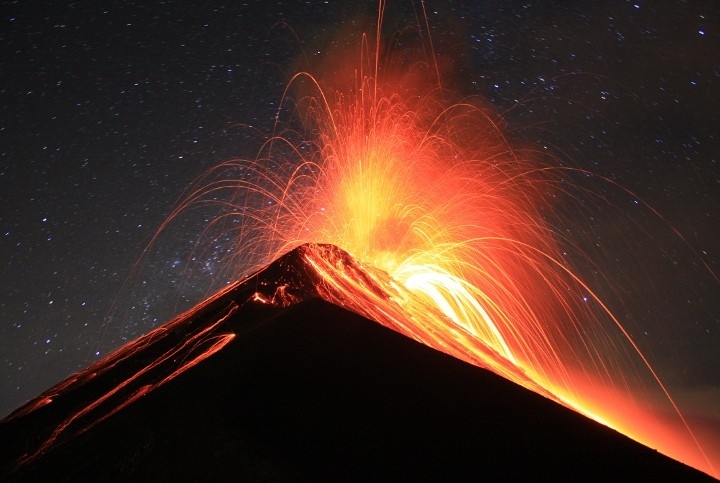
There are some volcanoes that erupt all the time. Stromboli, in the Aeolian Islands of Italy, has been erupting for centuries. In these volcanic eruptions, lava, along with lumps of rock, is thrown high into the air.
Ring of Fire

More than half of the world's active volcanoes encircle the Pacific Ocean. They form what is called the "Ring of Fire". This area, also called the Pacific Rim, has many earthquakes. This is because there are many tectonic plate boundaries surrounding the Pacific Ocean. The Earth’s crust near these boundaries has weak points through which magma can rise easily to the surface.
Active, dormant or extinct?
An active volcano erupts lava, ash and dust frequently. When a volcano has not erupted for many years, it is called a dormant volcano. This type of volcano may erupt again some time in the future. When eruptions stop altogether, the volcano is described as extinct.

Consultant: Ian Fairchild
Ready to find out more?
Here are some pages in another part of Q-files you might like to explore:
Volcanoes
Types of volcanic eruption
pics
Without in any way limiting Q-files Ltd’s exclusive rights under copyright, any use of this publication to “train” generative artificial intelligence (AI) technologies to generate text is expressly prohibited. Q-files Ltd reserves all rights to license use of this work for generative AI training and development of machine learning language models.