
Oceans

CITE
We have made every effort to follow citation style rules, but there may be some minor differences. If in doubt, please refer to the appropriate citation style manual.
Waves. (2026). In Q-files Encyclopedia, Earth, Oceans. Retrieved from
https://www.q-files.com/earth/oceans/waves
"Waves." Earth, Oceans, Q-files Encyclopedia, 6 Mar. 2026.
https://www.q-files.com/earth/oceans/waves.
Accessed 6 Nov. 2026.
Waves 2026. Earth, Oceans. Retrieved 6 November 2026, from
https://www.q-files.com/earth/oceans/waves
Earth, Oceans, s.v. "Waves," accessed November 6, 2026.
https://www.q-files.com/earth/oceans/waves


Waves
As wind moves across the surface of the ocean, the water turns over and over in circles, forming waves. The stronger the wind and the wider the expanse of ocean it has blown across, the greater the waves. The wave itself moves along, but the water in a wave does not. It spins around in the same place and makes the water below turn, too. In mid-ocean, large waves, called swell, can develop.

Breakers
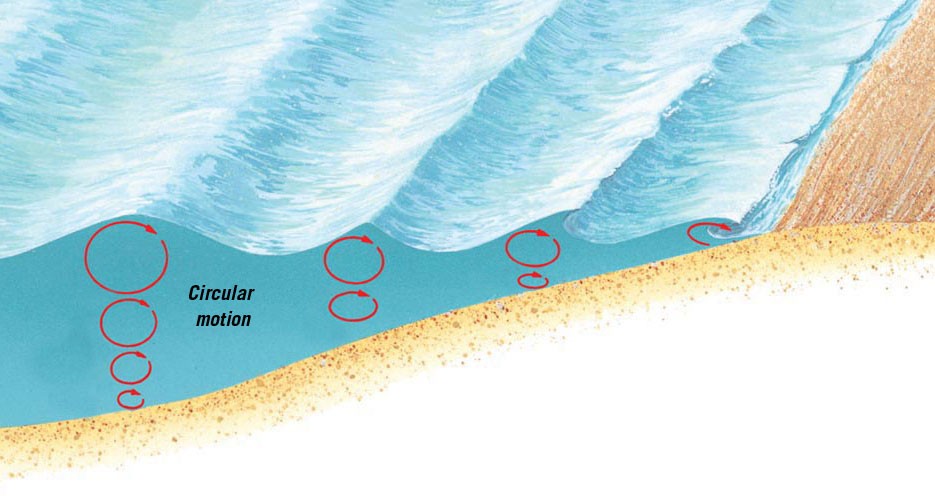
As a wave approaches the shallower seashore, the lower part drags on the sea bed, causing the circular spinning motion to become more and more elliptical (oval) in shape. Eventually the upper part of the wave topples over, or breaks, on the shore.

Wave erosion
Waves, particularly during a storm, can be powerful forces of erosion. Air trapped inside joints and faults in the rocks is compressed by the massive force of the waves when they strike the cliffs. This causes explosions that break up the rock, sending whole blocks crashing into the sea. When waves undercut soft rocks, creating a notch at the base of the cliff, the rocks collapse on to the shore and break up into tiny fragments.
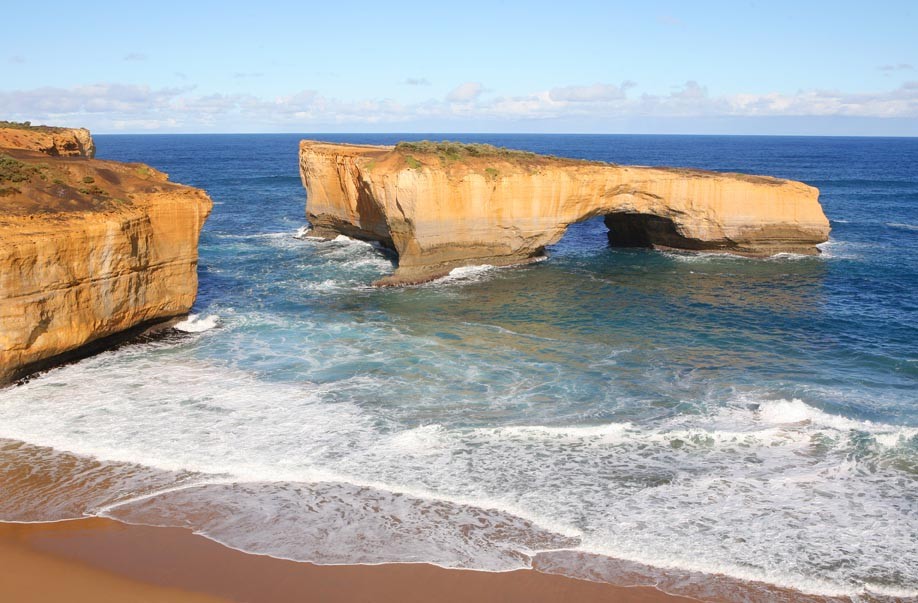
A headland may be attacked on both sides, becoming narrower and narrower. Joints and other weak areas are enlarged into sea caves. If caves form on either side of a headland, they may join up as a tunnel, later becoming a natural arch. If this collapses, a stack will result. This, too, eventually crumbles away over time.
Consultant: Ian Fairchild
pics
Without in any way limiting Q-files Ltd’s exclusive rights under copyright, any use of this publication to “train” generative artificial intelligence (AI) technologies to generate text is expressly prohibited. Q-files Ltd reserves all rights to license use of this work for generative AI training and development of machine learning language models.