
EASY READ Famous people
Who was Nelson Mandela?
From the 1940s until 1994, Nelson Mandela (1918–2013) was a leader in the struggle against apartheid (segregation, the keeping people of different races apart) in South Africa. During that time, he was held as a prisoner for 27 years. In 1994, Mandela became the first black president of South Africa. He was also the first president to be elected by voters of all races in that country.


Early life
Nelson Mandela was born Rolihlahla Mandela on 18th July 1918 in a small village in the Transkei region, southeastern South Africa. His father was a chief of the Thembu clan, a Xhosa-speaking people. He attended the local Methodist school, where the teacher gave him his English name, Nelson. His father died when he was nine, and he was cared for by Jongintaba Dalindyebo, the acting chief of the Thembu people.
Law student
In 1941, Mandela ran away from home to avoid an arranged marriage (one where the bride or groom is chosen by family members). He went to Johannesburg, where he found work in a law firm while he studied for a degree in law. He was the only black student in the law faculty at the University of Witwatersrand. In 1944, he joined the African National Congress (ANC). This organization was dedicated to fighting for equal rights for black people.


Apartheid
In 1948, there was a general election in South Africa. Only white people were allowed to vote. It resulted in victory for the National Party. This then introduced a policy of racial segregation and discrimination, known as apartheid.
In 1952, the ANC planned a campaign to oppose this policy. They were inspired by Mahatma Gandhi in India, who believed that non-violence was the best way to fight for independence for his country.

By law, the South African government required non-whites to carry documents with them in order to be allowed into "restricted" areas. The ANC challenged this law. The government then arrested thousands of protesters and introduced even harsher measures. Mandela himself was arrested in 1952, and again in 1956.
Sharpeville and after

On 21st March 1960, the police opened fire on a group of unarmed black protesters at Sharpeville, killing 69 people. When riots broke out, Mandela and other ANC leaders were arrested. The ANC was banned.

Mandela now changed his mind: non-violent protest could not work against apartheid. He started a new campaign of sabotage (deliberate destruction), aimed at targets such as power stations and telephone lines. In August 1962, he was arrested once more and sentenced to five years' imprisonment. The following year, he was tried for sabotage and for attempting to violently overthrow the government. This time the sentence, passed in 1964, was life imprisonment.
In prison
Mandela was sent to a prison on Robben Island, just off the west coast of South Africa. He spent 18 years there living in a tiny cell and was forced to work in a quarry. When his mother, and then his eldest son died, he was not permitted to go to their funerals. In 1982, he was moved to Pollsmoor Prison in Tokai, Cape Town.

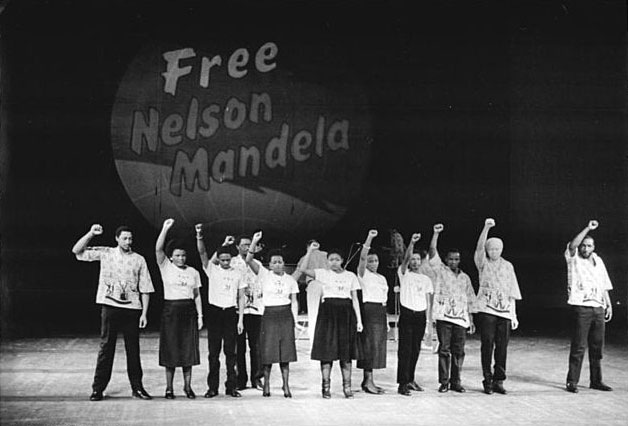
By this time, an international campaign to free Mandela had begun. Many countries had imposed sanctions (measures to damage a country's trade) on South Africa. On his 70th birthday in 1988, a Nelson Mandela tribute concert was held in Wembley Stadium in London. It was broadcast around the world and attracted an audience of hundreds of millions of people.

Nobel Peace Prize
In 1990, the South African president FW de Klerk lifted the ban on the ANC. On 11th February, Mandela was released from prison. He became president of the ANC in July 1991. He worked with de Klerk to end apartheid and bring about a peaceful change to full democracy. Now people of all races would be able to vote. In 1993, Mandela and de Klerk were jointly awarded the Nobel Peace Prize.
President
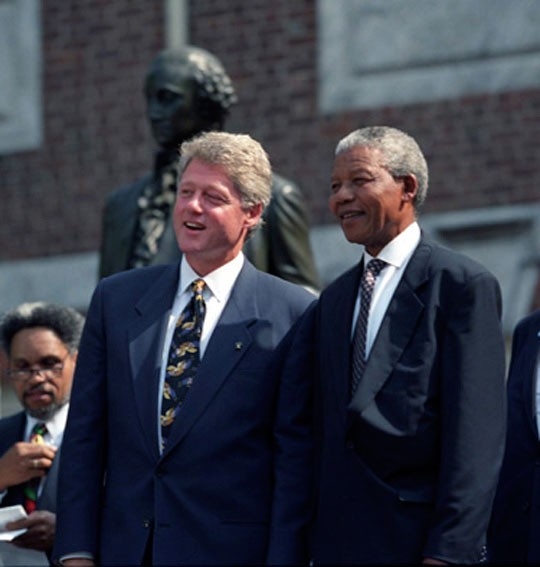
In April 1994, the ANC won the first full elections to be held in South Africa. Mandela became the country’s first black president. He worked hard to ensure that all people of the "Rainbow Nation" of South Africa were represented in government (FW de Klerk, for example, became Deputy President).

Retirement and death
Mandela did not stand for a second term as president. He retired in 1999. He remained active in public life, working to help to end conflict around the world. On 5th December 2013, at the age of 95, Nelson Mandela died after suffering from a long illness. More than 90 world leaders, including President of the USA Barack Obama, British Prime Minister David Cameron and the UN Secretary General Ban Ki-moon, attended his memorial service in Johannesburg.
Ready to find out more?
Here are some pages in other parts of Q-files you might like to explore:
Nelson Mandela
World history since 1945
Consultant: Philip Parker