
Famous leaders

CITE
We have made every effort to follow citation style rules, but there may be some minor differences. If in doubt, please refer to the appropriate citation style manual.
John F. Kennedy. (2022). In Q-files Encyclopedia, History, Famous leaders. Retrieved from
https://www.q-files.com/history/famous-leaders/john-f-kennedy
"John F. Kennedy." History, Famous leaders, Q-files Encyclopedia, 10 Feb. 2022.
https://www.q-files.com/history/famous-leaders/john-f-kennedy.
Accessed 6 Aug. 2026.
John F. Kennedy 2022. History, Famous leaders. Retrieved 6 August 2026, from
https://www.q-files.com/history/famous-leaders/john-f-kennedy
History, Famous leaders, s.v. "John F. Kennedy," accessed August 6, 2026.
https://www.q-files.com/history/famous-leaders/john-f-kennedy


John F. Kennedy
In January 1961, John F. Kennedy (1917–1963) became the youngest person ever to be sworn in as president of the United States, at the age of 43. Amongst other things, his time as president is remembered for the Bay of Pigs invasion and Cuban missile crisis, for the Nuclear Test-Ban Treaty, for the start of the US Apollo space programme, and for the creation of the Peace Corps. His presidency was brought to an abrupt end when he was assassinated in Dallas, Texas, on 22nd November 1963. He is particularly remembered for his powerful speeches, and for his belief that people could solve their problems if they were willing to work together as citizens of their country.

Early life
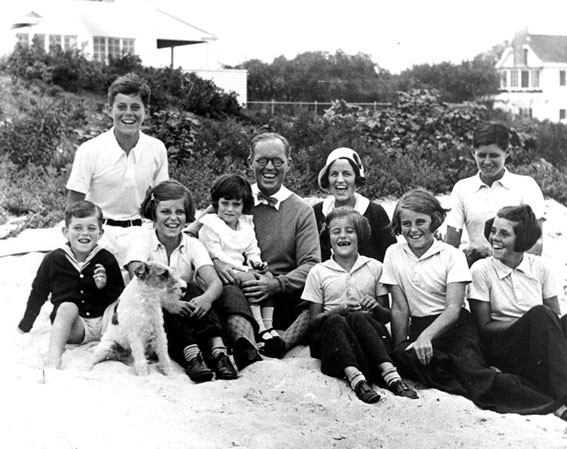
The Kennedy family came to the United States from Ireland in 1849, settling in Boston, Massachusetts. John Fitzgerald (often known as Jack) was the second of nine children born to Joseph Kennedy and his wife Rose. Joseph was a banker and amassed a huge fortune. John went to several schools, where he excelled at sport. He was, however, dogged by ill-health and in 1936 he injured his spine in a football accident, an injury that would stay with him for the rest of his life. He studied at the London School of Economics before following his elder brother Joe to Harvard University.
War service
Kennedy was turned down for enlistment in the US army because of his back problems, but he was permitted to join the navy. He eventually took command of a patrol torpedo (PT) boat. In 1943, after the PT was rammed by a Japanese destroyer, Kennedy showed great courage in rescuing a badly burned member of the crew, and leading all his crew to safety by swimming to an island. He was awarded the Navy and Marine Corps Medal for
his heroism.
Marriage and politics
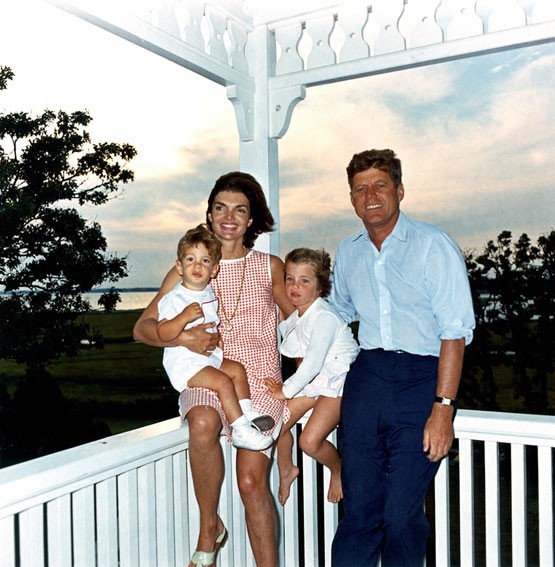
Kennedy was elected as a Democrat to the US House of Congress in 1946, and in 1952 he became a US senator. Not long after entering the US Senate, Kennedy married Jacqueline Bouvier, a newspaper photographer and renowned beauty. The couple went on to have two children.
In 1956, Kennedy just missed being nominated to run for the Democrats as vice-president. That campaign, however, made him a household name, and he decided to put all his efforts into running for president in the next election, in 1960. The glamorous and youthful Kennedy, with his beautiful and fashionable wife, provided an attractive proposition for many US voters.
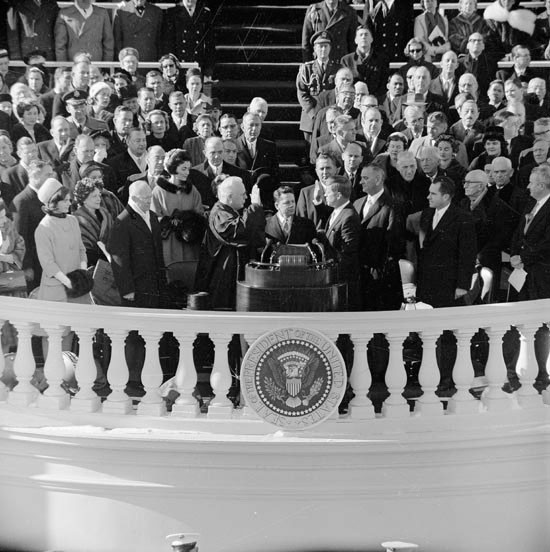
In the general election of 8th November 1960, John F. Kennedy defeated the Republican candidate, Richard M. Nixon, to become president of the United States. In his swearing-in ceremony, the following January, he stressed the need for people to be active citizens, famously stating: "Ask not what your country can do for you, ask what you can do for your country…".
Bay of Pigs
In the early 1960s, the Cold War between the USA and the Soviet Union was at its height. Fidel Castro had seized power in Cuba 1959, and established strong connections with the Soviet Union. As relations between Cuba and the USA worsened, the US Central Intelligence Agency (CIA) planned an invasion of Cuba. The aim was to spark an uprising against Castro. Kennedy gave approval for the plan to go ahead in April 1961, but the Bay of Pigs invasion (named after the principal landing site of the invaders) was a disaster. The Cuban forces completely overwhelmed the attackers. Many people blamed Kennedy for the failure of the operation.
Berlin
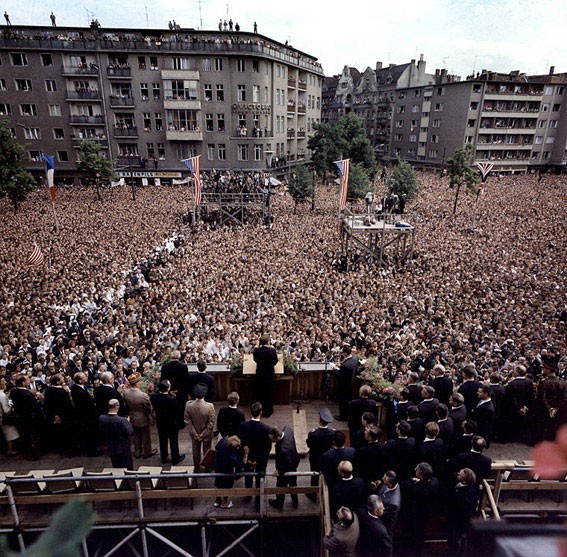
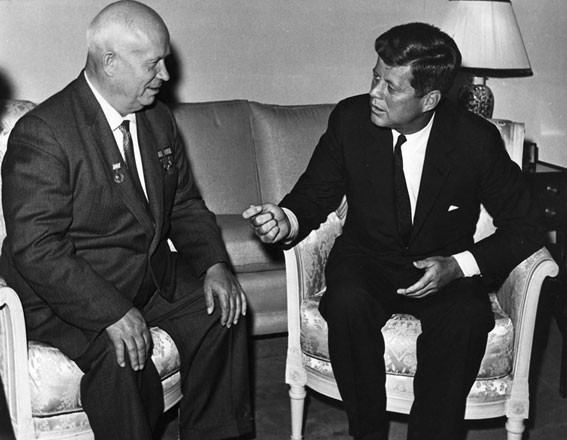
In June 1961, Kennedy met with the Soviet premier, Nikita Khrushchev. The main subject under discussion was the city of Berlin, which at that time was divided into a Soviet-controlled East sector and a British, French and US-controlled West sector. But the meeting between the two leaders did not prevent the Soviets from erecting the Berlin Wall across the city, to divide the two sectors and stop people from leaving East Berlin. Kennedy committed the USA to support the people of West Berlin, and in 1963 went to the divided city and made a famous speech criticizing Communism. He ended the speech by declaring, "Ich bin ein Berliner" ("I am a citizen of Berlin").
Nuclear threat
Both the USA and the Soviet Union were nuclear powers. In October 1962, photographs taken by US spy planes over Cuba showed that the Soviet Union was building nuclear missiles on the island. As the USA was well within range of these missiles, they posed an unacceptable threat. Kennedy demanded that the missiles be withdrawn. For several days the world seemed on the brink of nuclear war while Kennedy and Khrushchev continued their negotiations. But by the end of November, the missiles had been withdrawn.
Fight against Communism
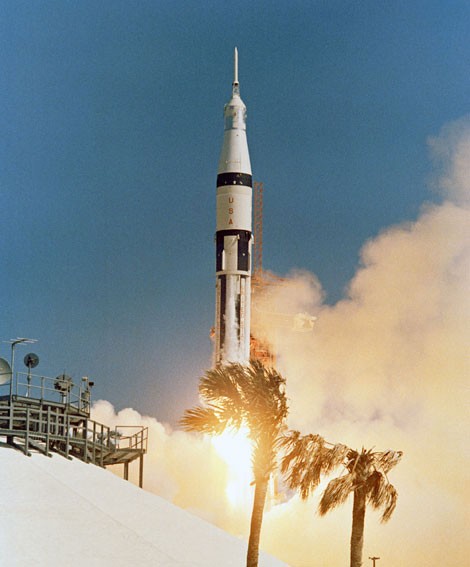
As part of the Cold War, Kennedy was committed to fight the spread of Communism in countries all around the world. In Southeast Asia, the Communist forces of Ho Chi Minh were threatening South Vietnam. Kennedy sent US military forces and equipment to help the South Vietnamese government fight the Communist threat. At home, even space research was a part of the Cold War battle. After the Soviets successfully put a man into space in April 1961, Kennedy ordered an increase in funding for US space research to land a man on the Moon before the end of the 1960s.
Policies at home
Kennedy called his programme for domestic policies the "New Frontier". He promised to prioritize spending on education, medical care for the elderly, help for farmers and tax reforms. He also wanted to bring an end to racial discrimination. In many of the southern states of the USA there was still segregation between black and white people in public places such a schools, buses, restaurants and theatres. In June 1963, Kennedy gave a landmark speech that proposed a Civil Rights Act to end discrimination against all African-Americans. This came into force in 1964, after Kennedy's death.
Assassination
With presidential elections due in 1964, President Kennedy flew to Texas in November 1963 to give several political speeches. He was accompanied by Jacqueline. On 22nd November, they were both sitting in an open-topped limousine driving slowly in a motorcade through the city of Dallas when a sniper opened fire. Kennedy was hit twice, once in the neck and once in the head. He was rushed to hospital, but died soon afterwards.

The police quickly tracked down the killer, a man named Lee Harvey Oswald, who seemed to be acting entirely alone. But Oswald was never brought to trial because two days later he was murdered by a local nightclub owner called Jack Ruby. After Kennedy’s assassination, vice-president Lyndon Johnson was quickly sworn in as president. President Johnson set up an enquiry into Kennedy’s death, but the assassination remains one of the most controversial crimes of the 20th century.
Consultant: Philip Parker
pics
Without in any way limiting Q-files Ltd’s exclusive rights under copyright, any use of this publication to “train” generative artificial intelligence (AI) technologies to generate text is expressly prohibited. Q-files Ltd reserves all rights to license use of this work for generative AI training and development of machine learning language models.