
EASY READ World history

CITE
We have made every effort to follow citation style rules, but there may be some minor differences. If in doubt, please refer to the appropriate citation style manual.
EASY READ Why were castles built?. (2025). In Q-files Encyclopedia, History, EASY READ World history. Retrieved from
https://www.q-files.com/history/easy-read-world-history/easy-read-why-were-castles-built
"EASY READ Why were castles built?." History, EASY READ World history, Q-files Encyclopedia, 5 Dec. 2025.
https://www.q-files.com/history/easy-read-world-history/easy-read-why-were-castles-built.
Accessed 1 Nov. 2026.
EASY READ Why were castles built? 2025. History, EASY READ World history. Retrieved 1 November 2026, from
https://www.q-files.com/history/easy-read-world-history/easy-read-why-were-castles-built
History, EASY READ World history, s.v. "EASY READ Why were castles built?," accessed November 1, 2026.
https://www.q-files.com/history/easy-read-world-history/easy-read-why-were-castles-built


Why were castles built?
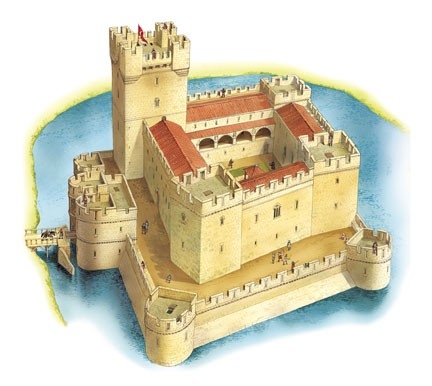
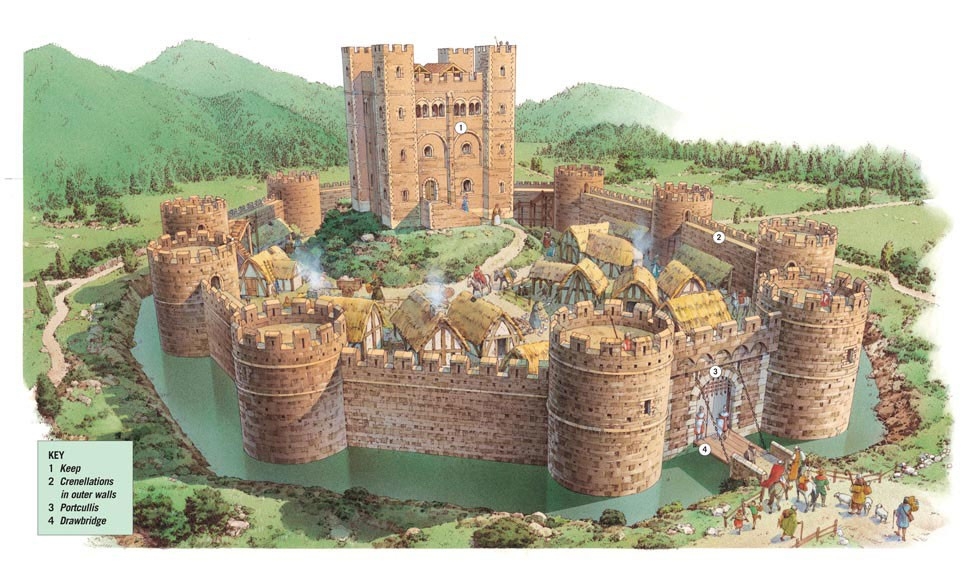
Castles were built by kings and lords in the Middle Ages to defend their lands. These massive buildings had thick, high walls with battlements. Most castles had a moat or ditch, a strong outer wall and a gatehouse with a drawbridge and portcullis. For extra protection, the outer walls had jagged tops, called battlements or crenellations. The main building of the castle was called a keep.


Middle Ages
The Middle Ages, also known as medieval times, lasted from around 600 to 1500. For much of this time, the king had to rely on barons, the most important noblemen in the land, to provide soldiers to help him fight wars against his enemies. In return, the king gave the barons land. The barons built castles on their new lands. They, along with their family and followers, lived inside the thick, high walls of their castle homes.
Stronghold
Wars often broke out between barons. The castle was a base from which he and his army could launch attacks on his enemies. It was also a stronghold to which he could retreat if he himself came under attack. Castles needed to be strong enough to withstand the weapons likely to used against them—anything from arrows or crossbow bolts to boulders hurled by giant catapults.
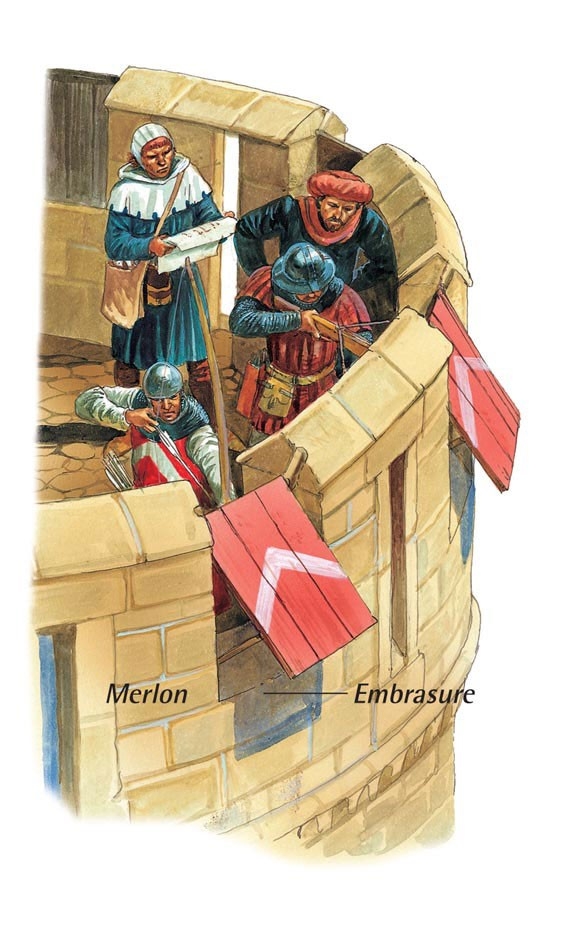
Castle defences


A gatehouse was built at the castle’s entrance. Two towers stood on either side of the entrance. From here, guards could shoot arrows down on intruders. The heavy gate to the castle was protected by one or more portcullises (heavy wood or iron grilles). The garrison (soldiers hired to defend the castle) spent most of their time in the gatehouse. They were under the command of the castle's constable.
The outer walls of the castle were usually topped with crenellations. These allowed defenders to fire arrows while remaining under cover. There were also narrow slits in the walls through which archers fired.
The castle was often surrounded by a ditch or a water-filled moat. A drawbridge across the moat could be pulled up if the castle was attacked.

Keep

The strong tower inside the walls was called the keep. This was where the lord and his family lived. It was the safest place to be if the castle ever came under attack. The stone walls were several metres thick. There were look-out towers on each of the four corners.
The keep was surrounded by a high stone wall called a curtain wall. Later, castles were designed without keeps. All the main rooms were inside the towers or housed in separate buildings inside the walls.
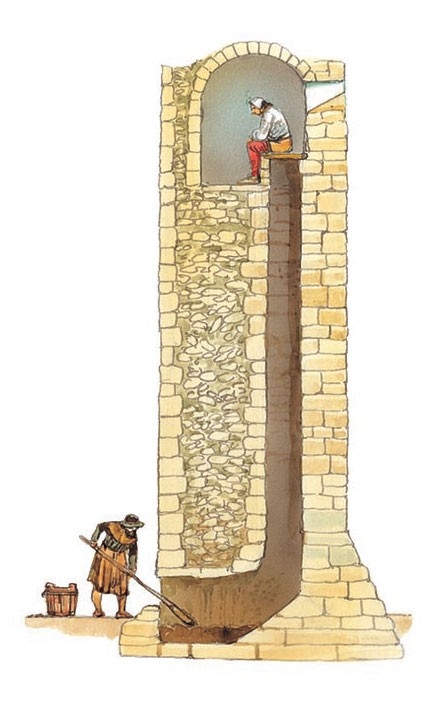
Toilets, or garderobes, were built into the walls. They consisted of a seat above a chute leading down into a cesspit. It was the job of workers called gong farmers to clean out the pit about twice a year.
Great Hall
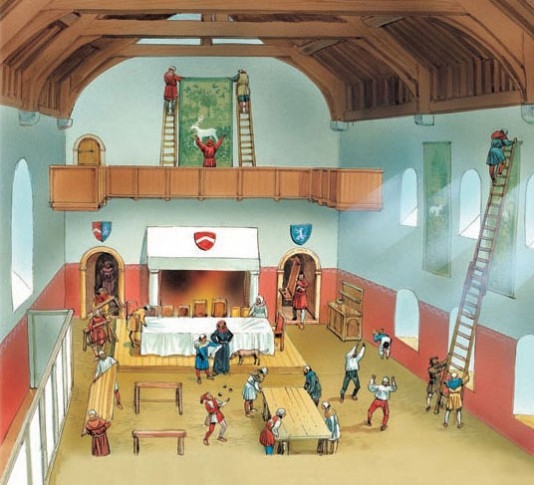
The Great Hall was the largest and grandest room in the castle. It was the general gathering and dining area for everyone in the castle. It was also the place where the lord of the castle received his guests. Here, the lord could show off his great wealth and throw grand banquets.
Bailey


The castle walls enclosed both the keep and one or more courtyards called baileys. Various workshops and other outbuildings were clustered inside the walls. The blacksmith made or mended metal objects, such as horseshoes. The armourer ensured that all weapons, chainmail and helmets were in good order.
The windmill ground grain into flour to make bread. The stables provided a home for the lord’s horses. The kitchens prepared food for the lord and his family.
Dungeon
The gatehouse also served as the castle prison, the dungeon. The damp, narrow cells were in the basement. They had very little light. They could be reached only through a trapdoor in the guardroom above.

Ready to find out more?
Here are some pages in other parts of Q-files you might like to explore:
Castles and knights
Building a castle
Castle gatehouse
Castle walls and battlements
Inside a castle
Life in a castle
Story of castles
Castles and knights A-Z
Consultant: Philip Parker
pics

Without in any way limiting Q-files Ltd’s exclusive rights under copyright, any use of this publication to “train” generative artificial intelligence (AI) technologies to generate text is expressly prohibited. Q-files Ltd reserves all rights to license use of this work for generative AI training and development of machine learning language models.