
Mathematics

CITE
We have made every effort to follow citation style rules, but there may be some minor differences. If in doubt, please refer to the appropriate citation style manual.
Measuring temperature. (2022). In Q-files Encyclopedia, Maths, Mathematics. Retrieved from
https://www.q-files.com/maths/mathematics/measuring-temperature
"Measuring temperature." Maths, Mathematics, Q-files Encyclopedia, 26 Oct. 2022.
https://www.q-files.com/maths/mathematics/measuring-temperature.
Accessed 21 Sep. 2026.
Measuring temperature 2022. Maths, Mathematics. Retrieved 21 September 2026, from
https://www.q-files.com/maths/mathematics/measuring-temperature
Maths, Mathematics, s.v. "Measuring temperature," accessed September 21, 2026.
https://www.q-files.com/maths/mathematics/measuring-temperature


Measuring temperature
Temperature is a measure of how fast the molecules in a substance are moving. When heat energy is added to an object, its molecules move faster and its temperature increases. A slice of apple pie at 40°C contains more heat energy than a same-sized slice of the same pie at 30°C. Temperatures can be measured accurately using devices called thermometers. Older thermometers used mercury, the only metal that is liquid at room temperature. Because mercury is poisonous, many types of thermometer nowadays usually use some type of liquid alcohol.


Thermometers
When a substance gets hotter, it expands to a greater volume. Nearly all substances have this property, which is called thermal expansion. It is the basis of how thermometers work. In a thermometer, liquid is enclosed in a tall, narrow glass (or plastic) tube. When the temperature increases, the liquid increases in volume, and the height of the column of liquid in the tube rises. The height is proportional to the increase in temperature. Marks, called calibrations, alongside the tube, give a measure of temperature according to a certain scale.
The first thermometers
A thermoscope is a simple device in which a liquid, such as water, rises and falls as the temperature changes. Usually, the water is held in a tube that leads up to a container filled with air. When the device cools, the air contracts and the water rises up the tube. The higher the water, the higher the temperature.
The first thermoscope was built by Galileo Galilei around 1592. In later versions, made in the 17th century, calibrations were added, producing the first thermometers. But each one was unique: there was no standard scale.

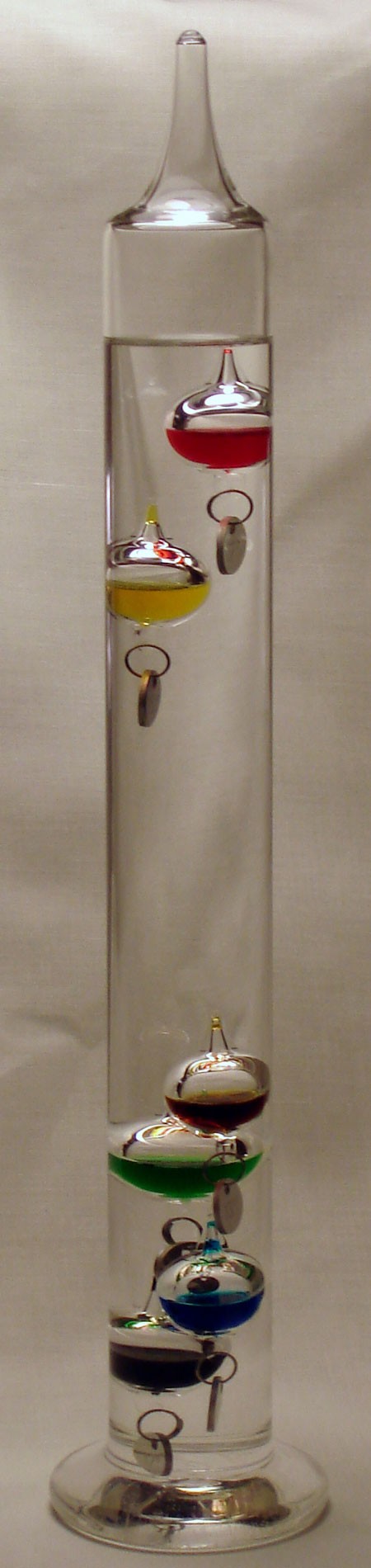
The Galileo thermometer is a modern version of Galileo's thermoscope, although it works in a different way. It is a sealed glass cylinder containing liquid with several glass bulbs of different densities. As the temperature changes, the bulbs rise or fall according to their density. The one that floats gives the approximate temperature.
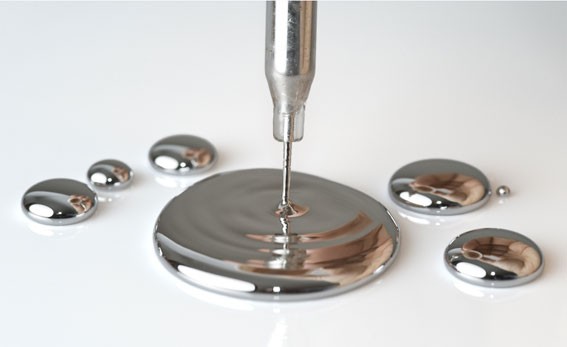
Mercury thermometer
Gabriel Daniel Fahrenheit (1668–1736), a German physicist, glass-blower and instrument-maker working in Holland, decided to improve the design of the thermometer. Thermometers of the time depended on the expansion and contraction of alcohol within a glass tube, but truly accurate ones were difficult to build.
In 1714, Fahrenheit saw the advantage of using mercury inside the glass tube instead, because it expands much less than alcohol and in a more regular manner. Using his glass-making skills, he constructed the first mercury thermometer.
Fahrenheit scale
To calibrate (mark a scale of measurement on) his new thermometer, Fahrenheit needed to choose two temperatures that were fixed in nature, mark them on the thermometer, then divide the length of tube into a number of equal degrees.
Instead of using the freezing point of water for the bottom of the scale—as suggested by Isaac Newton in 1701—Fahrenheit, accustomed to Holland's freezing winters, decided to adopt the freezing point of salt water for the lower extreme. At the top end, he chose the temperature of blood in the human body. Unfortunately, neither of these temperatures are fixed points, which limited the accuracy of his system.

Splitting his scale into 12 sections, each of them divided into eight equal parts, gave him a total of 96 degrees. Zero was the freezing point of salt water and 96° the temperature of blood. On the revised modern version of this scale, the freezing point of pure water is 32° and its boiling point at normal pressure 212°.

Celsius and Kelvin
In 1742, the Swedish astronomer Anders Celsius (1701–44) proposed a centigrade scale, which took the freezing and boiling temperatures of pure water at normal pressure as 100° and 0°. Because of its simplicity, it was quickly adopted for general use worldwide, apart from in English-speaking countries. However, it was soon reversed so that 100° became the boiling temperature and 0° the freezing temperature. In the USA, the Fahrenheit system is (outside scientific circles) still used today.
The SI unit of measurement of temperature is the kelvin (after British physicist William Thomson, Baron Kelvin, 1824–1907). Its lowest point is absolute zero, the coldest possible temperature, –273.15° on the Celsius scale.
Consultant: Mike Goldsmith
pics
Without in any way limiting Q-files Ltd’s exclusive rights under copyright, any use of this publication to “train” generative artificial intelligence (AI) technologies to generate text is expressly prohibited. Q-files Ltd reserves all rights to license use of this work for generative AI training and development of machine learning language models.