
Mathematics

CITE
We have made every effort to follow citation style rules, but there may be some minor differences. If in doubt, please refer to the appropriate citation style manual.
Famous mathematicians A-Z. (2026). In Q-files Encyclopedia, Maths, Mathematics. Retrieved from
https://www.q-files.com/maths/mathematics/famous-mathematicians-a-z
"Famous mathematicians A-Z." Maths, Mathematics, Q-files Encyclopedia, 15 Apr. 2026.
https://www.q-files.com/maths/mathematics/famous-mathematicians-a-z.
Accessed 6 Aug. 2026.
Famous mathematicians A-Z 2026. Maths, Mathematics. Retrieved 6 August 2026, from
https://www.q-files.com/maths/mathematics/famous-mathematicians-a-z
Maths, Mathematics, s.v. "Famous mathematicians A-Z," accessed August 6, 2026.
https://www.q-files.com/maths/mathematics/famous-mathematicians-a-z


Famous mathematicians A-Z
Aryabhata
Aryabhata (AD 476–550) was an Indian mathematician and astronomer who worked during the classical age of Indian mathematics. In his major book, Aryabhatiya, written in verse (poetry), he calculated an approximate value for pi. The book also contained a method for solving quadratic equations and working out square roots. When the book was translated into Arabic in the 8th century, it greatly influenced mathematics and astronomy across the Arab Empire.
Studying astronomy, Aryabhata realised that stars appear to move across the night sky because of the rotation of the Earth, and that eclipses are caused by the shadows of the Earth and Moon. Though ancient Greek astronomers had previously made these discoveries, Aryabhata used them to make accurate calculations about the speed of the Earth’s rotation and the details of eclipses.


Muhammad ibn Musa al-Khwarizmi
Muhammad ibn Musa al-Khwarizmi (c. AD 780–850) was a Persian mathematician and astronomer. A scholar at the House of Wisdom in Baghdad, modern-day Iraq, he is best known for writing an early study of algebra, Hisab al-jabr w'al-muqabala ("The Book of Rejoining and Balancing"). It explained how to solve quadratic equations, and included some new ways to do this. The book was known by its shortened name Al-Jabr (“Rejoining”), from which the English word “algebra” originated.
Al-Khwarizmi was the most widely read mathematician in medieval Europe and the Arab world to which he introduced what was then modern algebra. The Latin version of his surname, Algorismus, is the basis of the word algorithm (a sequence of instructions to perform a calculation) although he did not invent the idea.
Al-Khwarizmi's book also used Hindu-Arabic numerals (0, 1, 2, 3, 4, 5...), which many European mathematicians encountered for the first time. They began to use this number system—now known as Arabic numerals—instead of Roman numerals.
Archimedes
The Greek mathematician, physicist, astronomer and inventor Archimedes (c. 287–212 BC) was one of the greatest mathematicians of the classical age. Born in Syracuse in Sicily, he spent most of his life there, although as a young man he furthered his education in Alexandria, Egypt. Among many inventions and mathematical advances, Archimedes calculated an accurate estimate of π (pi): the ratio between a circle's diameter and its circumference (the length of its edge). He found that it lies between 223/71 and 22/7, which in decimal figures is about 3.14. Pi is used today in many areas of mathematics, science and engineering to measure the lengths of arcs and curves, the areas of curved surfaces and the volumes of many solids.
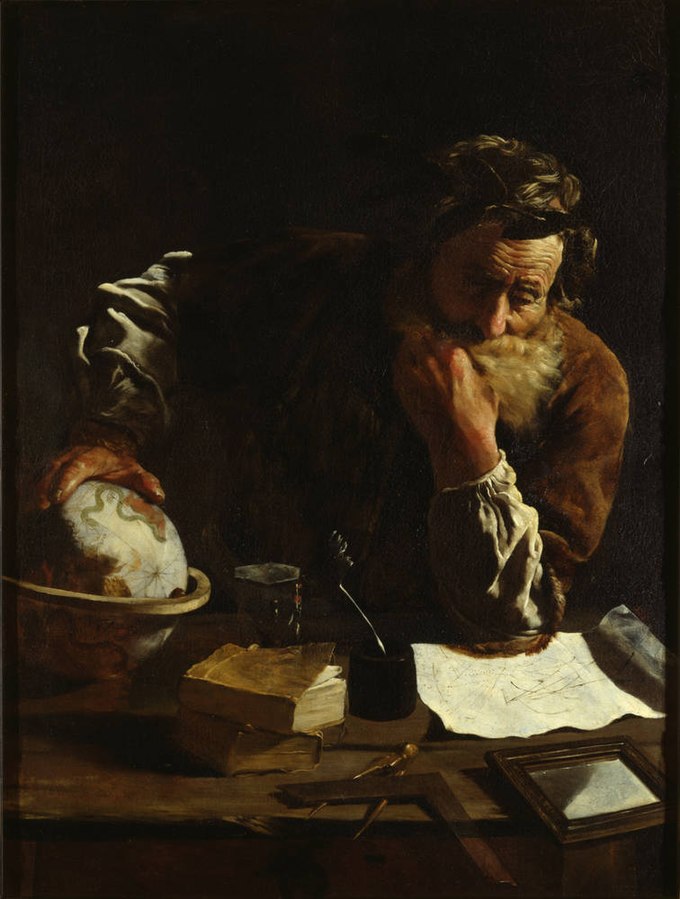
Archimedes developed a way of carrying out calculations with huge numbers, partly to investigate how many grains of sand would fit into the Universe. He suggested that a "myriad" (Greek for infinity) could stand for 10,000, and then proposed a number system using a myriad myriads, or 100 million. This work suggested for the first time the enormous scale of our Universe (Archimedes calculated that the Universe was, in modern notation, just a few light years across, although we now know the observable Universe measures nearly 100 billion light years in size).

Charles Babbage
English mathematician Charles Babbage (1791–1871) is sometimes called the "father of the computer". In 1822, he designed a hand-powered machine he called the Difference Engine, which could perform mathematical calculations. It was partially built but never completed. Instead, Babbage began work on a more complex, steam-powered machine: the Analytical Engine. This device was designed to perform calculations using punched cards as a way of submitting instructions, and, like the Difference Engine, had a memory unit that could store numbers. The Analytical Engine was designed to carry out any calculation its user wanted, which is the definition of a true computer. It was never built, but remained as a set of designs that Babbage worked on until his death in 1871. It was the earliest model of the design on which modern digital computers are based.
George Boole
George Boole (1815–64) was an English mathematician whose 19th-century work on logic laid the foundations for digital computing. Boole was a self-taught mathematician. He was born in Lincoln where he worked as a teacher and studied mathematics in his spare time, focusing on algebra. He became interested in logic—a branch of philosophy—and started to use it in mathematics alongside algebra. In 1854 he published his findings in a book called Laws of Thought. He showed that logical problems could be solved by algebra: Boolean variables are represented as binary numbers to represent true or false statements: 1 = true and 0 = false. This type of mathematical reasoning became known as Boolean algebra, or Boolean logic. In the 20th century, it became a central concept in computer programming.

Brahmagupta

The Indian mathematician Brahmagupta (598–670) was the first scholar to define the concept of zero. His book, Brahmasphutasiddhanta (628), is the earliest known text to treat the circular zero symbol as a number in its own right, rather than as the symbol for an absence of quantity used by ancient Egyptian and Greek scholars. This new system allowed any number to be expressed using 10 distinct symbols: the nine symbols devised by earlier generations of Indian mathematicians, plus zero. Brahmagupta wrote down—in Sanskrit verse—a set of arithmetic rules for working with positive and negative numbers. He was also the first mathematician to devise the solution of the quadratic equation, using what is called the quadratic formula.
Brahmagupta was the first person to describe gravity as an attractive force, which he termed gurutvakarsanam, some 1000 years before Isaac Newton set out his ideas. Brahmagupta wrote: "all heavy things fall down to the earth by a law of nature, for it is the nature of the earth to attract and to keep things."

Georg Cantor
German mathematician Georg Cantor (1845–1918) was the first mathematician to properly analyse the idea of infinity. In 1874 Cantor published a paper in which he proved that more than one type of infinity existed: there are infinities of different sizes. From this work, Cantor developed set theory: the study of collections of numbers, called “sets”. A new way of working with numbers, it came to be one of the most important ideas in modern mathematics.
Cantor’s work attracted strong interest—and criticism—during his lifetime, especially from philosophers and religious thinkers. Some Christian philosophers found his ideas about infinity difficult to accept, because it contradicted their idea of God’s perfect infinity. In 1904 Cantor received the Sylvester Medal, a prestigious award from the Royal Society, for his work.
Eratosthenes
Eratosthenes of Cyrene (276–195 BC), a Greek scholar, was the first to calculate the circumference of the Earth. He used geometry to compare the angle of the midday sun at two places, Alexandria and Syene in Egypt, which were a known distance apart on a direct north-south line. His calculation, 44,100 kilometres (27,400 miles), was remarkably accurate (today we know it is a distance of 40,075 kilometres or 24,901 miles around the Equator). Eratosthenes created one of the first maps of the world, incorporating lines of latitude and longitude based on the geographical knowledge that was available to him at the time. Erastothenes is also known for introducing a method for identifying prime numbers, which became known as the Sieve of Eratosthenes.

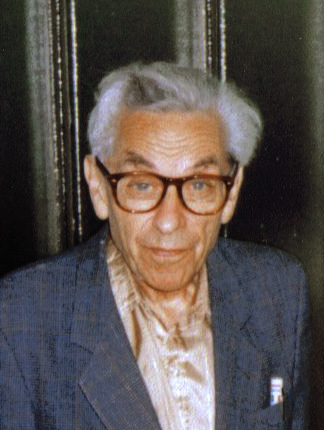
Paul Erdős
Hungarian mathematician Paul Erdős (1913–96) made it his life’s work to investigate prime numbers. He believed that it would take humankind at least a million years to understand prime numbers fully. While pursuing his work, he became especially well-known for collaborating (working with) other mathematicians. Erdős never made a permanent home. Instead he moved from place to place, staying with other mathematicians and working on papers with them. By the end of his life, he had published around 1525 papers—more than any other mathematician in history.
Euclid
The Greek mathematician Euclid (c. 365–300 BC) wrote a book called Elements in which he explored what numbers are and studied various rules of geometry (the study of shapes and angles). They included some of the first ideas that we learn at school in geometry today, such as that all right angles are equal and that we can draw a straight line between any two points. Euclid realised that neither of these statements can be proved—they are assumptions—but he showed how other rules could be built from these and other assumptions. For this reason, Euclid is sometimes called the “father of geometry”.
Elements was a major mathematics textbook for more than 1000 years, until it gradually fell out of use in the 19th century. As well as his work on geometry, Euclid did important work on number theory: the properties of numbers and the ways they can behave when used in calculations. He was the first to prove that there are an infinite number of prime numbers—they go on forever.


Leonhard Euler
The words that we use to write and speak about mathematics today, and the symbols that we use to represent mathematical terms, are thanks to Leonhard Euler (1707–83). Euler was a Swiss physicist, astronomer and mathematician. He made it standard practice to use certain mathematical terms and notation, including the use of the Greek character π to represent pi. He formulated the equations that relate the lengths of the sides of right-angled triangles to the angles between the sides. The formula he developed is today known as Euler's Formula. He also made important contributions to algebra.
Euler lost all his sight in later life but continued to work on mathematics, publishing 850 works in total—more than any other mathematician before him.
Pierre de Fermat
French mathematician Pierre de Fermat (1607–65) was among the greatest mathematicians of his time. Fermat worked as a lawyer and did mathematics in his spare time. Together with Blaise Pascal, he discovered probability theory. Probability is the likelihood that certain things will happen, for example, that a pair of rolled dice will both show the same number.
Fermat’s most famous work was in number theory, an area of mathematics which deals with the properties of integers (whole numbers) and the relationships between them. The study of prime numbers is an important part of number theory, and Fermat made major contributions to this.


In 1637 Fermat came up with a puzzling idea which is now known as Fermat’s Last Theorem. Pythagoras’ theorem states that a2 = b2 + c2, and there are endless solutions for this, e.g. 52 = 42 + 32. Fermat conjectured (put forward the idea) that there are no solutions for the similar equations a3 = b3 + c3, or a4 = b4 + c4, or any other such equation. Mathematically, this conjecture is written as an an ≠ bn + cn (n > 2).
Inside an old textbook he scribbled, “it is impossible for a cube to be a sum of two cubes...” adding that he also had a “truly remarkable proof”, but there was not enough space in the margin to write it down. Mathematicians worked for centuries to try and prove Fermat’s Last Theorem. British mathematician Andrew Wiles eventually proved it 357 years later, in 1995.
Leonardo Fibonacci
Arabic numerals reached Europe during the Middle Ages thanks to an Italian mathematician called Leonardo Fibonacci (c.1170–c.1250). As a child, Fibonacci travelled across the Middle East with his merchant father, where he encountered Arabic numbers for the first time. When his Book of Calculation was published in 1202, it introduced the Hindu-Arabic numeral system (0, 1, 2, 3, 4, 5...) to European mathematicians, who began to switch to it. Previously they had used Roman numerals. The new numeral system made calculating easier and faster, and this improved banking across Europe.
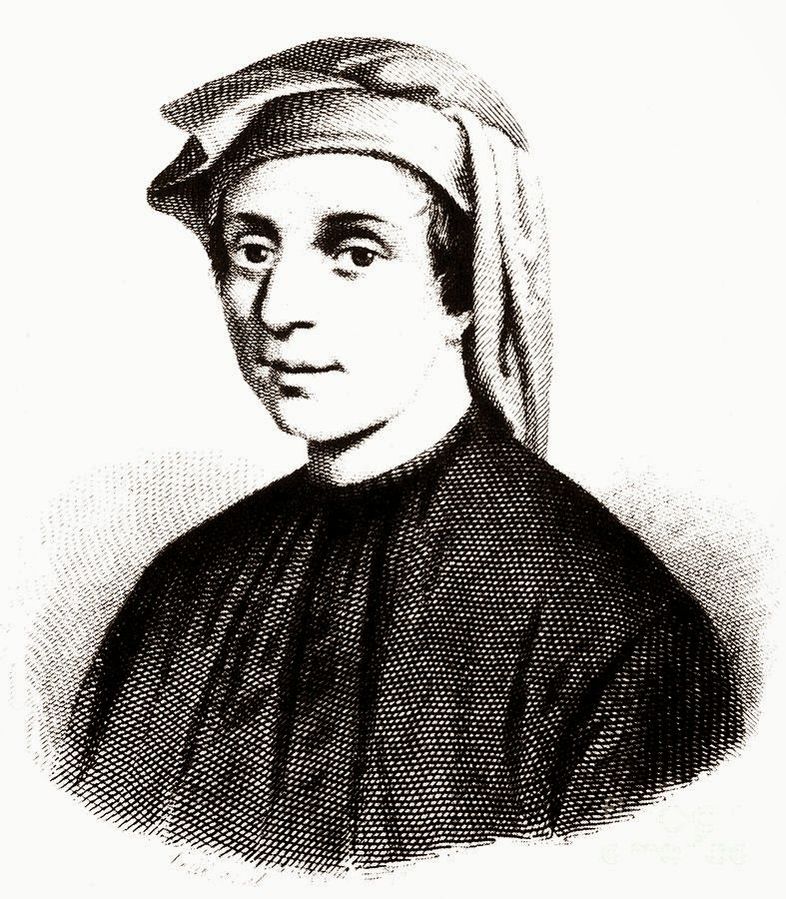
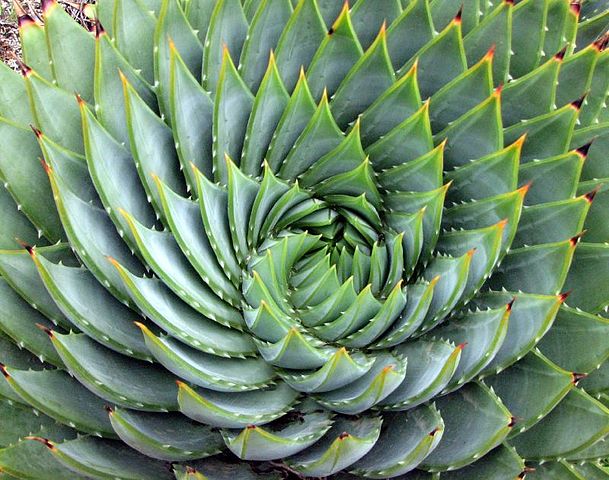
Fibonacci is most famous for developing an idea that still fascinates mathematicians today: it is known as the Fibonacci sequence. Each number in the sequence is made by adding up the two before it. So it begins 0, 1, 1, 2, 3, 5, 8, 13 and continues into infinity. Intriguingly, the Fibonacci sequence describes multiple patterns in nature, for example, the arrangement of leaves on a plant, the segments in a pineapple or a pine cone or the spiral of a sea shell. The Fibonacci sequence also uses an important mathematical idea: infinity—something without an end.
Carl Friedrich Gauss
Carl Gauss (1777–1855) was a German mathematician and physicist, believed by many to have been one of the greatest mathematicians that ever lived. During his lifetime he did important work on geometry and complex algebra, and proved several major theories. Aged just 21, Gauss wrote a book called Disquisitiones Arithmeticae which tackled a new field of mathematics now known as number theory, which first Fermat and later Euler had developed. Number theory is the study of integers (whole numbers) and their properties—for example, working out which ones are prime numbers. Gauss spent time looking for a pattern to explain the distribution of primes. He discovered that a logarithm could be used to roughly predict the proportion of primes in any group of numbers. This idea became known as Gauss’ Conjecture. It was later developed by his student Bernhard Riemann.

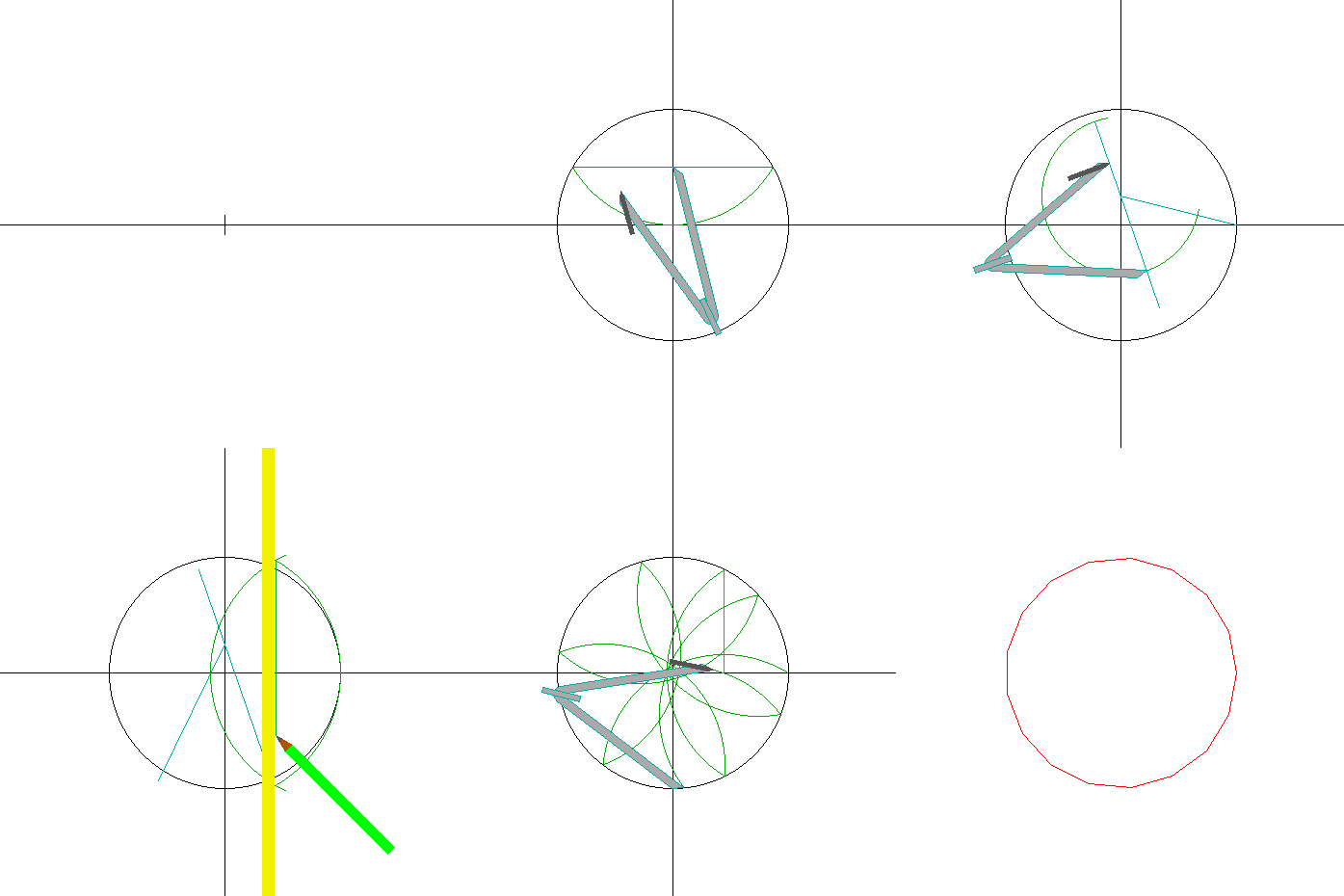
Gauss made his first mathematical discoveries while he was still a teenager. Aged 19, he found a way to construct the regular seventeen-sided polygon, or heptadecagon, inside a circle using compasses and a straight-edge. This solved a problem that had puzzled mathematicians for more than a thousand years. Gauss was so pleased with his solution that he asked for a 17-sided polygon to be carved on his tombstone when he died.
In 1801, Gauss calculated the orbit of the asteroid Ceres and predicted its next appearance in the night sky. Modern computers still use his methods to calculate orbits today. In the 1830s Gauss invented the magnetometer, a device that could measure the Earth’s magnetic field.
Sophie Germain
Sophie Germain (1776–1831) was a French mathematician known for her work in number theory. Growing up during the French Revolution, Germain taught herself mathematics, and studied Latin and Greek. At 18, she began taking mathematics courses at university in Paris, but she was prevented from officially joining because at that time, women were not allowed to attend. Germain’s early work was in number theory, a branch of mathematics which deals with the properties of numbers and the relationships between them. She advanced the search for a proof of Fermat’s Last Theorem, and mathematicians built on her ideas for the next two centuries. In the 1810s Germain worked on a topic called elasticity theory, which uses mathematics to describe the relationship between forces applied to an object and how it deforms as a result. She won a prize for this work from the Paris Academy of Sciences, becoming the first woman to do so.


Alexander Grothendieck
Alexander Grothendieck (1928–2014) was a German mathematician. His work in algebraic geometry made him one of the greatest European mathematicians of the 20th century. His work was about the ways that algebra could be used in geometry to describe surfaces, structures and spaces. He developed scheme theory, a powerful tool for solving problems in algebraic geometry. In the 1960s Grothendieck made significant progress on proving the Riemann hypothesis, one of the greatest unsolved problems in mathematics.
As a child, Grothendieck was sent to live in France and his family were persecuted by the Nazis, a terror that haunted him all his life. Grothendieck worked for a long time in Paris. He also studied and taught maths in universities around the world.
In later life Grothendieck turned his attention increasingly towards politics and the environment. He stopped working on mathematics and moved to an isolated cottage in the French Pyrenees, where he lived for the last 20 years of his life.
Margaret Hamilton
Margaret Hamilton (b.1936) is an American mathematician and computer scientist. She is best known for her role as the lead developer of the flight software for the Apollo missions—helping send the first people into space. Hamilton began her career working at the Massachusetts Institute of Technology (MIT) where she learnt to write computer programmes to solve weather-predicting problems. She began working on MIT’s Apollo project in 1964, where she led a team of software developers to code the software (computer programmes) for the command module, Columbia, and the onboard module, Eagle. During the early Apollo missions, she was the first to use the term “software engineering” for the work she and her team were doing. In 2016 she received the Presidential Medal of Freedom for her work on the Apollo Moon missions, the highest civilian award in the United States.


Grace Hopper
Grace Hopper (1906–92) was a United States Navy rear admiral, computer scientist and pioneer of computer programming. Born in New York, she was a curious and intelligent child, who was admitted early to Vassar College aged 17. In 1934, she received a PhD in mathematics from Yale University. By 1941, she had become an associate professor at Vassar. During World War II, she joined the United States Navy Reserve and remained in the Navy—apart from brief periods of retirement—for the rest of her life.
Grace Hopper received 40 honorary degrees during her lifetime, and was posthumously (after her death) awarded the Presidential Medal of Freedom by President Barack Obama.
In 1949, Hopper joined the team developing the UNIVAC computer, the first large-scale electronic computer. She believed that computer programming could be done using English words rather than numbers. In the 1950s she developed a compiler, software that automatically translates computer programs written in languages that humans can write easily into machine code that would be understood by computers. This led to the development of COBOL (which stands for Common Business-Oriented Language), a computer language for data processors. It is still in use in computers today.
Hypatia
Hypatia (c. AD 351–415) was a mathematician, philosopher and astronomer in Roman times. Hypatia was born in Alexandria, Egypt, which was then part of the Roman Empire. She was probably the first woman to teach mathematics and give lectures to large audiences. She studied and wrote about new ideas that were emerging at the time, especially in mathematics, and it is likely that during her lifetime she was one of the world’s leading mathematicians. Hypatia lived at a time when there were tensions between Christians, Jews and pagans (those with other religious beliefs). Hypatia herself was a pagan, but she lived and worked peacefully alongside Christians. In 415 she was brutally murdered by a group of Christians who were protesting against her teachings. Her death shocked scholars all over the Western world.

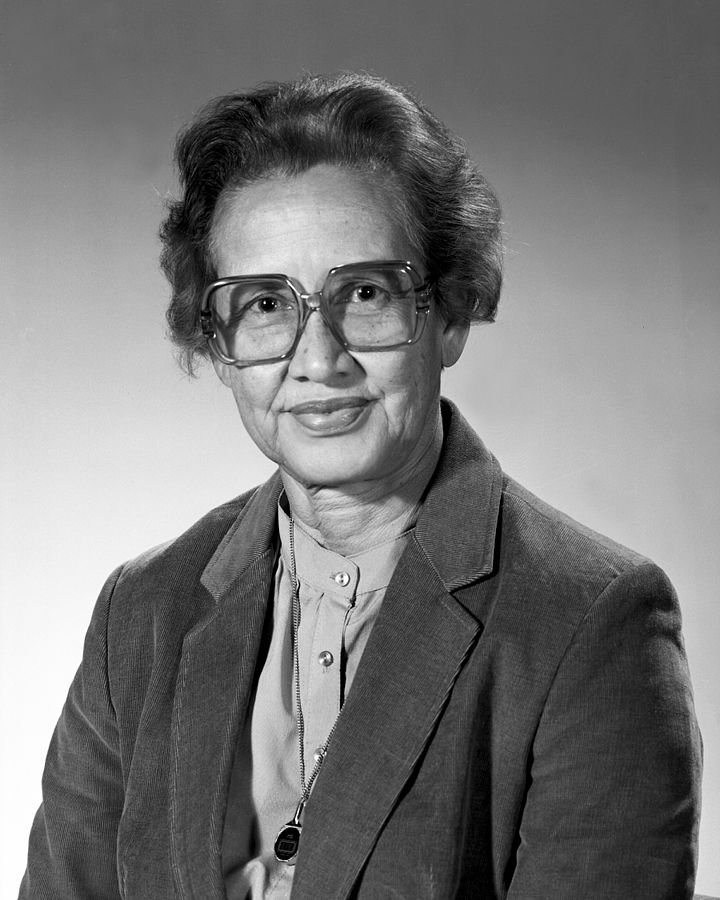
Katherine Johnson
Katherine Johnson (1918–2020) was an African American mathematician who worked for the National Aeronautics and Space Administration (NASA). She performed the accurate calculations and analysed the data needed for space flights, which today would be done by computers. Johnson also played a crucial role in many important moments at the start of space exploration. These included mission Freedom 7 in 1961, the first American manned space flight, and Apollo 11 in 1969, the first time a person walked on the Moon. In 2015, she was awarded the Presidential Medal of Freedom by President Barack Obama in recognition for her role as a pioneering African American woman in science. She died at the age of 101 in February 2020.
Sofya Kovalevskaya
Russian mathematician Sofya Kovalevskaya (1850–91) was a pioneer for women in mathematics. At a time when there were still many barriers for women to study and work in science, she became the first woman to receive a doctorate (PhD) in mathematics in Europe, and the first woman to work as a mathematics professor in Northern Europe. Kovalevskaya is best known for her work in two fields: mechanics and analysis. Some of her first work was a study of Saturn’s rings. In 1888 Kovalevskaya published the work for which she is most famous: a mathematical description of the motion of a spinning top. Her 50-page solution used equations to show the different possibilities for the top's movement. Known as the “Kovalevskaya top”, this work earned her the first prize from the Paris Academy of Sciences.


Gottfried Wilhelm Leibniz
Gottfried Wilhelm Leibniz (1646–1716) was a German mathematician, philosopher and scientist. His greatest contribution to mathematics was his discovery of calculus, which he made at the same time as Isaac Newton. The rivalry between Leibniz and Newton over who discovered calculus raged for the rest of their lives. Leibniz’s early work was in philosophy. He was born in Leipzig, Germany, where his father was a philosophy professor, and the young Leibniz quickly became an advanced student by reading his father’s books. By the age of 16 he had a degree in philosophy. In the early 1670s he studied mathematics and physics with the Dutch scientist Christiaan Huygens.
In 1673 Leibniz invented a mechanical calculator called the “stepped reckoner”, which he worked on for 20 years. Unlike Blaise Pascal’s earlier model, it could perform all four arithmetical functions: addition, subtraction, multiplication, division. It was the first to do so.
Ada Lovelace
English mathematician Ada Lovelace (1815–52) first met Charles Babbage in 1833. Babbage had designed—but not built—a machine he called the Analytical Engine, which would perform calculations using punched cards. In 1843 Lovelace published an article explaining how the Analytical Engine would work. In the accompanying notes, she wrote about her belief that this kind of machine could also do much more elaborate things—the kinds of processes modern computers do today. To prove it, she wrote a programme for the Analytical Engine, a method for calculating a mathematical problem using a sequence of instructions. Effectively, she had written the world's first algorithm, a step-by-step procedure for calculations. For this reason, Ada Lovelace is today considered the world's first computer programmer.


Maryam Mirzakhani
Maryam Mirzakhani (1977–2017) was an Iranian mathematician. In 2014 she became the first woman to be awarded the Fields Medal, a prestigious prize in mathematics. Mirzakhani’s work was in an area of mathematics called complex geometry, which studied and described curved surfaces. She observed the behaviour of lines as they crossed curved surfaces, and made studies of the possible paths that existed inside spaces, such as the paths that a billiard ball could take as it bounced off the sides of the table. One of her ways of working out her ideas was to draw on large sheets of paper spread on the floor, which led her daughter to describe her work as “painting”. Mirzakhani died of breast cancer in 2017, aged just 40 years old.
John Napier
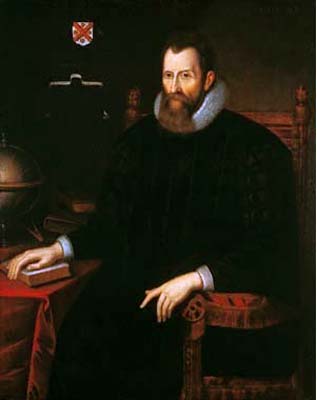
John Napier (1550–1617) was a Scottish mathematician. He is most famous for developing the idea of the logarithm, which became an important tool to help mathematicians do calculations. A logarithm is the power to which a number (called the base) must be raised to give another number. For instance, 102 = 100, which means that the logarithm of 100 to base 10 is 2. Napier also made it standard practice to use the decimal point in mathematics. Napier was born near Edinburgh, Scotland. He studied at university when he was just 13 years old but left without finishing his degree. He began his work on logarithms in around 1594.
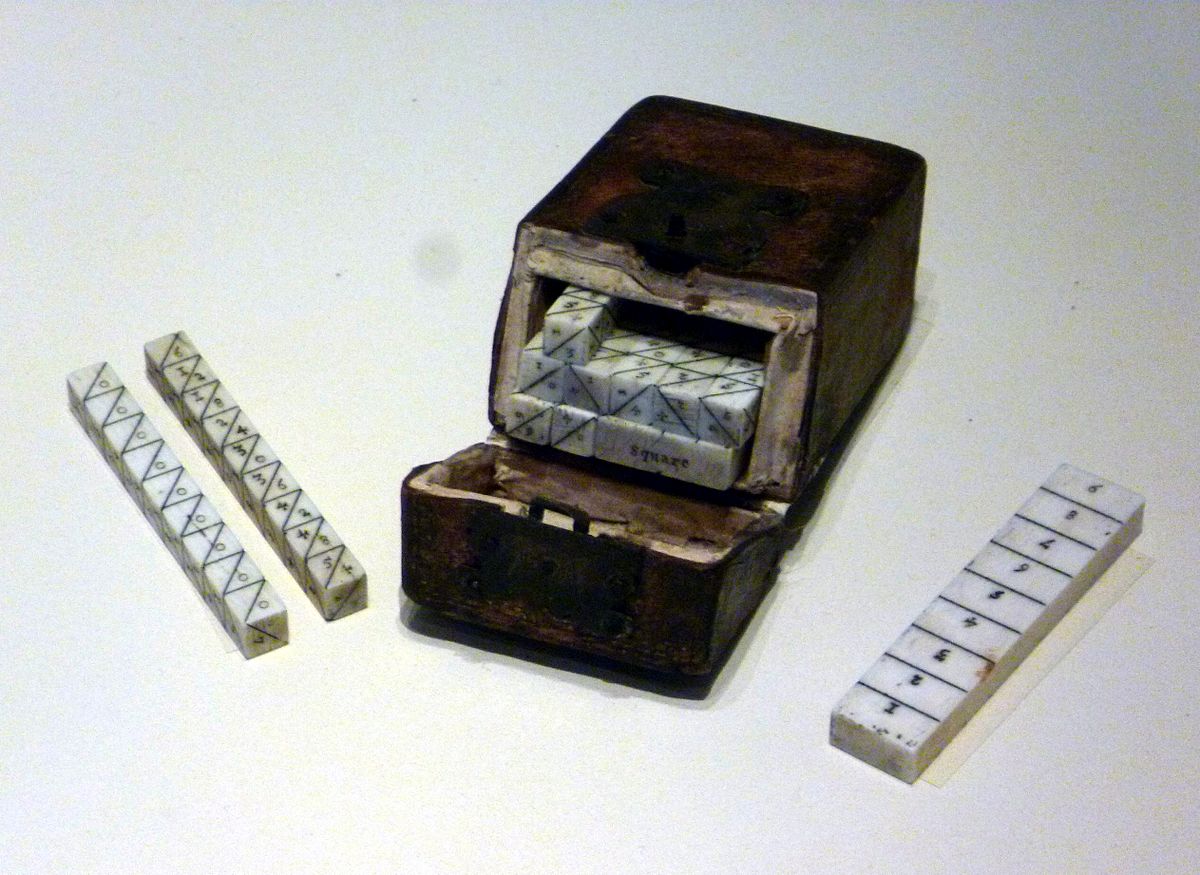
Napier invented a type of early calculator which he called Napier’s Bones. It was a set of numbered rods in a case that could be used to calculate multiplications and divisions in a simple way. The rods were arranged so that their numbers made a grid. A user could work out the answer to a multiplication by looking up the pair of numbers on the grid. The grid then showed them which two numbers they could add together to find the answer instead of having to multiply them, a trickier calculation to carry out.

Isaac Newton
English scientist, astronomer and mathematician Sir Isaac Newton (1642–1727) made some of the greatest contributions to science in history. As well as furthering our understanding of the laws of motion, how gravity works and the nature of light and colour, he invented a branch of mathematics called calculus, which he called “fluxions”. Newton developed his ideas on fluxions during a period of isolation, when an outbreak of bubonic plague confined him to his hometown in Lincolnshire. Calculus is a branch of mathematics which deals with quantities that are constantly changing, such as changes in speed as an object accelerates. It can also be used to work out the length of a curved line, which can be seen as an infinite number of tiny straight lines, joined end to end.
The German mathematician Gottfried Wilhelm Leibniz worked on the same idea at the same time, and the rivalry between Leibniz and Newton over who discovered calculus persisted for the rest of their lives.
Emmy Noether
German mathematician Emmy Noether (1882–1935) was among the most influential mathematicians of the early 20th century, best known for an important discovery she made in physics. In 1915 Noether was studying a topic called symmetry. In physics, symmetry occurs when a property of something (its number of atoms and molecules for example) remains unchanged even after it has been "transformed" in some way, such as by a chemical reaction.
Noether realized that every instance of symmetry in physics is governed by a corresponding rule, known as a conservation law. (An example of a conservation law is the law of conservation of energy, which states that energy can neither be created nor destroyed—only converted from one form to another. An example is the conversion of chemical energy to heat energy.)
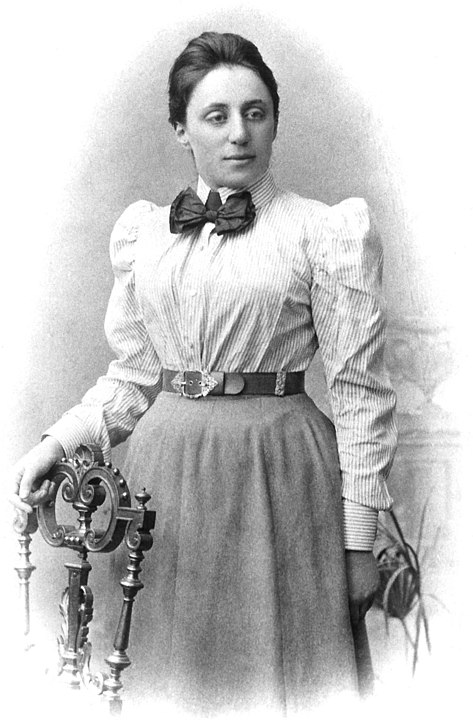
Now known as Noether’s theorem, her work helps us to better understand any area of physics—the path of a planet's orbit, the behaviour of black holes, and so on.
Since Noether’s discovery, many physicists have focused their work on searching for these symmetries and their connected laws. When the Nazis came to power in Germany in 1933, Noether faced persecution as a Jewish person and lost her position teaching in a university. She emigrated to the USA, where she taught for two years before her death aged just 53.
Blaise Pascal
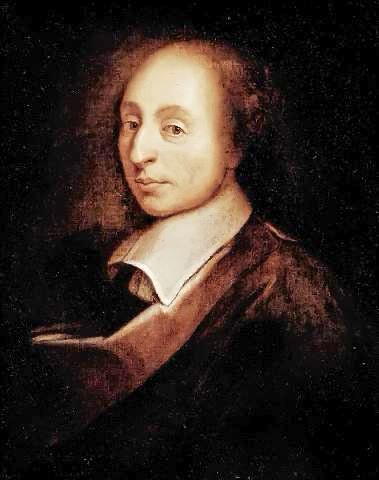
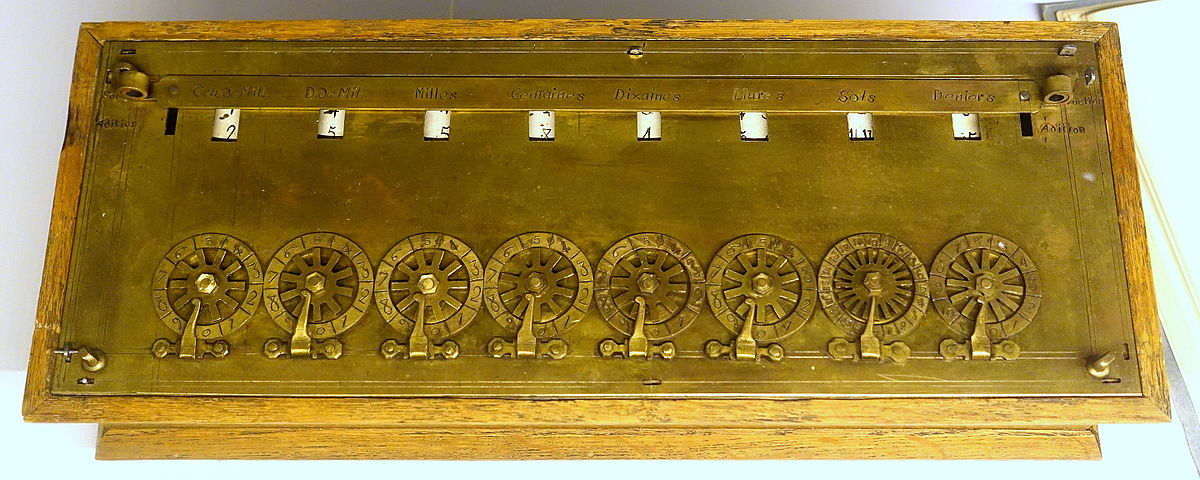
Blaise Pascal (1623–62) was a French mathematician known for his work on probability and for inventing one of the earliest calculators. Pascal was a gifted mathematician as a child, and wrote his first major paper, "Essay on Conics", about the relationships between cones and flat surfaces, at the age of 16. In 1642, when Pascal was 18, he was helping his father with his work doing tax calculations when he developed his famous calculator, the “Pascaline”, to speed up their work. This mechanical device could add, subtract and multiply numbers. Over the next ten years, Pascal improved its design, building as many as 20 new versions of the device.
Pascal gave up studying mathematics aged 23 and immersed himself in the study of philosophy and religion instead. However, a few years later he returned to make his most famous contribution. In 1654, working with the mathematician Pierre de Fermat, he developed probability theory, the idea that we can use mathematics to help us work out the likelihood that certain things will happen.
Pingala
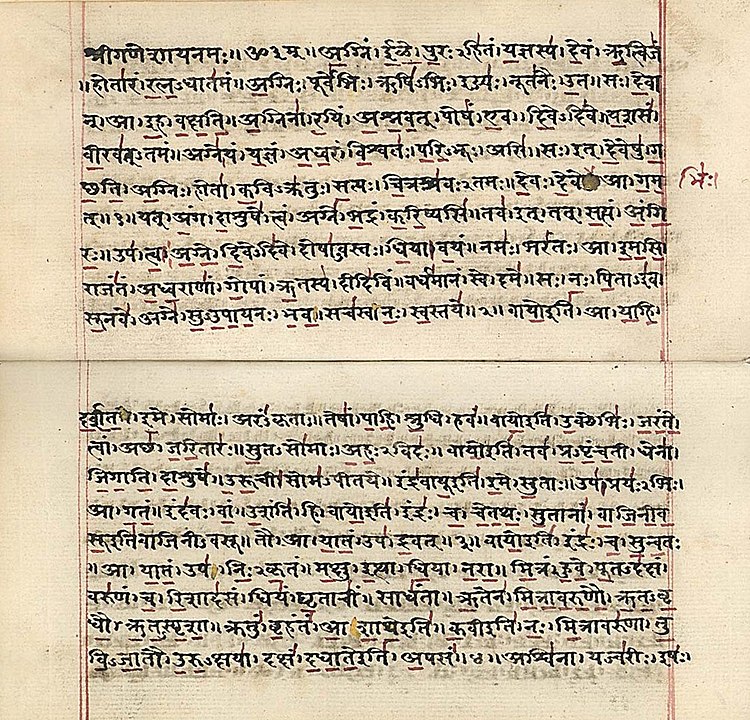
Pingala (c. 2nd or 3rd century BC) was a mathematician in ancient India. Although we know very little about Pingala’s life, we know that he wrote a book called the Chandaḥśāstra in which he analysed poetry, looking for mathematical patterns to explain why some combinations of sounds were more pleasing than others. The poetry was written in Sanskrit, an ancient Indian language. In this work, Pingala developed the earliest known system of binary numbers (though he used 1 and 2, rather than 0 and 1). He used it to describe the meter of poetry, noting that the poetry was made up of two lengths of sound: a short one, and a sound twice as long. Many people also consider Pingala to be the first person to have used zero.

Pythagoras
Greek philosopher and mathematician Pythagoras (c. 570–490 BC) is most famous for a discovery he made about triangles, now known as Pythagoras’ theorem. Pythagoras showed that in a right-angled triangle, the length of the longest side (hypotenuse) multiplied by itself (squared) is equal to the sum of the squares of the lengths of the other two sides. Pythagoras’ theorem is useful when we only know the lengths of two sides of a right-angled triangle, and need to find out the third.
Historians know little about Pythagoras’ life. It is likely that he grew up on the Greek island of Samos, where his father was a gem-engraver. When he became a working philosopher, he opened a school with strict rules: the scholars lived in a commune, studied mathematics and music, ate a vegetarian diet and were sworn to secrecy about their work.
Srinivasa Ramanujan
Indian mathematician Srinivasa Ramanujan (1887–1920) made some of the most interesting discoveries in 20th century mathematics, despite having little formal education. Ramanujan grew up in India, where he taught himself mathematics as a teenager. As a young man he wrote to a mathematician in England with some of his ideas, and as a result he was invited to study and work at Cambridge University, England. Here, Ramanujan came up with extraordinary and new formulae in pure mathematics (the area of mathematics that is not concerned with real-life applications). He died at the age of just 32, leaving behind many unpublished ideas and notebooks.


Bernhard Riemann
German mathematician Bernhard Riemann (1826–66) was famous for his work work in many areas of mathematics. Following the work of Euler, Gauss, and others, he developed a branch of mathematics called complex analysis, which studies formulae which contain complex numbers. These are numbers that include imaginary numbers, which are the square roots of negative numbers. He investigated such formulae by inventing manifolds, imaginary surfaces on which complex formulae can be plotted and studied. He also developed the mathematics that Albert Einstein would come to use in his General Theory of Relativity.
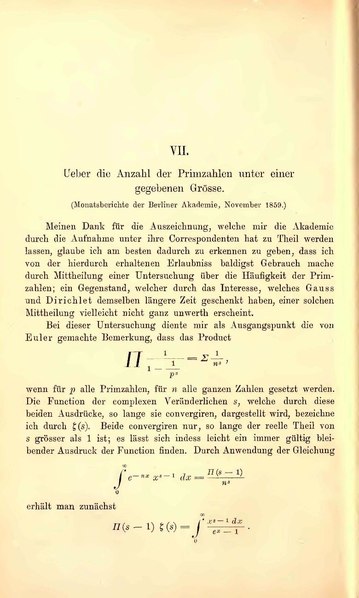
Riemann is especially well-known for one of his ideas on prime numbers, the Riemann hypothesis. Since ancient Greek times, mathematicians have tried to work out if there is any pattern to the way prime numbers (primes) occur. Riemann began searching for a way to work out the pattern, building on work that had already been done by Carl Gauss—his teacher—and Leonhard Euler.
By 1859 he was able to make a statement about the distribution of prime numbers, now known as the Riemann hypothesis. It was well known that prime numbers appear less frequently the higher you count—that is, the gaps between prime numbers generally get larger. Riemann found a rule which described this pattern. Other mathematicians finalized this work and the result is called the Prime Number Theorem. Riemann also discovered signs of a deeper pattern, but could not prove that it exists. This is called the Riemann conjecture, one of the hardest problems in mathematics and one that is still unsolved: no one has yet been able to come up with a proof.
Alan Turing
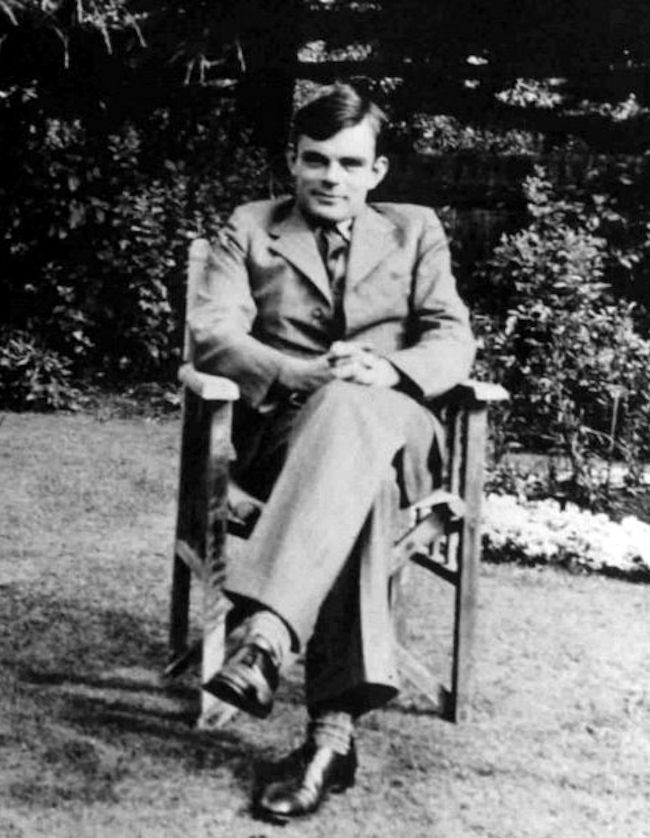
Alan Mathison Turing (1912–54) was an English mathematician and computer scientist. Turing is well-known for his work developing code-breaking machines during World War II (1939–45). He was highly influential in the development of computers. In 1936 Turing described plans for a machine now known as the "Turing machine", in which he demonstrated how computers could work. It is now considered the model on which modern computers are based.
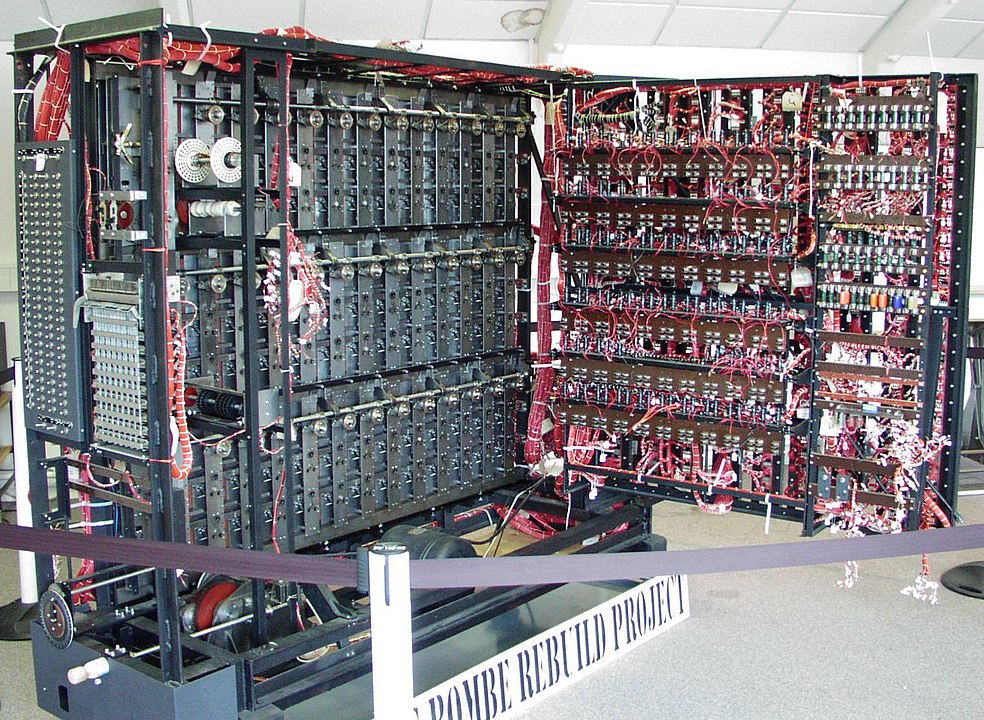
During the war, Turing worked at Britain's code-breaking centre at Bletchley Park. Working with electro-mechanical machines known as bombes, he devised a number of techniques for breaking German codes. Knowledge of the enemy's plans and movements was key to the Allies' success in winning the war. When Turing's team began successfully decoding German messages, they enabled the Allies to defeat Nazi Germany in several crucial battles.
After the war, Turing concentrated on developing a machine that could process information in a logical way, and at high speed. At the National Physical Laboratory he made the first designs for a stored-program digital computer: the Automatic Computing Machine (ACE). A prototype was built in 1950 after he had left the laboratory. Turing died at the age of just 42. His portrait appears on the Bank of England £50 note, commemorating his great contribution to mathematics and to society.
Gladys West
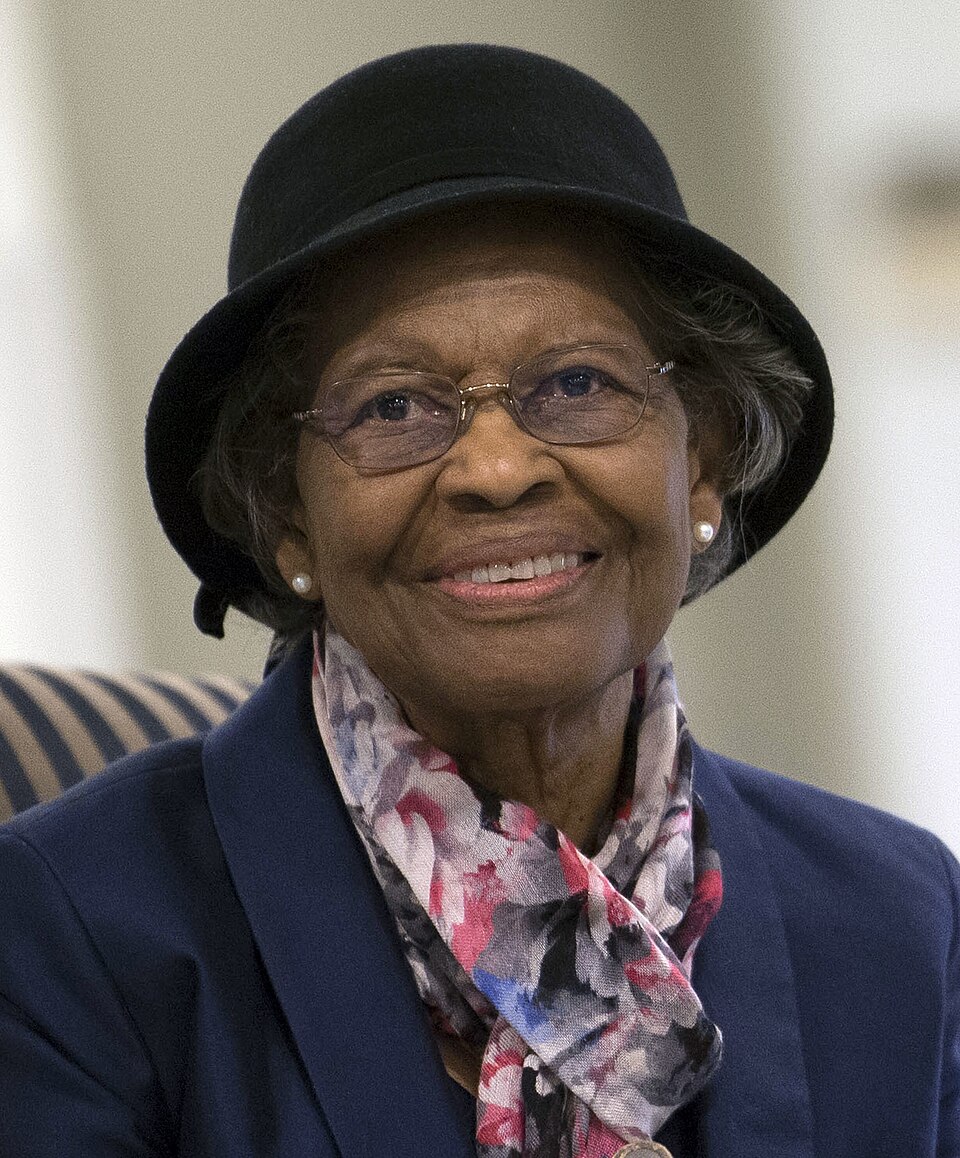
Gladys West (1930– 2026) was an African American mathematician. She is known for her work on satellite geodesy, using data from satellites to produce precise measurements of the Earth's size, shape and orientation. The mathematical modelling she did for the US Navy, which involved creating complex algorithms for early IBM supercomputers, would later play a critical role in the development of GPS technology.
Born Gladys Brown in rural Virginia to a family of poor sharecroppers, she saw education as the way to a better life. She won a full scholarship to Virginia State University, from where she graduated with a degree in maths, returning to complete a masters degree. In 1956 she began work at the Naval Surface War Centre in Dahlgren, Virginia. As a government employee, West and her black colleagues were unable to take part in the civil rights movement. "We tried to do our part by being a role model", she later recalled.
West's work went unacknowledged until 2017, when she wrote an article about her life. Newspapers picked up her story. She was inducted into the United States Air Force Hall of Fame in 2018 and received the Webby Lifetime Achievement Award for her part in the development of satellite geodesy models.
Andrew Wiles
British mathematician Andrew Wiles (b. 1953) was the first to prove Fermat’s Last Theorem, a problem that had puzzled mathematicians for more than 350 years. Wiles became fascinated with the theorem at the age of 10, and tried hard to solve it as a young man. In the late 1980s, spurred on by new mathematical discoveries, he began working full-time on the theorem, and solved it seven years later, in 1993. When he presented his first proof it turned out to have a small error. He returned to work on it and presented a correct proof in 1995, solving one of the toughest problems in mathematics to date.

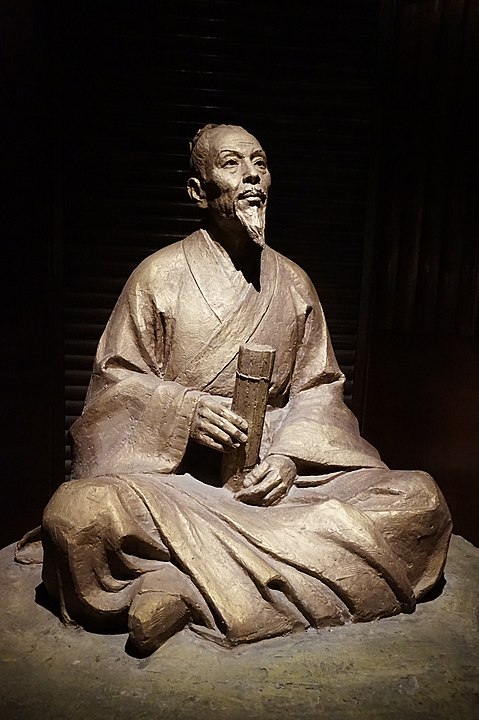
Zu Chongzhi
Zu Chongzhi (429–501) was a Chinese mathematician and astronomer. He advanced the search for an accurate value of pi (π) by calculating it to seven decimal places, a highly accurate degree. The Greek mathematician Archimedes had calculated pi many centuries earlier. Although it is unlikely that Chongzhi was aware of his work, he used a similar method. Archimedes had arrived at a value for pi by calculating the lengths of two imaginary polygons (regular, many-sided shapes), one inside and one outside a circle. The length (circumferernce) of the circle lay between the lengths of the polygons. Archimedes’ polygons had 96 sides, but Chongzhi and his son worked together to calculate pi using a 24,576-sided polygon. This produced a value that was between 3.1415926 and 3.1415927. For the next 800 years, it would remain the most accurate approximation.
Consultant: Mike Goldsmith
pics
Without in any way limiting Q-files Ltd’s exclusive rights under copyright, any use of this publication to “train” generative artificial intelligence (AI) technologies to generate text is expressly prohibited. Q-files Ltd reserves all rights to license use of this work for generative AI training and development of machine learning language models.