
Q-news

CITE
We have made every effort to follow citation style rules, but there may be some minor differences. If in doubt, please refer to the appropriate citation style manual.
Death toll rises as coronavirus spreads across China and the rest of the world. (2022). In Q-files Encyclopedia, , Q-news. Retrieved from
https://www.q-files.com/news/death-toll-rises-as-coronavirus-spreads-across-china-and-the-rest-of-the-world
"Death toll rises as coronavirus spreads across China and the rest of the world." , Q-news, Q-files Encyclopedia, 10 Feb. 2022.
https://www.q-files.com/news/death-toll-rises-as-coronavirus-spreads-across-china-and-the-rest-of-the-world.
Accessed 13 Sep. 2026.
Death toll rises as coronavirus spreads across China and the rest of the world 2022. , Q-news. Retrieved 13 September 2026, from
https://www.q-files.com/news/death-toll-rises-as-coronavirus-spreads-across-china-and-the-rest-of-the-world
, Q-news, s.v. "Death toll rises as coronavirus spreads across China and the rest of the world," accessed September 13, 2026.
https://www.q-files.com/news/death-toll-rises-as-coronavirus-spreads-across-china-and-the-rest-of-the-world


Death toll rises as coronavirus spreads across China and the rest of the world
On 31th December 2019, several cases of pneumonia caused by an unknown virus were reported in Wuhan, Hubei province, China. One week later, on 7th January 2020, Chinese authorities confirmed that they had identified a new virus, later called COVID-19, a type of coronavirus. Symptoms include fever, coughing and breathing difficulties. Cases of severe infection can result in pneumonia, kidney failure and, in some cases, death. Highly contagious, the coronavirus's rate of infection escalated sharply in mid-January. Its spread to other Chinese provinces was accelerated by the Chinese New Year migration, during which people all over China return to their hometowns for the celebrations, starting 25th January. Cases also started to be reported in other countries, carried by international travellers as they returned to Europe, North America and the Asia Pacific.


Coronavirus
The new virus, COVID-19, is a coronavirus (so-called because of its resemblance to the Sun and its corona, its shimmering outer atmosphere). Coronaviruses are a family of viruses that cause respiratory illnesses. These range from the common cold to more severe diseases such as Middle East Respiratory Syndrome (MERS) and Severe Acute Respiratory Syndrome (SARS). Symptoms include fever, coughing and breathing difficulties. Cases of severe infection can result in pneumonia, kidney failure and, in a few cases, death.
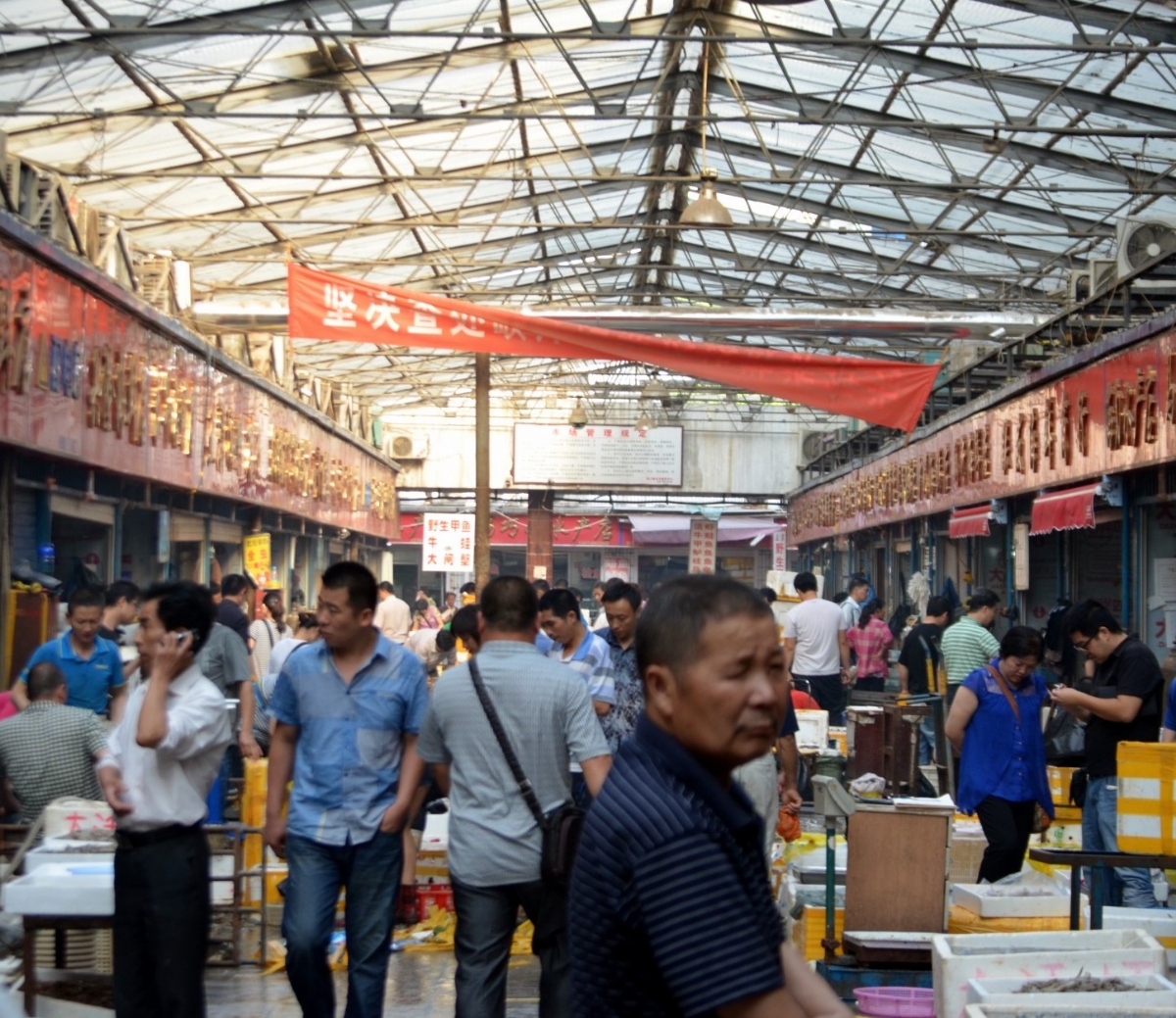
Because many of the first sufferers recently visited a large seafood and animal market in Wuhan (which has a thousand stalls selling fish, chickens, pheasants, bats, marmots, deer, snakes and other wild animals), the Wuhan coronavirus is thought to be zoonotic: one transmitted between animals and people. Scientists strongly suspect the virus originated in bats.
The incubation period (the length of time from exposure to the virus the development of symptoms) is between two and 10 days; it is likely that the virus is contagious during this period. To prevent infection, the World Health Organization (WHO) recommends regular hand washing, covering the mouth and nose when coughing and sneezing, thoroughly cooking meat and eggs, and avoiding close contact with anyone showing symptoms of respiratory illness such as coughing and sneezing.

Effects of the disease
Of 99 cases of the new coronavirus observed at Wuhan Jinyintan Hospital, 49 had visited the Huanan Seafood Wholesale Market in Wuhan, believed to be at the centre of the outbreak. The average age was 55.5 years; two-thirds were men. Of the 99, 51 people already suffered from a chronic (long-term) condition which had damaged their immune system in some way. Fever and a cough were the most common symptoms in the group as a whole. Thirty-one of the 99 had been released from hospital by 25th January.
Confirmed cases
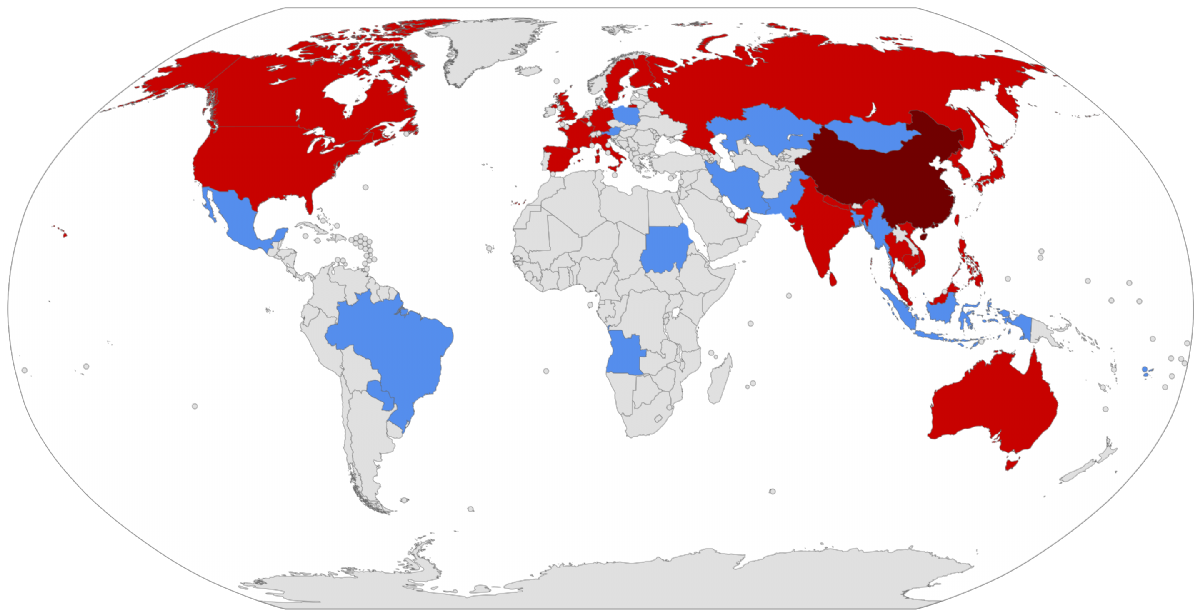
As of 12th February, the death toll from the coronavirus outbreak has risen to 1115, with confirmed cases more than 45,000 (compared to just 291 on 20th January), of whom more than 8216 are in a critical condition. Infections have also spread to at least 27 other countries, with 175 cases reported so far on a cruise liner moored in Yokohama, Japan. Studies suggest that a larger number of people may have been already infected, but not yet detected: the number of actual infections is estimated to be 10 times higher than confirmed cases. The death rate of 2019-nCoV is so far around 2% (4.1% in Wuhan itself).
By 12th February it was being reported that new cases in Hubei province had fallen to their lowest in weeks. The number of new cases in China as a whole was 2015, the lowest daily rise since 30th January. With the overall death toll also falling, some Chinese government experts are forecasting that the epidemic could peak this month, although that view is not shared by many experts outside China.

Evacuation


Evacuations of hundreds of foreign nationals from Wuhan are now under way. The UK, Australia, South Korea, Singapore and New Zealand plan to quarantine all evacuees for two weeks to avoid the disease spreading. Australia says it will quarantine its evacuees on Christmas Island, a detention centre 2000 kilometres (1200 miles) from the mainland, while Singapore is setting up a quarantine facility on Pulau Ubin, an offshore island. Around 200 US citizens were flown out of Wuhan and are being isolated at a military base in California.
Lockdown
Meanwhile, Hubei, a province of 60 million people of which Wuhan is the capital, has been in a state of lockdown since 23rd January—an attempt to prevent the disease from spreading from one person to another. With all urban public transport and outward transport by train, air and long-distance buses suspended, the province has effectively been sealed off from the rest of China. But because Wuhan, a city of more than 11 million people, is a major transportation hub of the country, long known as the "Nine Provinces' Thoroughfare", the lockdown is likely to cause major disruption across the country. About 5 million residents left Wuhan before it was placed under lockdown.

Due to quarantine measures, Wuhan residents rushed to stockpile on essential goods, food and fuel. This caused prices of goods to rise significantly. There have been reports of food shortages. Medical staff faced difficulties in travelling to their hospitals, as they were now limited to walking or going by private car.
Other measures
A growing number of countries are advising their citizens to avoid all non-essential travel to China. Several international airlines have stopped or scaled back their routes to China. The Chinese Football Association has announced the postponement of all games in the 2020 season. Many Chinese New Year events and tourist attractions have been closed throughout China.

All schools and universities in Hubei province have had their winter break prolonged. A nationwide extension of the New Year holiday has been announced. Large numbers of people would normally be travelling back from their hometowns to workplaces in different parts of China after the holiday. Several provinces and cities have encouraged people to stay in their hometowns and not travel back yet.
A special hospital, Huoshenshan Hospital, is being constructed at high speed—just six days—to treat Wuhan citizens infected by the virus. They can be better quarantined here. Wuhan authorities say the hospital will be ready to use by 3rd February.

Researchers are also racing to develop a vaccine to protect people from the virus. One lab in California has already developed a potential vaccine, which will be ready for trials by June or July.
Photo acknowledgements (from top): China News Service (CNS); Public domain; CNS; Public domain; Pharexia; Wikimedia.org; Public domain; CNS; CNS; BoyuZhang1998; CNS