
Q-news

CITE
We have made every effort to follow citation style rules, but there may be some minor differences. If in doubt, please refer to the appropriate citation style manual.
NASA launches a mission to crash a spacecraft into an asteroid. (2022). In Q-files Encyclopedia, , Q-news. Retrieved from
https://www.q-files.com/news/nasa-launches-a-mission-to-crash-a-spacecraft-into-an-asteroid
"NASA launches a mission to crash a spacecraft into an asteroid." , Q-news, Q-files Encyclopedia, 11 May. 2022.
https://www.q-files.com/news/nasa-launches-a-mission-to-crash-a-spacecraft-into-an-asteroid.
Accessed 13 Sep. 2026.
NASA launches a mission to crash a spacecraft into an asteroid 2022. , Q-news. Retrieved 13 September 2026, from
https://www.q-files.com/news/nasa-launches-a-mission-to-crash-a-spacecraft-into-an-asteroid
, Q-news, s.v. "NASA launches a mission to crash a spacecraft into an asteroid," accessed September 13, 2026.
https://www.q-files.com/news/nasa-launches-a-mission-to-crash-a-spacecraft-into-an-asteroid


NASA launches a mission to crash a spacecraft into an asteroid
NASA has launched a mission to deliberately crash a spacecraft into an asteroid in order to change its orbit. The aim is to test a planetary defence system, one that could prevent an asteroid from colliding with Earth in future. The mission, the first of its kind, should provide the first real data about what it would take to deflect an asteroid away from Earth. Carried aboard a SpaceX Falcon 9 rocket, the Dart (Double Asteroid Redirection Test) robot spacecraft lifted off at 6.21 a.m. UTC (Co-ordinated Universal Time) on 24th November 2021 from the Vandenberg US Space Force Base in California. The probe, about the size of a small car, was released from the rocket booster minutes after launch. It is now on a 10-month journey to its target, a tiny asteroid named Dimorphos lying around 11 kilometres (6.8 million miles) from Earth. The impact is scheduled to take place some time between 26th September and 1st October 2022.
24th November 2021


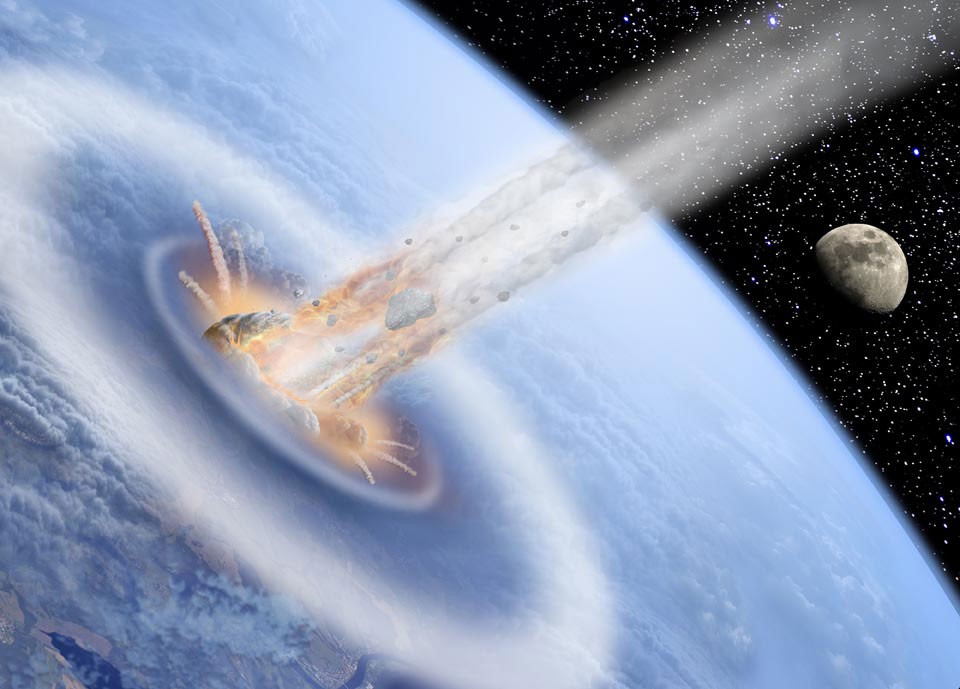
Asteroid collision
Earth is constantly being bombarded by small pieces of rock—fragments of larger asteroids or comets called meteoroids. These usually burn up in the atmosphere; we see them as brief streaks of light in the night sky called meteors, or "shooting stars". Once in a while, however, a much larger lump of rock crashes to the ground. Known as a meteorite, the larger it is, the more damage it causes. About 66 million years ago, a very large meteorite—often described as an asteroid—collided with the Earth. Vast amounts of dust and debris were ejected into the upper atmosphere, obscuring the Sun and causing food chains to collapse. This brought the Age of Dinosaurs to an abrupt end. It is possible that something similar could call time on our own age, too—unless we can find a way to deflect it.
Near-Earth Asteroids

Dimorphos is a 160-metre (520-foot) “moonlet” asteroid that closely orbits a larger 780-metre (2560-foot) asteroid called Didymos, just as a moon orbits a planet. (Dimorphos is a Greek word meaning "having two forms", while Didymos means "twin" in Greek.) Dimorphos is one of 27,500 known near-Earth asteroids. These do not orbit within the main Asteroid Belt but circle the Sun closer to Earth. Around 1800 of these are called Aten asteroids. Their orbits actually cross Earth's orbital path around the Sun and therefore are of particular concern. The Dart mission will help scientists perfect the technology needed to counter the threat they pose to our planet.

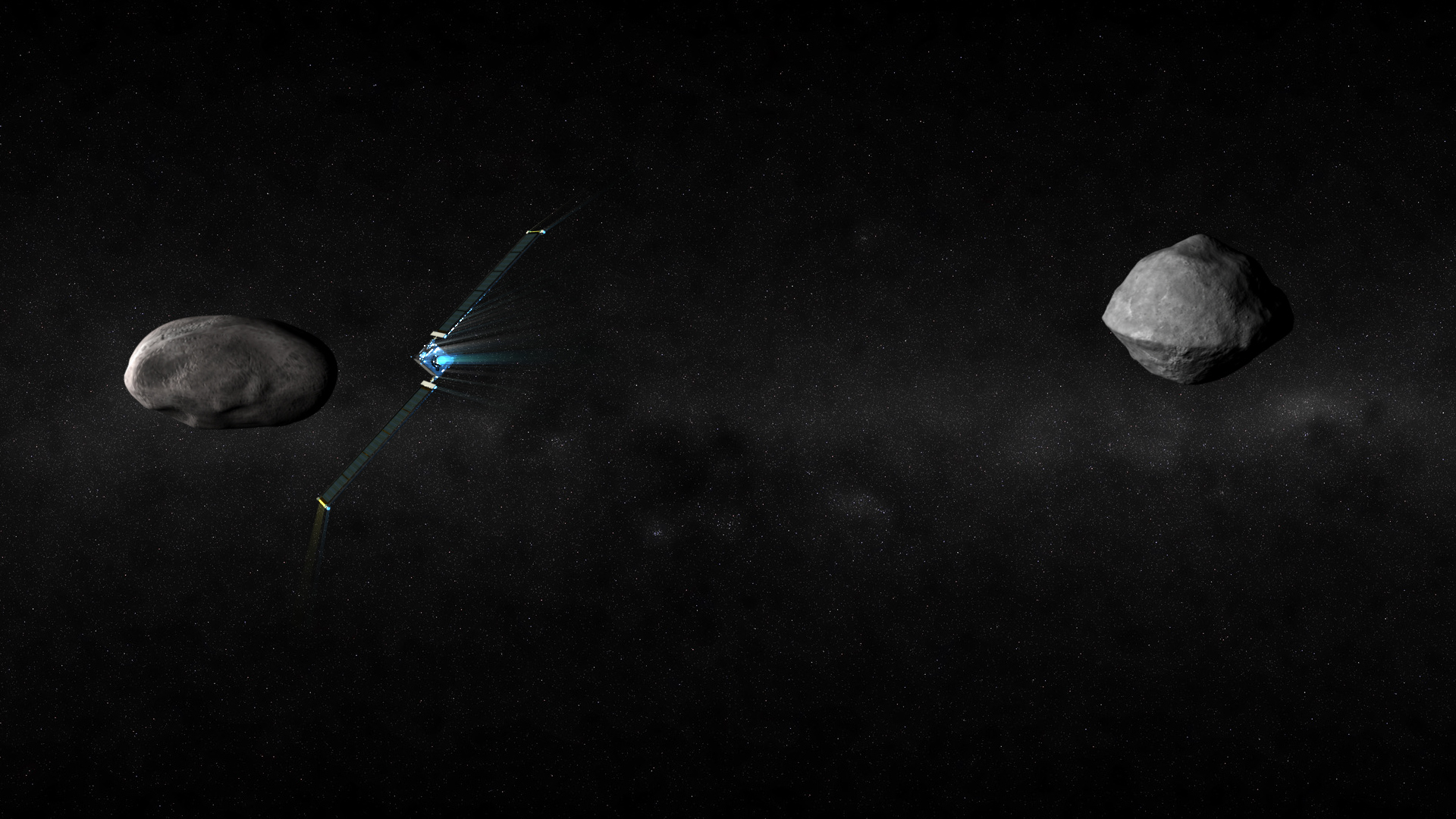
Dimorphos is not an Aten asteroid and poses no threat to Earth. The team behind the Dart mission chose the Didymos/Dimorphos asteroid system because it is relatively near Earth, which makes it easier for scientists to observe the results of the impact.
NASA is not attempting to deflect any asteroid at this stage. It is simply carrying out some "target practice" in order to be better prepared for tackling a real asteroid threat some time in the future. As a NASA spokesperson said: “We don’t want to be in a situation where an asteroid is headed toward Earth and then have to be testing this kind of capability.”

Mission schedule
About 10 days before impact, a briefcase-sized mini-spacecraft called the Light Italian CubeSat for Imaging of Asteroids (LICIACube) will separate from the main Dart spacecraft. Along with observations from ground-based telescopes and radar—plus an onboard camera that will capture the final moments before collision—LICIACube's images of the impact will be relayed back to Earth. The data should enable scientists to calculate the degree to which the impact has altered Dimorphos’s orbit.
The expectation is that the impact will move the asteroid only by a fraction of a single percentage point and alter its orbital period around the larger asteroid only by a few minutes. Nevertheless, over a span of millions of kilometres, the changes should easily be enough to eliminate the risk of an asteroid that was previously on collision course with Earth actually hitting our planet.
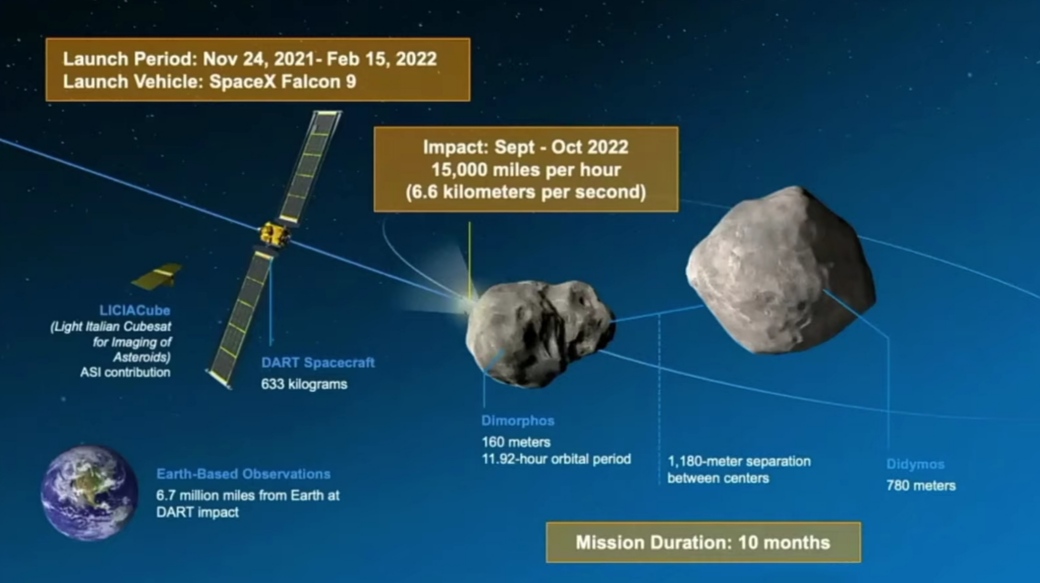
In November 2024, the European Space Agency’s Hera spacecraft will visit the Didymos system and measure the actual speed change and orbital shift of Dimorphos. It will also collect data, such as the size and shape of the crater left by Dart. This information will greatly help scientists fine-tune the asteroid deflection technique and make it a fully effective weapon for use against any asteroid discovered to be heading towards Earth in the future.
pics
Without in any way limiting Q-files Ltd’s exclusive rights under copyright, any use of this publication to “train” generative artificial intelligence (AI) technologies to generate text is expressly prohibited. Q-files Ltd reserves all rights to license use of this work for generative AI training and development of machine learning language models.