
Q-news

CITE
We have made every effort to follow citation style rules, but there may be some minor differences. If in doubt, please refer to the appropriate citation style manual.
Supermassive black hole at the centre of the Milky Way Galaxy revealed. (2022). In Q-files Encyclopedia, , Q-news. Retrieved from
https://www.q-files.com/news/supermassive-black-hole-at-the-centre-of-the-milky-way-galaxy-revealed
"Supermassive black hole at the centre of the Milky Way Galaxy revealed." , Q-news, Q-files Encyclopedia, 17 Nov. 2022.
https://www.q-files.com/news/supermassive-black-hole-at-the-centre-of-the-milky-way-galaxy-revealed.
Accessed 13 Sep. 2026.
Supermassive black hole at the centre of the Milky Way Galaxy revealed 2022. , Q-news. Retrieved 13 September 2026, from
https://www.q-files.com/news/supermassive-black-hole-at-the-centre-of-the-milky-way-galaxy-revealed
, Q-news, s.v. "Supermassive black hole at the centre of the Milky Way Galaxy revealed," accessed September 13, 2026.
https://www.q-files.com/news/supermassive-black-hole-at-the-centre-of-the-milky-way-galaxy-revealed


Supermassive black hole at the centre of the Milky Way Galaxy revealed
The enormous black hole lying at the centre of our Galaxy has been pictured for the first time. Known as Sagittarius A*, or Sgr A* for short, it is four million times the mass of our Sun. The central dark region in the picture is the location of the black hole—but not the black hole itself. The region is circled by light coming from super-heated gas, called plasma, accelerated by very powerful gravitational forces. Luckily for us on Earth, this black hole is around 26,000 light years away, so there is no possibility of our planet being dragged towards it.
20th May 2022

Event Horizon Telescope


The image, released on 12th May 2022, was produced by an international team of scientists called the Event Horizon Telescope (EHT) collaboration. In 2019, the team released a picture of a black hole at the heart of another galaxy called Messier 87, or M87—the first image of a black hole ever produced. At 6.5 billion times the mass of our Sun, that black hole is more than a thousand times bigger than the one at the heart of the Milky Way Galaxy. "But this new image is special because it's our supermassive black hole," said Professor Heino Falcke of the EHT project. Or, as another scientist put, referring to the image's shape: “It’s another doughnut, but it’s our doughnut.”
To capture on image lying so far away, EHT used a technique called very long baseline array interferometry (VLBI). This combines a network of eight radio telescopes widely spaced around the world in such a way that it is as if the object was observed by a telescope the size of the Earth itself.
Accretion disc
The halo of light is the black hole’s accretion disc (also called an emission ring), a fuzzy ring of gas and dust. The disc measures about 63 million kilometres across. The EHT detected radiation emitted by particles heated to billions of degrees Celsius swirling around the black hole at close to the speed of light before they disappear into it. The black hole itself cannot be seen—it is the brilliance of the accretion disc surrounding it that betrays its presence. Instead, the image shows the dark region around the black hole in which light is bent out of sight. Hidden deep inside this region is the black hole’s boundary, known as the event horizon (from which the EHT takes its name), which measures around 24 million kilometres across.


"Gentle giant"
The latest image might appear quite similar to that of the black hole, M87, but there are key differences between the two. Sagittarius A* is around a thousand times smaller than M87, and its structure changes much more rapidly. If you could hover over centre of our galaxy and view the scene with eyes sensitive to radio waves, you would see the super-heated gas (or plasma) whizzing around the black hole at 300,000 kilometres per second.
For the team attempting to create a still image of the fast-changing accretion disc, this created challenges. Observations for both black holes were actually acquired at the same time in early 2017, but the rapid changes in Sagittarius A*—likened by one member of the team as trying to photograph a puppy chasing its tail using a camera with a slow shutter speed—were part of the reason why it took so much longer to produce an image than for M87. The larger black hole lies at a distance of 55 million light-years and looks static by comparison.
Another major difference between the two black holes is that Sagittarius A* is consuming only a trickle of material. M87, by contrast, is one of the largest and most violent black holes in the Universe. It features vast, powerful jets that blast out light and matter into intergalactic space. In fact, black holes like Sagittarius A*—quiet, "gentle giants"—are much more common.

Galactic centre
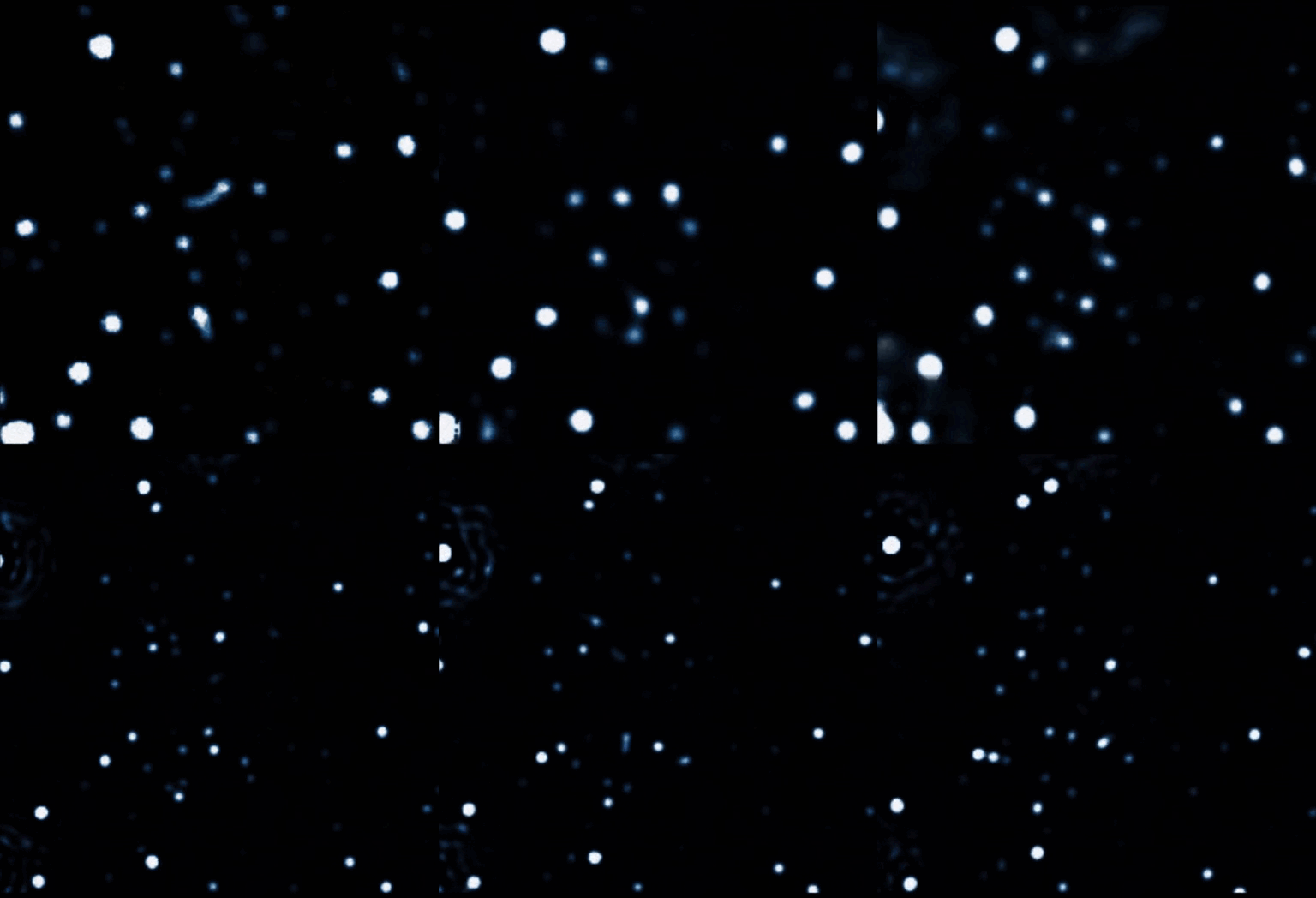
Scientists have long suspected that a supermassive black hole "lives" at the centre of the Milky Way Galaxy. Reinhard Genzel and Andrea Ghez were awarded the 2020 Nobel Prize in Physics for their discovery that Sagittarius A* is a supermassive compact object, for which a black hole was the only plausible explanation at the time. What else, scientists asked themselves, could produce gravitational forces that accelerate nearby stars through space at speeds of up to 24,000 kilometres a second? (Our Sun, far from the black hole, travels around the Galaxy at just 230 km/s.)
The new image of Sagittarius A* provides firm proof that there is indeed a supermassive black hole at the centre of the Milky Way.
pics

Without in any way limiting Q-files Ltd’s exclusive rights under copyright, any use of this publication to “train” generative artificial intelligence (AI) technologies to generate text is expressly prohibited. Q-files Ltd reserves all rights to license use of this work for generative AI training and development of machine learning language models.