
Q-news

CITE
We have made every effort to follow citation style rules, but there may be some minor differences. If in doubt, please refer to the appropriate citation style manual.
The Cassini space probe goes out in spectacular style. (2022). In Q-files Encyclopedia, , Q-news. Retrieved from
https://www.q-files.com/news/the-cassini-space-probe-goes-out-in-spectacular-style
"The Cassini space probe goes out in spectacular style." , Q-news, Q-files Encyclopedia, 10 Feb. 2022.
https://www.q-files.com/news/the-cassini-space-probe-goes-out-in-spectacular-style.
Accessed 13 Sep. 2026.
The Cassini space probe goes out in spectacular style 2022. , Q-news. Retrieved 13 September 2026, from
https://www.q-files.com/news/the-cassini-space-probe-goes-out-in-spectacular-style
, Q-news, s.v. "The Cassini space probe goes out in spectacular style," accessed September 13, 2026.
https://www.q-files.com/news/the-cassini-space-probe-goes-out-in-spectacular-style


The Cassini space probe goes out in spectacular style
The Cassini mission to Saturn is entering its final week. On 15th September in what is called its “Grand Finale”, the Cassini space probe will dive towards the planet and burn up in its atmosphere like a meteor. Launched on 15th October 1997 in a collaboration between NASA, ESA and the Italian space agency, Agenzia Spaziale Italiana, the spacecraft took seven years to travel across the Solar System to reach Saturn. Now, nearly 20 years on, Cassini will complete its mission by plunging into Saturn’s atmosphere. It will continue to beam back data and images until the very end.


All images and video NASA/JPL-Caltech/SSI
Soon after arriving in orbit around Saturn in late 2004, Cassini launched the Huygens lander, which touched down on Saturn’s moon Titan in January 2005. It sent back the first pictures of the moon’s landscape, along with astonishing images of lakes of liquid methane on its surface. Cassini later collected valuable information about the chemical make-up of another of Saturn’s moons, Enceladus, after steering through plumes of icy water sprayed into space by geysers erupting from its southern regions. It also detected a global ocean just beneath Enceladus’s icy crust—one that might just contain microbial life-forms.
With Cassini now running out of fuel (used for adjusting its course), scientists are anxious that it should not go out of control and crash land on to Enceladus or Titan. They are concerned that any Earth microbes still clinging to parts of the spacecraft might contaminate the moons. So the mission control team have decided to destroy the space probe deliberately by steering it directly into Saturn itself.

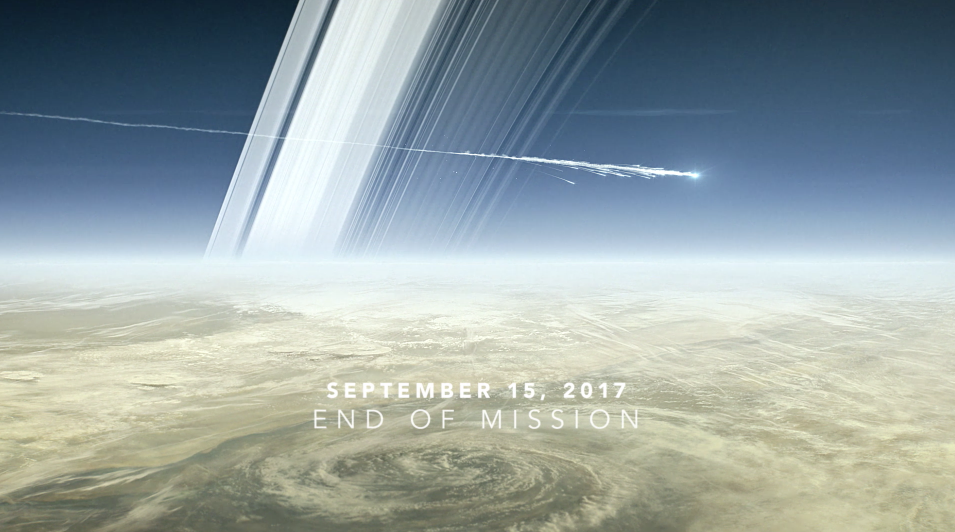

In April this year, the mission team placed Cassini on an impact course. They used Titan's gravity to bend Cassini's orbit, so that instead of passing just outside Saturn’s rings, the spacecraft flew just inside them. Since then, it has made a total of 22 looping dives between the rings and the planet, travelling at speeds of around 120,000 km/h (75,000 mph).
The mission team hopes that Cassini’s observations in this final phase will give them insights into the planet's internal structure and the origins of the rings, before it finally burns up in Saturn’s atmosphere. "Cassini's grand finale is so much more than a final plunge," says Linda Spilker, Cassini project scientist at NASA’s Jet Propulsion Laboratory (JPL). "It's a thrilling final chapter for our intrepid spacecraft, and so scientifically rich that it was the clear and obvious choice for how to end the mission."

pics
Without in any way limiting Q-files Ltd’s exclusive rights under copyright, any use of this publication to “train” generative artificial intelligence (AI) technologies to generate text is expressly prohibited. Q-files Ltd reserves all rights to license use of this work for generative AI training and development of machine learning language models.