
Early life

CITE
We have made every effort to follow citation style rules, but there may be some minor differences. If in doubt, please refer to the appropriate citation style manual.
Permian Period. (2026). In Q-files Encyclopedia, Prehistoric, Early life. Retrieved from
https://www.q-files.com/prehistoric/early-life/permian-period
"Permian Period." Prehistoric, Early life, Q-files Encyclopedia, 18 May. 2026.
https://www.q-files.com/prehistoric/early-life/permian-period.
Accessed 13 Sep. 2026.
Permian Period 2026. Prehistoric, Early life. Retrieved 13 September 2026, from
https://www.q-files.com/prehistoric/early-life/permian-period
Prehistoric, Early life, s.v. "Permian Period," accessed September 13, 2026.
https://www.q-files.com/prehistoric/early-life/permian-period


Permian Period
During the Permian Period (299–252 million years ago), the humid, tropical forests of the Carboniferous gave way to vast, dry scrublands and deserts. Large amphibians, dependent on water for breeding, started to die out, while reptiles multiplied. Their ability to lay eggs on land allowed them to thrive in dry environments. They also developed powerful jaws, which enabled them to eat tough desert plants. Reptiles of all kinds dominated the parched Permian world. Some species, such as Mesosaurus, adapted to life in the sea and began a long period when marine reptiles ruled supreme in the oceans.

Permian world
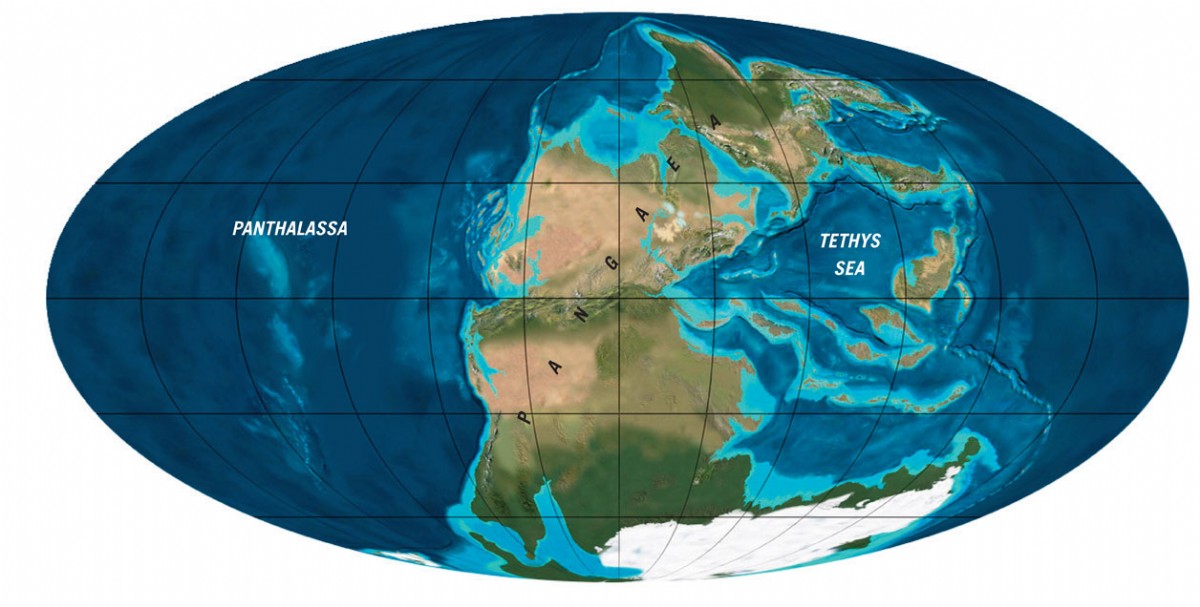
During the Permian Period, much of the world’s land formed a single “supercontinent” called Pangaea. Southern Pangaea lay across the South Pole and was covered by a massive ice cap. A great deal of the Earth’s water was locked up in the ice. This meant that for the rest of the world the climate became very dry. With such a large, single landmass, there were extreme variations of hot and cold—and highly seasonal rainfall. The lush swamp forests of the Carboniferous were replaced in northern tropical regions of Pangaea by conifers, ginkgo, cycads, seed ferns and other drought-resistant plants.

Reptile types
Many different kinds of reptiles evolved in the Permian Period. Some developed powerful jaw muscles that enabled them to eat plants, while others preyed on insects or other, smaller reptiles. (Some even adapted to life in the oceans and became voracious predators of fish and other marine creatures). Three types of Permian reptiles can be distinguished by openings in their skulls. The first type, called anapsids, forerunners of turtles and tortoises, had none. The synapsids, the dominant type, had one opening on each side. Diapsids, the third type, had two skull openings on each side. This group gave rise not only to modern lizards, snakes and crocodiles, but also, in the Triassic Period, to the dinosaurs.
Pelycosaurs
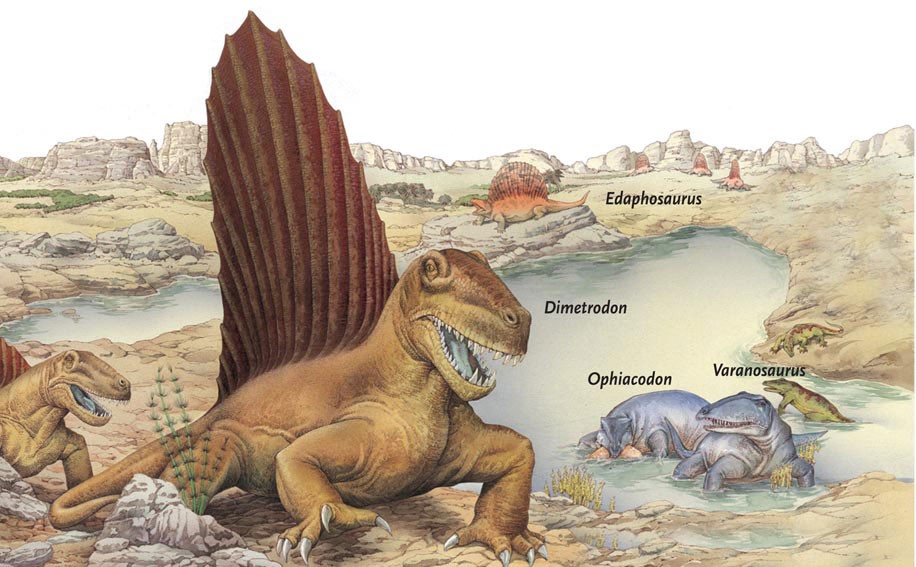
Synapsid reptiles were the type from which mammals would later evolve. The earliest synapsids to evolve were the pelycosaurs. Some of them, like Dimetrodon and Edaphosaurus, were three-metre-long (10-foot) giants with great sails on their backs. The sails were made of skin, supported by long thin spines sticking up from the backbone. Scientists think that the sails may have acted as temperature regulators: the blood vessels in the skin would quickly take up the sun’s heat, and just as quickly give off heat when the animal became too hot.
Late Permian
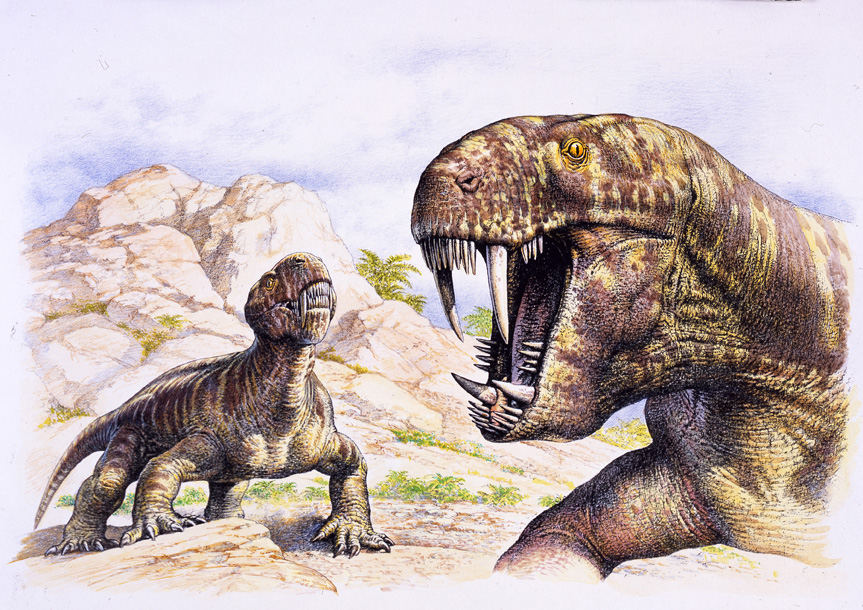
The pelycosaurs were succeeded by more advanced kinds of synapsids, called therapsids. The 5-metre (16-foot) slow-moving herbivore, Moschops, was a therapsid. Among later therapsids were the cynodonts, the direct ancestors of the mammals. Unlike other reptiles, they might have been warm-blooded, a feature that would allow them to conserve heat generated from digesting their food. In this way, they could survive the harsh conditions of Pangaea, and so became the dominant animals of the Late Permian. Just as lumbering as Moschops was the anapsid Scutosaurus. Diapsids, still quite scarce, included Coelurosauravus, a tiny glider, and fast-moving Protorosaurus.


Coelurosauravus
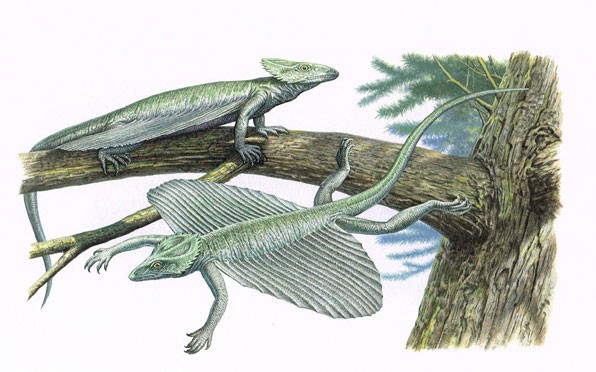
Coelurosauravus was a diapsid reptile that lived in Late Permian Europe. It had wing-like structures, made from long, thin bones with skin stretched over them, that enabled it to glide through the air. Coelurosauravus, whose name means "hollow lizard grandfather”, had a flat, streamlined body, about 40 centimetres (16 inches) in length.
The Great Dying
At the end of the Permian Period, a vast number of animals were wiped out by the biggest mass extinction in the Earth's history, an event sometimes called the “Great Dying”. Scientists are unsure why it occurred. It is thought that 70% of all land animals and plants, and up to 95% of all marine life-forms were wiped out.

The mass extinction may have been triggered by an asteroid collision, just like the later event that caused the dinosaurs to die out. Another possibility was a series of volcanic eruptions thought to have taken place at this time over a vast area of Siberia, leading to a dramatic rise in carbon dioxide in the atmosphere. Some scientists think that the release of vast amounts of methane—also a greenhouse gas—into the atmosphere from the melting of reservoirs of frozen methane in polar ice and permafrost, and below the ocean floor, could have been responsible for extreme climate change that was so disastrous for life.
Consultant: Chris Jarvis
pics


Without in any way limiting Q-files Ltd’s exclusive rights under copyright, any use of this publication to “train” generative artificial intelligence (AI) technologies to generate text is expressly prohibited. Q-files Ltd reserves all rights to license use of this work for generative AI training and development of machine learning language models.