
EASY READ Prehistoric life

CITE
We have made every effort to follow citation style rules, but there may be some minor differences. If in doubt, please refer to the appropriate citation style manual.
EASY READ How did life begin?. (2026). In Q-files Encyclopedia, Prehistoric, EASY READ Prehistoric life. Retrieved from
https://www.q-files.com/prehistoric/easy-read-prehistoric-life/easy-read-how-did-life-begin
"EASY READ How did life begin?." Prehistoric, EASY READ Prehistoric life, Q-files Encyclopedia, 12 Mar. 2026.
https://www.q-files.com/prehistoric/easy-read-prehistoric-life/easy-read-how-did-life-begin.
Accessed 13 Sep. 2026.
EASY READ How did life begin? 2026. Prehistoric, EASY READ Prehistoric life. Retrieved 13 September 2026, from
https://www.q-files.com/prehistoric/easy-read-prehistoric-life/easy-read-how-did-life-begin
Prehistoric, EASY READ Prehistoric life, s.v. "EASY READ How did life begin?," accessed September 13, 2026.
https://www.q-files.com/prehistoric/easy-read-prehistoric-life/easy-read-how-did-life-begin


How did life begin?
Along with all the other planets of the Solar System, the Earth was formed about 4.6 billion years ago. In its early years, it had no water or life. It was just a ball of barren rock. Meteorites (large boulders), rained down from space, punching large craters out of the ground. Life probably arose in the Earth's oceans about 3800 million years ago.
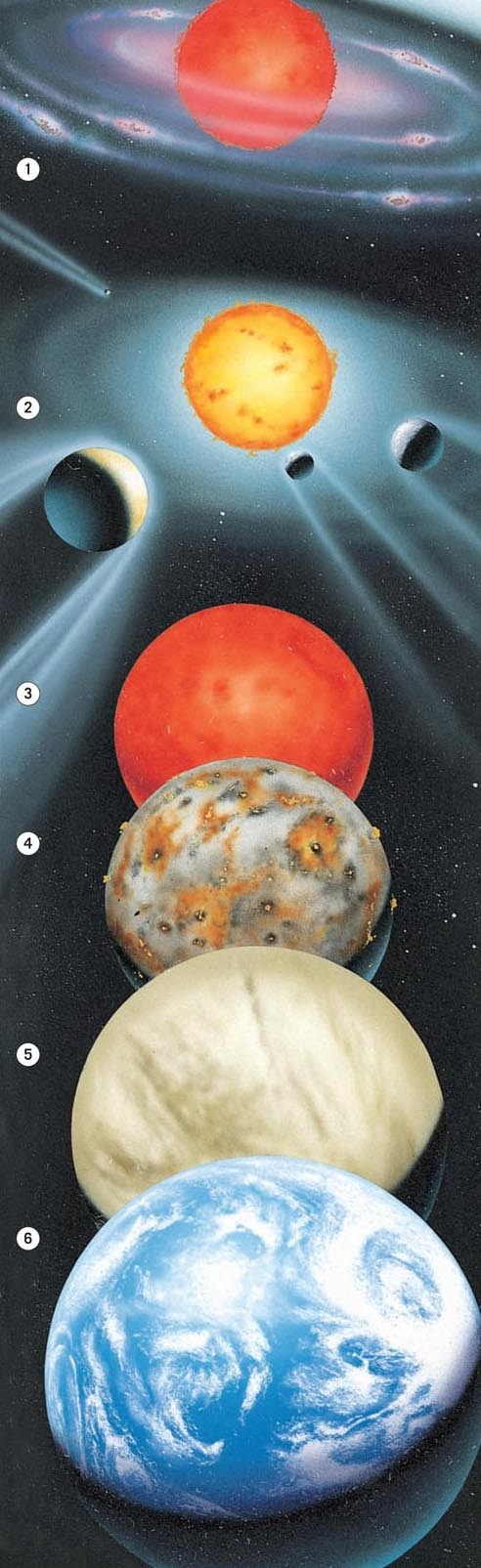
Formation of the Earth


The Solar System began life as billions of small rocks whirling round a dense ball of hot gas: what would become the Sun. Over millions of years, the rock fragments gradually "snowballed” into boulders and then into large, rocky globes. Scientists call them planetesimals. One of them became the Earth.
Young Earth
Chunks of rock, called meteorites, kept on crashing into the Earth (see illustration 1, top left). This made its surface so hot it became a sea of molten rock (2). Eventually the bombardment eased and the surface cooled to a rocky shell.
To begin with, the Earth was a barren planet, rather like the Moon is today. Volcanoes started to blast out gases that were trapped beneath its outer shell (3). The gases, carbon dioxide and nitrogen, collected to form the atmosphere. (It did not then contain oxygen, like it does today).
Scientists think that water was brought to Earth carried on meteorites. Water vapour formed clouds that surrounded the planet. As the Earth cooled, rain started to fall. Over millions of years, the basins in the land gradually filled to become the oceans (4).

Where did life begin?
All forms of life need water to survive. So the first living things appeared in the ocean. No one knows exactly how or where. Many scientists think that life may have arisen on the ocean bed, in those places where jets of hot water, filled with chemicals, gush through cracks in the rocks, as they do today. The jets spurt through chimneys called "black smokers". The chemicals provide food for microscopic living things.

Consultant: Chris Jarvis
Ready to find out more?
Here are some pages in other parts of Q-files you might like to explore:
Story of the Earth
Origin of life
Precambrian and Cambrian
pics

Without in any way limiting Q-files Ltd’s exclusive rights under copyright, any use of this publication to “train” generative artificial intelligence (AI) technologies to generate text is expressly prohibited. Q-files Ltd reserves all rights to license use of this work for generative AI training and development of machine learning language models.