
EASY READ Prehistoric life

CITE
We have made every effort to follow citation style rules, but there may be some minor differences. If in doubt, please refer to the appropriate citation style manual.
EASY READ What were the first fish like?. (2026). In Q-files Encyclopedia, Prehistoric, EASY READ Prehistoric life. Retrieved from
https://www.q-files.com/prehistoric/easy-read-prehistoric-life/easy-read-what-were-the-first-fish-like
"EASY READ What were the first fish like?." Prehistoric, EASY READ Prehistoric life, Q-files Encyclopedia, 12 Mar. 2026.
https://www.q-files.com/prehistoric/easy-read-prehistoric-life/easy-read-what-were-the-first-fish-like.
Accessed 2 Nov. 2026.
EASY READ What were the first fish like? 2026. Prehistoric, EASY READ Prehistoric life. Retrieved 2 November 2026, from
https://www.q-files.com/prehistoric/easy-read-prehistoric-life/easy-read-what-were-the-first-fish-like
Prehistoric, EASY READ Prehistoric life, s.v. "EASY READ What were the first fish like?," accessed November 2, 2026.
https://www.q-files.com/prehistoric/easy-read-prehistoric-life/easy-read-what-were-the-first-fish-like


What were the first fish like?
The first fish evolved later in the Cambrian Period, probably about 500 million years ago. The fish had neither fins nor jaws. They swam with their mouths held open all the time, sucking in things to eat. Many of these jawless fish had bony armour on their bodies. This would help to protect them from attack by other marine creatures.

Sea scorpions

Sea scorpions were fearsome animals. Some grew up to two metres (6.6 feet) long. They scuttled around on the sea floor hunting fish and other marine creatures. They caught them in their claws.
Trilobites
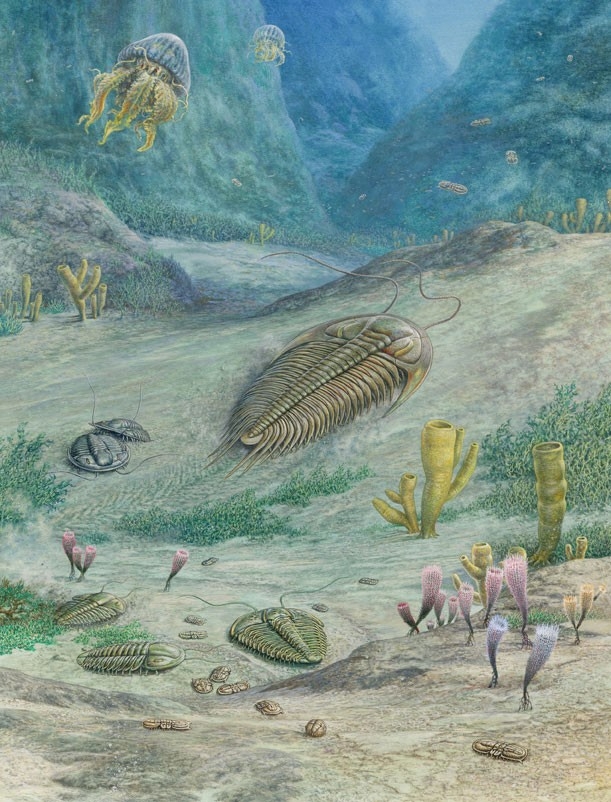
Trilobites first appeared in the Cambrian seas. They became very numerous animals for the next 250 million years. Their bodies were divided into three lengthwise strips, or lobes. They used their legs to carry food to their mouths. Some kinds of trilobite swam in open water, while others crawled along the sea bed. To protect themselves from predators, some kinds of trilobite burrowed into the mud of the sea floor, while others were covered in long spines and rolled themselves into a ball.
Fish with jaws
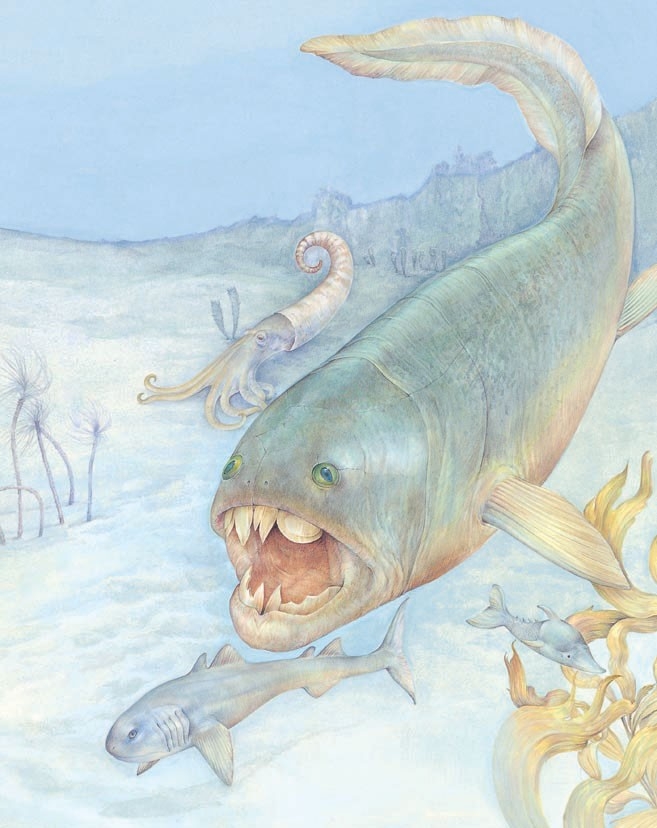
Millions of years later, fish with fins evolved. Their fins allowed them to steer more easily through the water and swim faster. Some fish also developed jaws and teeth. They could now feed on other sea creatures.
Dunkleosteus was a 9-metre-long (30 feet) predator. Instead of teeth, it had huge plates of bone in its jaws. These acted like slicer blades.
Consultant: Chris Jarvis
Ready to find out more?
Here is a page in another part of Q-files you might like to explore:
Ordovician, Silurian and Devonian
pics

Without in any way limiting Q-files Ltd’s exclusive rights under copyright, any use of this publication to “train” generative artificial intelligence (AI) technologies to generate text is expressly prohibited. Q-files Ltd reserves all rights to license use of this work for generative AI training and development of machine learning language models.