
EASY READ Prehistoric life

CITE
We have made every effort to follow citation style rules, but there may be some minor differences. If in doubt, please refer to the appropriate citation style manual.
EASY READ What was it like in the Permian deserts?. (2026). In Q-files Encyclopedia, Prehistoric, EASY READ Prehistoric life. Retrieved from
https://www.q-files.com/prehistoric/easy-read-prehistoric-life/easy-read-what-was-it-like-in-the-permian-deserts
"EASY READ What was it like in the Permian deserts?." Prehistoric, EASY READ Prehistoric life, Q-files Encyclopedia, 12 Mar. 2026.
https://www.q-files.com/prehistoric/easy-read-prehistoric-life/easy-read-what-was-it-like-in-the-permian-deserts.
Accessed 1 Nov. 2026.
EASY READ What was it like in the Permian deserts? 2026. Prehistoric, EASY READ Prehistoric life. Retrieved 1 November 2026, from
https://www.q-files.com/prehistoric/easy-read-prehistoric-life/easy-read-what-was-it-like-in-the-permian-deserts
Prehistoric, EASY READ Prehistoric life, s.v. "EASY READ What was it like in the Permian deserts?," accessed November 1, 2026.
https://www.q-files.com/prehistoric/easy-read-prehistoric-life/easy-read-what-was-it-like-in-the-permian-deserts


What was it like in the Permian deserts?
During the Permian Period, which began 299 million years ago, the rainy, tropical jungle of the Carboniferous disappeared. The Permian world was one of dry scrublands and deserts. Large amphibians, which needed to spend time in the water, died out, while reptiles multiplied. Many reptiles evolved powerful jaws, enabling them to feed on tough desert plants.


Pelycosaurs
Some Permian reptiles, like Dimetrodon and Edaphosaurus, were three-metre-long (10-foot) giants. They belonged to a group of reptiles called pelycosaurs. Rising from their backs were “sails” of skin, held up by long, thin spines. These sails may have helped the animals heat up or cool down quickly.
Therapsids
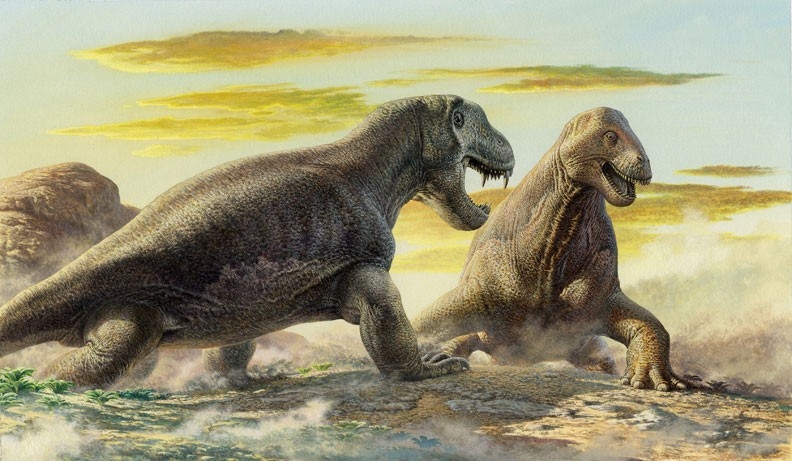
Towards the end of the Permian Period, about 250 million years ago, other kinds of reptiles started to dominate the Earth. These were a group called the therapsids. Most of them were huge, plant-eating creatures. One, Moschops, was about the size of a hippo.
The Great Dying
At the end of the Permian Period, a great number of animals died out. More than two-thirds of land animals and plants disappeared. It was the biggest mass extinction in the Earth's history. Scientists do not know what triggered it, but extreme climate change probably led to the extinctions.

Consultant: Chris Jarvis
Ready to find out more?
Here is a page in another part of Q-files you might like to explore:
Permian Period
pics
Without in any way limiting Q-files Ltd’s exclusive rights under copyright, any use of this publication to “train” generative artificial intelligence (AI) technologies to generate text is expressly prohibited. Q-files Ltd reserves all rights to license use of this work for generative AI training and development of machine learning language models.