
Great scientists

CITE
We have made every effort to follow citation style rules, but there may be some minor differences. If in doubt, please refer to the appropriate citation style manual.
Charles Darwin. (2026). In Q-files Encyclopedia, Science, Great scientists. Retrieved from
https://www.q-files.com/science/great-scientists/charles-darwin
"Charles Darwin." Science, Great scientists, Q-files Encyclopedia, 10 Mar. 2026.
https://www.q-files.com/science/great-scientists/charles-darwin.
Accessed 31 Oct. 2026.
Charles Darwin 2026. Science, Great scientists. Retrieved 31 October 2026, from
https://www.q-files.com/science/great-scientists/charles-darwin
Science, Great scientists, s.v. "Charles Darwin," accessed October 31, 2026.
https://www.q-files.com/science/great-scientists/charles-darwin


Charles Darwin
Charles Darwin (1809–1882) was a British scientist whose work on evolution—the way living things change over generations—revolutionized scientific thinking. At the beginning of the 19th century, many people still believed the story of creation as told in the Bible. But scientists were already challenging this. Even Darwin’s own grandfather, Erasmus Darwin (1731–1802), had suggested that living things changed or evolved. The discovery of fossils of long-extinct animals threw up new evidence. But how living things might have undergone changes over millions of years was still a mystery. Darwin’s most famous work, On the Origin of Species, first published in 1859, occupied many years of his life, and suggested a ground-breaking solution.


Early life
Charles Darwin was the son of a wealthy doctor from Shrewsbury, the fifth of six children. From an early age he had a passion for collecting specimens of creatures. He was sent to boarding school, which he hated. In 1825, he went to Edinburgh University to study medicine. There, the zoology professor, Robert Grant, taught him how to make observations and to dissect specimens.
Darwin left Edinburgh without a degree, but his father sent him to Christ’s College, Cambridge, to study to become a clergyman. Once again, Darwin was distracted by his fascination for wildlife, and he befriended the professor of botany, John Henslow.
Voyage of the Beagle

It was John Henslow who suggested to Darwin in 1831, after his final exams, that he should travel aboard the Royal Navy’s survey ship, the HMS Beagle, as a naturalist, on a trip to South America. Darwin jumped at the chance. He took with him a book entitled Principles of Geology, by the geologist Charles Lyell (1797–1875). This was to have an important effect on Darwin’s thinking, as it used fossil evidence to show how the Earth had changed over the centuries.
The Beagle reached South America in February, 1832. Darwin, who had already been studying sea creatures, now made observations in the rainforest, with its millions of species. He sent many specimens back to England. Darwin also studied the fossils of long-extinct animals. Some were giant versions of creatures that still lived in South America: sloths, armadillos and anteaters. What, Darwin asked himself, was the relationship between these long-dead creatures and the existing wildlife of South America?

Galapagos Islands
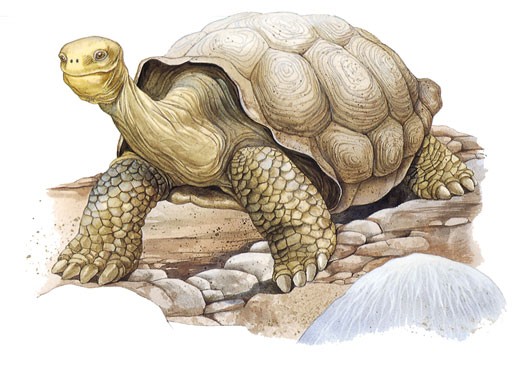
The Beagle also visited the Galapagos Islands in the Pacific Ocean, nearly 1000 kilometres (1600 miles) west of the South American mainland on the equator. There he observed some extraordinary creatures, including giant tortoises, marine iguanas and different kinds of finches and mockingbirds.
Local people told Darwin that each island had its own particular kind of tortoise. On the islands where there was plenty of lush grass, the tortoises had domed shells and short necks, but on the drier ones their shells were shaped to allow them to reach up to eat taller plants, and they had longer necks.
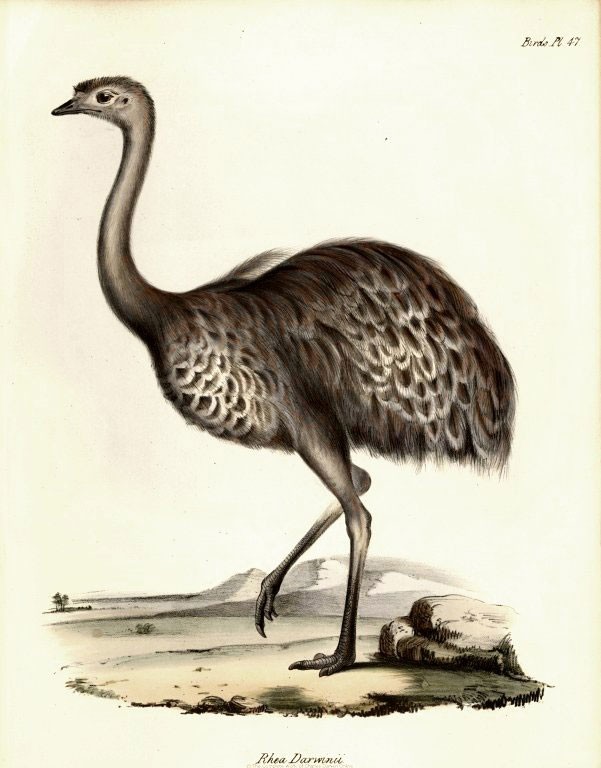
Each island also had its own type of finch. These had different shaped beaks, which Darwin later realised were suited to the kinds of food they mostly ate: nuts, seeds or insects.
On the "struggle
for existence"
Darwin returned home in 1836. He married his cousin Emma Wedgwood in 1839. He spent the next years puzzling over the various questions raised by his travels. Why were there different kinds of animals on each different island in the Galapagos? What gave some individuals the edge when it came to surviving while others did not?
A breakthrough came when he read a book by English clergyman Thomas Robert Malthus (1766–1834). Malthus’s Essay on the Principle of Population (1798) expressed a fear that, unless people adapted their behaviour and limited the size of their families, humankind would outgrow the resources available and starvation would kill millions. Only a few individuals would survive in this "struggle for existence".
A theory of evolution
Malthus's work gave Darwin a vital clue. In the Galapagos, similar species had evolved in different ways because on each island, certain characteristics made some individuals better suited to their environment, giving them improved chances of survival. Over time, they had produced more offspring with those characteristics, while the others that did not have them, died out.
This explained why a creature such as, for example, a giant sloth (from South America) did not survive, while its smaller relatives, better suited to their environment, were still around. Gradually, over millions of years, a species could evolve into something new and different. Darwin called this process evolution through natural selection.

So, for example, honeycreepers (members of the finch family) on the Hawaiian islands, like the finches on the Galapagos Islands that Darwin had studied, changed their diets according to the different foods they found on each different island: fruits, seeds, insects and nectar. Their beaks changed, or adapted, accordingly. Slowly, the original single honeycreeper species evolved into many different species.
Evidence for evolution
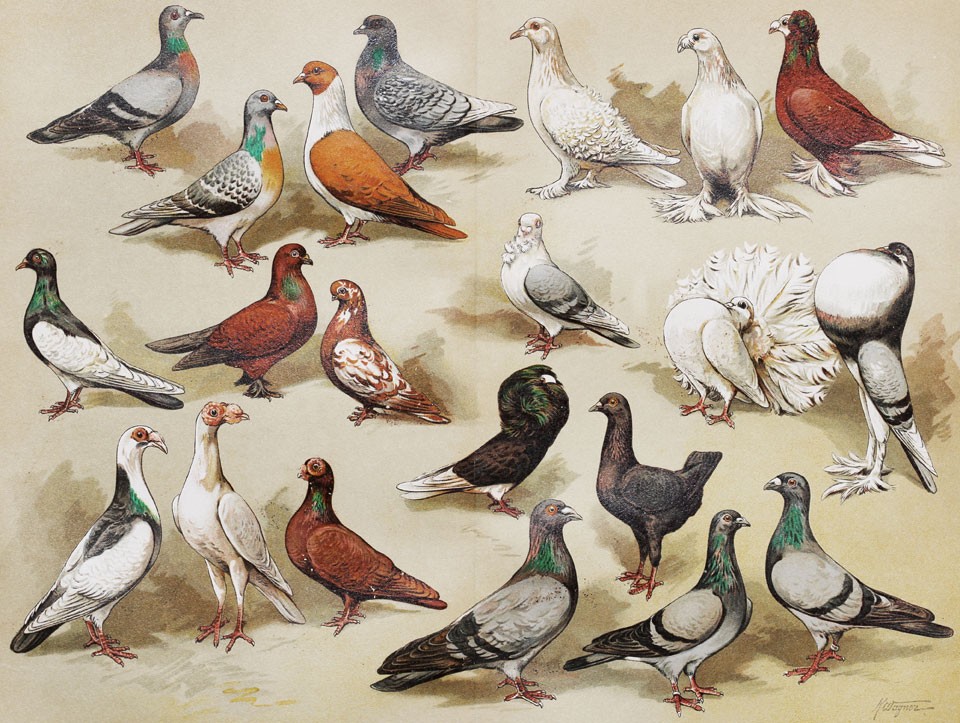
Darwin was aware he needed evidence for his theory. He carried out his own experiments with breeding pigeons with different characteristics, and noted they could be selectively bred to have different colour feathers, fan-like tails, and long or short legs. This supported his idea that, in the wild, a species might naturally change as the better-adapted survived and bred.
Origin of Species
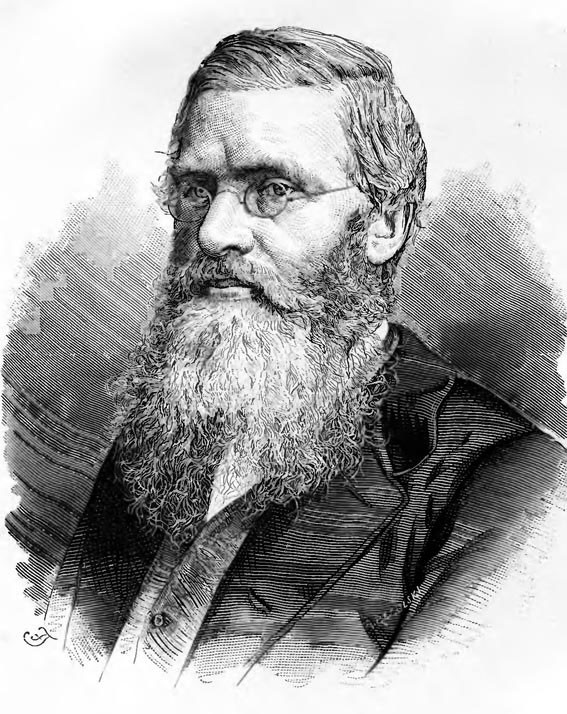
Darwin continued to work on his theory until, in 1857, he received an essay from another naturalist, Alfred Russel Wallace (1823–1913), outlining the very same ideas he had been working on. Darwin was forced to act, and two of his friends, the botanist Joseph Hooker (1817–1911) and Lyell, arranged for the work of both Darwin and Wallace to be presented at the annual meeting of the biological society, the Linnean Society of London, in 1858.
Darwin published his ideas in the book On the Origin of Species in 1859 and, although it received criticism from traditional Christians because of its challenge to the Biblical story of creation, many scientists supported it enthusiastically.
The Descent of Man
Although Darwin was in poor health, he continued to work, concentrating on, among other topics, the study of orchids. In 1870, he published a second major work, The Descent of Man, and Selection in Relation to Sex. Here, he spelled out what had already been hinted at in the Origin of Species, that humans were also the product of evolution. People of all races, he concluded, however different they seemed, belonged to a single species and shared a common ancestor with apes.
The same book also presented the theory of evolution in the animal kingdom by sexual selection, that females choose those mates that appeared most likely to breed successfully, perhaps by being bigger and stronger, and that males competed with each other for females. The characteristics the females favoured, along with those that helped the males win their competitions, were passed on to the next generation just like survival advantages.


Later years
Darwin was plagued by poor health for much of his life, although he continued to work right up to the very end of his life. He died in 1882 and was buried in Westminster Abbey—despite his own wish to be buried in his local churchyard at Downe, in Kent, alongside his brother and those of his children who had died young.
Consultant: Mike Goldsmith
pics
Without in any way limiting Q-files Ltd’s exclusive rights under copyright, any use of this publication to “train” generative artificial intelligence (AI) technologies to generate text is expressly prohibited. Q-files Ltd reserves all rights to license use of this work for generative AI training and development of machine learning language models.