
Universe
Dark matter
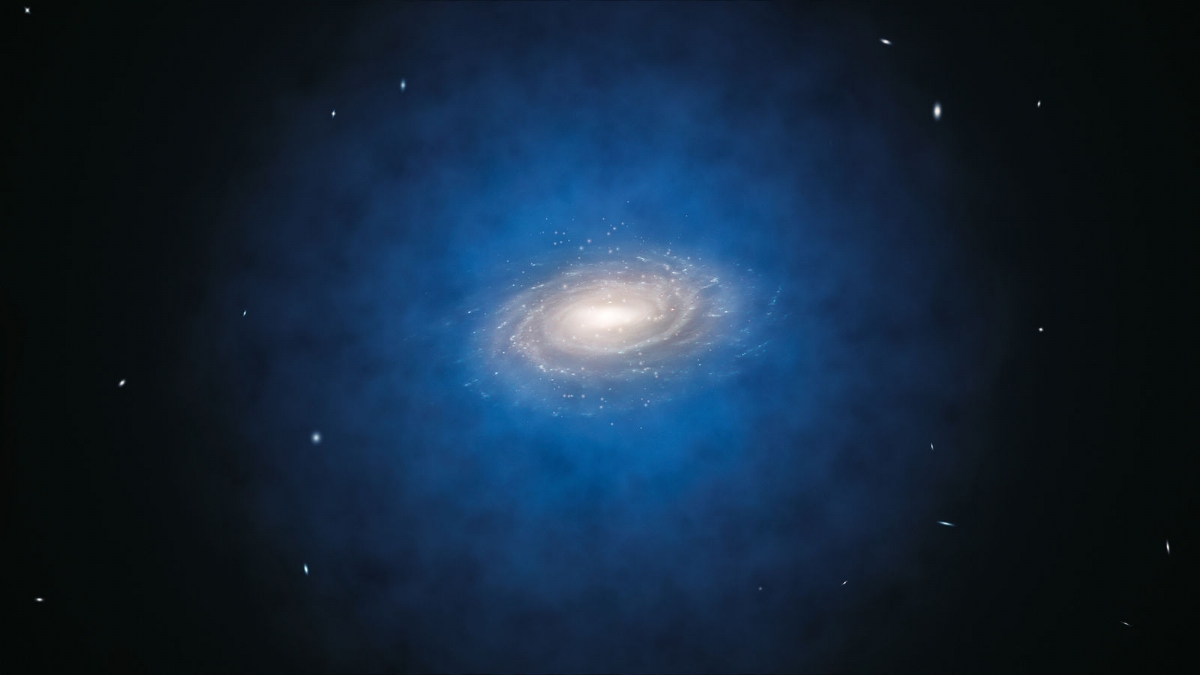
Scientists think that a large part of the total matter in the Universe—about 85% of it—cannot be accounted for by the mass of objects we can see or detect. Only the small remaining fraction, 15%, is made up of atoms, the building blocks of galaxies, stars, planets and living things. Scientists call the mysterious "invisible" portion of the Universe's matter dark matter. Dark matter cannot be detected using telescopes, because it does not give out or absorb light or any other form of electromagnetic radiation. This is why it is described as "dark." It is likely that dark matter is made up of types of subatomic particle that have yet to be discovered, called "Wimps".

Spinning galaxies

Scientists have discovered that, contrary to earlier predictions that stars lying far from the centre of a galaxy would orbit it far more slowly than those closer to the centre (much like the planets in the Solar System do), all a galaxy's stars in fact move round at about the same speed. The only explanation seems to be that matter in the galaxy is spread more or else evenly through it, and not concentrated at the centre. Looking at a galaxy through a telescope, however, shows that almost all the stars are close to the centre. This must mean that most of the matter in a galaxy cannot be seen: it is dark matter.

Gravitational lensing
The existence of what scientists call gravitational lenses provides more evidence for the existence of dark matter.
One of the consequences of general relativity, as shown by Albert Einstein, is that massive objects, such as a galaxy cluster, lying between the observer and a more distant object, such as a quasar, should act as a lens to bend the light from this source. Carrying out observations using this gravitational lensing technique, scientists have been able to map the distribution of dark matter around a galaxy cluster. (Matter, whether dark or otherwise, does not bend light itself. It is the mass of the dark matter surrounding the galaxy cluster that bends what Einstein called space-time. Light follows the curvature of space-time, resulting in the lensing effect.)
Wimps
Scientists say that there are vast haloes of material that cannot be detected by telescopes of any kind that surround galaxies. These haloes are believed to be made up of what are called Weakly Interacting Massive Particles (“Wimps”), which may be the main constituents of dark matter. Wimps are believed to be types of subatomic particle that are yet to be discovered.
Detecting Wimps
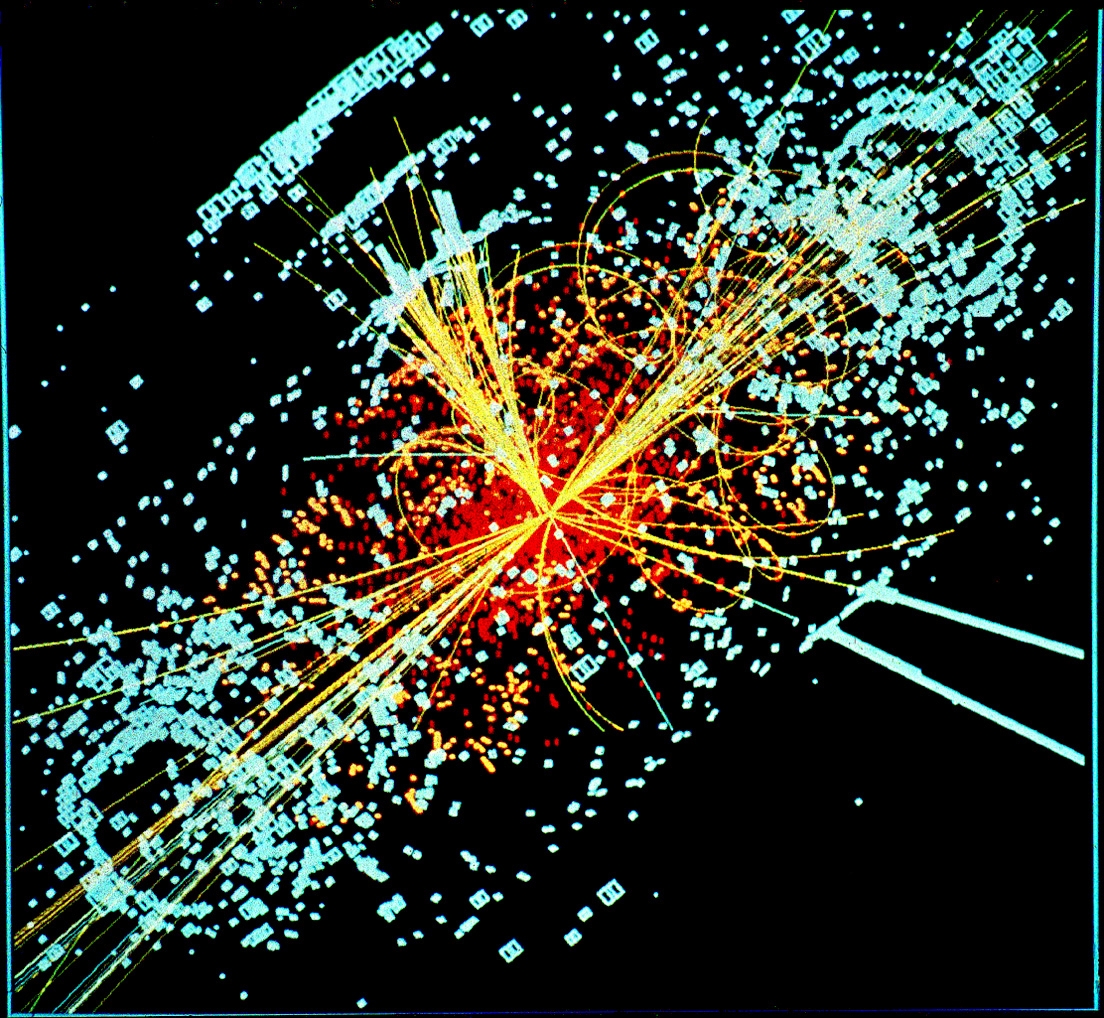
Two ways have been developed to try to detect Wimps. First, researchers are trying to spot them as they are created in the Large Hadron Collider (LHC) at the European Organization for Nuclear Research (CERN) in Geneva. Just as the Higgs boson was produced from high-speed particle collisions in the LHC, so a Wimp could also be created inside the collider.
The other method involves building special detectors deep underground—in disused mines for example—where they are protected from the particles produced by cosmic rays that rain down on Earth’s surface. These detectors contain chambers filled with the gas xenon and hundreds of light detectors. If a Wimp struck a gas particle it might release light, revealing its presence. In an experiment carried out in a former gold mine in South Dakota in September 2026, scientists believe they observed such a particle interaction involving a Wimp, but this has yet to be confirmed.
Consultant: Mike Goldsmith