
EASY READ Electronics

CITE
We have made every effort to follow citation style rules, but there may be some minor differences. If in doubt, please refer to the appropriate citation style manual.
EASY READ What is a transistor?. (2026). In Q-files Encyclopedia, Technology, EASY READ Electronics. Retrieved from
https://www.q-files.com/technology/easy-read-electronics/easy-read-what-is-a-transistor
"EASY READ What is a transistor?." Technology, EASY READ Electronics, Q-files Encyclopedia, 7 May. 2026.
https://www.q-files.com/technology/easy-read-electronics/easy-read-what-is-a-transistor.
Accessed 13 Sep. 2026.
EASY READ What is a transistor? 2026. Technology, EASY READ Electronics. Retrieved 13 September 2026, from
https://www.q-files.com/technology/easy-read-electronics/easy-read-what-is-a-transistor
Technology, EASY READ Electronics, s.v. "EASY READ What is a transistor?," accessed September 13, 2026.
https://www.q-files.com/technology/easy-read-electronics/easy-read-what-is-a-transistor


What is a transistor?
A transistor is an electronic component that has three connections. The electric current flowing between two of them is controlled by a tiny current flowing into the third. It is like a switch that you can open and close using an electric current. By varying the amount of current passing through it, the transistor can also act an amplifier, a device for increasing the strength of an electric signal.

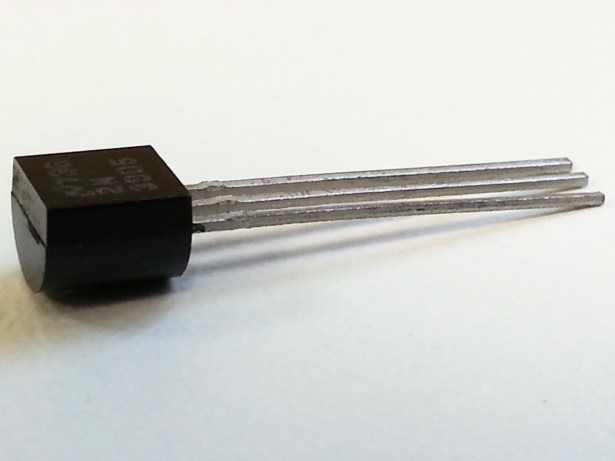
How a transistor works
A standard bipolar junction transistor (BJT) is a common type of transistor. Its three pins are known as the emitter (e), base (b) and collector (c). The electric current which you want to control using a transistor flows between the collector and the emitter.

When a tiny amount of current (say with a voltage of about 0.7 V) flows from the base to the emitter (controller part), the transistor is turned ON. It enables a larger current to flow from the collector to the emitter (switch part). When the transistor is OFF, no current can flow.
The tiny amount of voltage can be achieved by adding a resistor to the circuit to limit the current to the transistor.

Gain of the transistor
Varying the amount of current that flows between the base and the emitter while the transistor is ON also varies the amount flowing between the collector and the emitter. The size of the larger current is determined by the smaller one. This is called the gain of the transistor. If the gain is around 100, this would mean that when a 0.1 mA current flows from the base to the emitter, 10 mA (that is, 100 times more) will flow from collector to emitter.

Amplifier
We can use the gain of the transistor to make an amplifier. This is a device that increases the strength of an electric signal. An amplifier can convert the weak signal from a radio tuner into a signal strong enough to power a speaker.
How a MOSFET works
The MOSFET, another common type of transistor, also has three pins: the gate (g), source (s) and drain (d). It works in a similar way to the BJT. In the MOSFET the voltage between gate and source controls how much current can flow from drain to source.
MOSFET is short for Metal Oxide Silicon Field Effect Transistor. MOSFETs work much more quickly than BJTs and need much less current. They can also be made a lot smaller.
To turn a MOSFET ON, the voltage between gate and source must be higher than the transistor's threshold voltage e.g. 2.1 V. If the voltage is less than that the transistor turns OFF. The MOSFET also acts like a capacitor. When a voltage is applied between gate and source, this voltage stays there until it is discharged (used up).


Uses of transistors
Transistors are the most important components in electronics. They are used in almost all circuits, from the simplest ones to the most complex. Simple electronic circuits include sensor circuits, in which lights or appliances are automatically switched on or off according to touch, temperature, light levels, and so on.

One advantage of a transistor is that it enables a large current to be controlled by a much smaller one. This enables you to control relatively high-voltage devices, such as motors, from a Raspberry Pi or Arduino microcontroller (a microcontroller is a tiny computer, with all its parts contained on a single microchip).


Digital electronics
Transistors are essential to digital electronics. Numbers are represented in digital electronic circuits using the binary number system. In this system, just two digits, 0 and 1, represent ones, twos, fours, eights and so on. These are binary numbers. You can read about binary numbers here.
Almost any sort of information—from simple letters to complex moving images—can be turned into a series of numbers represented by binary numbers. This is called digitization. This information can then be represented in digital electronic circuits by controlling the flow of electricity through it by using transistors, which can turn the flow OFF or ON. OFF is 0 and ON is 1.
Computers data is stored in bits, where the value is either 1 or 0. A transistor and a capacitor work together to store one bit. If the capacitor is charged, that represents a 1. But because the capacitor loses charge over time, it must be refreshed continually. The transistor measures the charge on the capacitor every few milliseconds and keeps it “topped up”. The transistor also drains the capacitor of charge when required to charge the bit from 1 to 0.
A memory chip in a computer contains billions of microscopically small transistors. This enables it to store numbers, words, pictures and sounds in digital form.

Consultant: Mike Goldsmith
pics


Without in any way limiting Q-files Ltd’s exclusive rights under copyright, any use of this publication to “train” generative artificial intelligence (AI) technologies to generate text is expressly prohibited. Q-files Ltd reserves all rights to license use of this work for generative AI training and development of machine learning language models.