
EASY READ Electronics

CITE
We have made every effort to follow citation style rules, but there may be some minor differences. If in doubt, please refer to the appropriate citation style manual.
EASY READ What do "voltage" and "resistance" mean?. (2026). In Q-files Encyclopedia, Technology, EASY READ Electronics. Retrieved from
https://www.q-files.com/technology/easy-read-electronics/easy-read-what-do-voltage-and-resistance-mean
"EASY READ What do "voltage" and "resistance" mean?." Technology, EASY READ Electronics, Q-files Encyclopedia, 7 May. 2026.
https://www.q-files.com/technology/easy-read-electronics/easy-read-what-do-voltage-and-resistance-mean.
Accessed 22 Sep. 2026.
EASY READ What do "voltage" and "resistance" mean? 2026. Technology, EASY READ Electronics. Retrieved 22 September 2026, from
https://www.q-files.com/technology/easy-read-electronics/easy-read-what-do-voltage-and-resistance-mean
Technology, EASY READ Electronics, s.v. "EASY READ What do "voltage" and "resistance" mean?," accessed September 22, 2026.
https://www.q-files.com/technology/easy-read-electronics/easy-read-what-do-voltage-and-resistance-mean


What do "voltage" and "resistance" mean?
The pathway that allows electricity to flow from the positive terminal of a battery to the negative one is called an electric circuit. By connecting a battery to a metal wire, the electrons in a metal wire will start to move. Just like water through a pipe, the electrons flow in a current, so we call this an electric current.


Voltage
Electric current flowing around a circuit is like water flowing through pipes. In the same way that a pump is used to push the water along, a battery provides the pressure to push the electrons along the wire. This pressure is called voltage. The higher the voltage, the more energy each of the electrons carries. Voltage is measured in volts (we use the symbol V).

A current (the symbol is I) is the electrons flowing through a wire. A strong current means the electrons move faster. The rate at which a current flows round a circuit is measured in amperes (A), or amps for short.
Resistance
Just as the flow of water is slowed down if the pipe it runs through becomes narrower, an electric current is reduced if the electrons have less space through which to flow. We say there is resistance to the flow. This may happen if the electrons are forced to squeeze along a thinner stretch of wire, for example. A thicker wire has a lower resistance to a thin one. Also, a shorter wire has less resistance than a longer one.

Resistance (the symbol is R) is measured in ohms (Ω). Any appliance in an electric circuit, such as a light bulb or a heater, will provide some resistance to the flow of current.
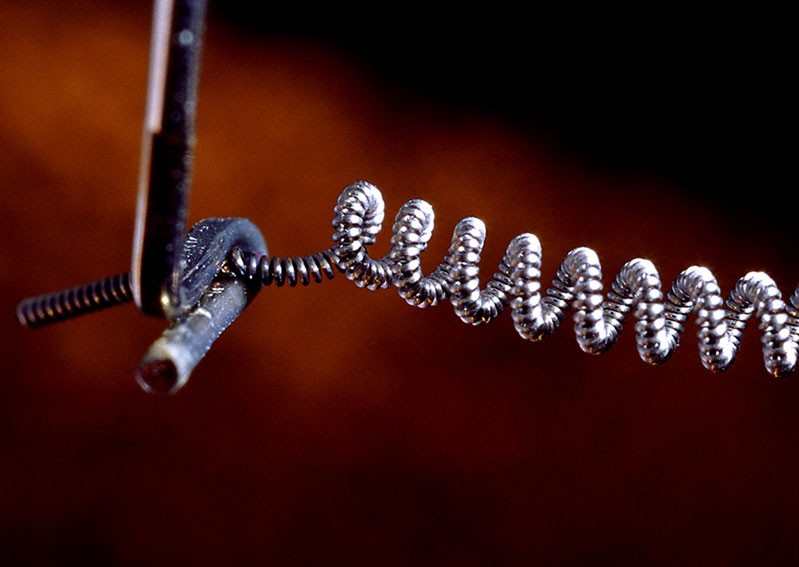
Thin wires can be made to have an even higher resistance if they are coiled round and round to extend their length. The wires become hot as they resist the current flowing through them. Coils of fine wire are used as filaments in old-style light bulbs (called incandescent light bulbs). They glow white hot when the electric current is switched on, giving out light. Coils of thicker wire are used in electric fires, which glow red hot.
Electric circuits that have electronic components connected to them are known as electronic circuits. In electronic circuits, resistance comes not from thinner wires but from something else. The electronic components are made from certain non-metallic materials that can conduct electricity—but not as well as metals. We call these materials semiconductors. Semiconductors provide some resistance to the flow of electric current.

Consultant: Mike Goldsmith
pics

Without in any way limiting Q-files Ltd’s exclusive rights under copyright, any use of this publication to “train” generative artificial intelligence (AI) technologies to generate text is expressly prohibited. Q-files Ltd reserves all rights to license use of this work for generative AI training and development of machine learning language models.